Peep! Tuesday, Mar 20 2012 

The peepers are going.  It is interesting to observe that the pond across the road, located in a field in full sun, starts up several days ahead of Julie’s pond, located in the woods.  The dance of temperature and light continues.

It is nice to hear the frogs though.  Now if we could just get the algae back under control in the pond.  Actually, it doesn’t appear to be growing denser at the moment, despite the temperatures, which suggests that the bio-balls may be able to bring it back under control.  Basically, they are basketball sized balls containing the bacteria* which naturally keeps algae in check, which is then spread on a time-release over several weeks.  We had to use them last year as well, and they did work.  Hopefully, in a few years the pond will restabilize…unless of course the vineyard’s** run-off does get into it.  We don’t think it does, but water does such odd things.  However, the nutrient load is probably still coming from the pond itself, since it is less than 18 months from when we rebuilt the dam and reflooded  a large area, which is not a terribly long time.  There is no option but to be patient with it though, even if it wasn’t located in a public water-supply watershed, I have no intention of dumping an algae-cide into it.  Somehow, even putting a targeted poison into a water-source strikes me as bad karma.

*That the bacteria doesn’t easily colonize a pond, despite adequate food, is a good illustration of how delicate bacteria can be, apocalyptic sci-fi not withstanding.

**Vineyards are about as un-green as you can get in commercial agriculture, right up there with any other intensive, finicky crop.  They pretty much have to be too if the farmer wants a reliable annual crop and a wine with the essentially the same profile every year.

Croci revisited Monday, Mar 19 2012 

As some of you may recall, I planted about 1100 crocus beneath the West Meadow fence line last fall.  So far, it appears that the experiment is reasonably successful.  The color balance is a bit off; right now it is dominated by gold and white, rather than the purple and blue shades, which is a bit baffling as there are more of the latter.  However, they may be a touch later in flowering.  I have at least five different species out there, plus the much later crocus vernus (the big one), so the bloom time should run for over a month.*  Rodents haven’t been too much of a problem, though something went along and tasted every single one of the light cream/gold ones.  They didn’t eat them, mind you, just bit the top half of the flower off and spat it out…repeatedly.

It will be interesting to know how they work in the long term.  They are interplanted with daylilies, which I have never seen anyone else do.  However, because crocus form new corms from the top of the older corm, rather than the side/bottom like daffodils and lilies, they should remain up above the root mass of the daylilies.  And hopefully they will spread out into the lawn and meadow.

One definite conclusion of course…I could use more.

*the HOT, dry weather is screwing over bloom times.

The Spreading Green Saturday, Mar 17 2012 

The transition of fields from their late winter, washed beige to spring green is both imperceptible and relentless.   You don’t see it occurring, and yet it occurs all the same.  One day, everything is brown; on the next day there is the faintest hint of green, a few days later, where the grass is short or there is a lot of water, there are tongues or fingers of green reaching out farther by every hour.  There is no pinpointing the exact time* when the eye starts to see green instead of brown.  It spreads in pattern not unlike low mist or fire, and the land turns towards spring with sure, unhurried grace.

*I am sure with time lapse photography and running it through a computer to look at the spectrum you could…what would be the fun in that?

March 15, 1875 Friday, Mar 16 2012 

Morris, in New Orleans, writing to his daughter, Carlotta, who was in Brockport, NY.

“That was a good long letter you sent me. I enjoyed it very much and then your Mother had a good laugh over it. It is undeniable that the bills of the Butcher and the Grocer were never so small, even making allowance for a short month and Lent at that. I renclose them with checks to pay, and when paid you can put them with the others in the desk drawer.

It has been a continual rain for weeks, yesterday we went to the French Market and had breakfast with Madam Eugenia, before the 15th April we will make an excursion to Carrolton, but not till strawberries are ripe.  And if it is ever pleasant we will go to the lake….

…Advices from Esperanza speak of horses as well in every particular. Mr. Kellogg offers his farm but wants more than I will give. I had rather buy his place than build a tenant house, if Ican get it at the right price. If he does not meet my views in his next letter, I suppose I must wait for his ultimate decision till July.”

The Kellogg place was Appleby.  This 1780’s house stands, though in poor shape, still.  The family did end up buying it, and owned it, along with a good apple orchard, for several decades, before selling it in the early twentieth century.  However, Morris also ended up building, or rebuilding, a tenant house on the plot in between Appleby and Esperanza, on the site of the family’s original purchase.


Either persistence or stupidity Wednesday, Mar 14 2012 

on the part of the chickadee that is.  Window reflections are horribly confusing for birds, but I did have to laugh at this instance.  One male chickadee, very sure of himself, had claimed the Japanese Maple and lilac as his.  The problem was the Other male chickadee, the cheeky one that kept appearing in the window everytime he shifted to the lilac.  His reflection, of course, which would set him off every few minutes and send him fluttering up and down against the window, trying to drive off the other bird.  He persisted for at least two hours, until the light had shifted and the reflection vanished.

A good looking bird, but definitely controlled by instinct and hormones….

Repeating Patterns Tuesday, Mar 13 2012 

One of the fun things about being able to study a fairly decent run of family history, in comparison to most middle-class families, is being able to pick out patterns.  One of the odder ones is where else in the country (and world) family members have lived.  While there are significant outliers: Vermont, New Mexico, the UK, Washington DC, Minnesota;* four places have been consistent either as places family members live or routinely visit in multiple generations: Montreal, New York City, Florida, and California.  While NYC, Florida, and California were all well known connections, Montreal was a bit of a surprise.  Today, three family members are based out of there, and I had assumed that it was only a single generation** connection.  However, on doing more research into the travels of the early nineteenth century, I found that the family had friends there and visited multiple times, furthermore that this activity predated Elizabeth Creevey’s marriage to Frederick Goucher, a Canadian.  One particularly interesting strand was the family’s relationship with Malcolm Fraser, a Canadian artist of some note.  Several portraits were done by him and there are two landscape oils done by him which appear to have been of Esperanza.  This raises a raft of questions, not the least being that Malcolm Fraser is not well known in the US, so why….?

*and elsewhere, there are relatives all over the country.  I was also not counting places where people who married into the family grew up, unless they became places people lived/visited after marriage into the family.

**technically two now!

On Galanthus and Leucojum Monday, Mar 12 2012 

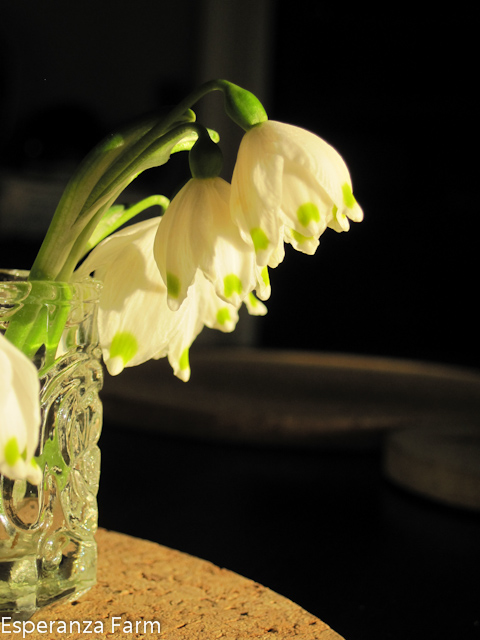
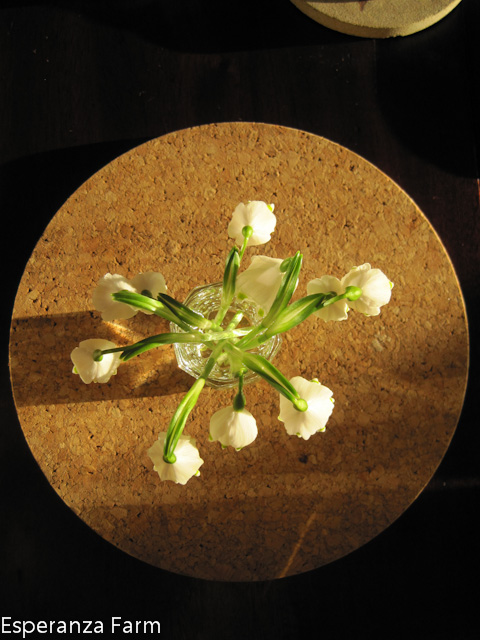
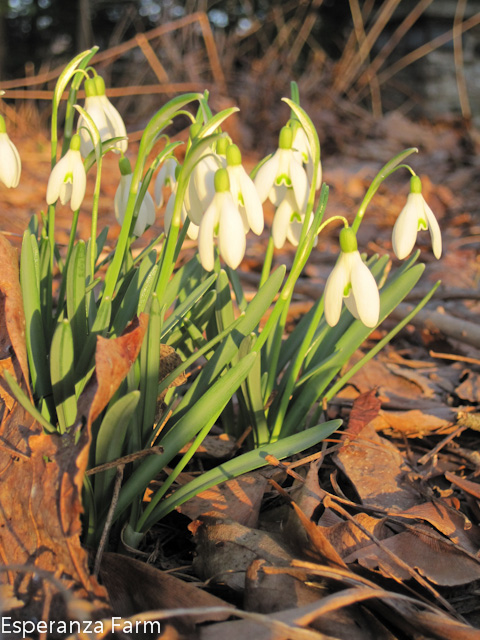
Or snowdrops and snowflakes.  As I mentioned the other day, we have both here.  As always, in a slightly perverse fashion, we have more Leucojum (snowflakes) which are the larger, bell shaped type.  They occupy about 30 square feet of ground beneath a hemlock, pine, oak area, which has western exposure.  Over the years we have gradually helped the patch’s expansion, though it mostly expands by virtue of its own seeds and divisions.  The Leucojum doesn’t seem to mind the intermittent streamlet in the area (winter flooding can sometimes dislodge the bulbs).  Nor does it mind the heavy oak leaf cover.  It is this latter issue that appears to be the downfall of the Galanthus, which generally are said to be the hardier type.  The Galanthus simply does not have stems sturdy enough to get through the leaves.  Possibly, I haven’t experimented.

In any event, they make a lovely white carpet beneath the hemlock, just as if they were a remnant snowdrift, only shining in the sun.  The leaves will stay as a good green groundcover well into summer, an added benefit.

Leucojum, on the table.


Galanthus, outside.

Year Round Gardening Sunday, Mar 11 2012 

Theoretically, in mild years such as this one, you can probably find something that is in bloom throughout the year at Esperanza.  It does take a little bit of work, and a few non-natives: the Chinese Witch-hazels have a longer blooming period than either of the two native American ones, which tend to avoid January.  Heather, if correctly located, will also bloom throughout the winter, as will some of the Hellebores (which we have not as yet had much luck with). 

However, these are definitely oddities.  Spring here starts with the with the two snowdrops: the large Leucojum and the smaller Galanthus.  These like the wet, partially shaded woodland edges and have been in full bloom these last few days.  Also starting up are some of the species crocus planted against a south facing foundation wall.  From now through the end of October something will be blooming here.  Rather nice, that.

Label your Photographs! Friday, Mar 9 2012 

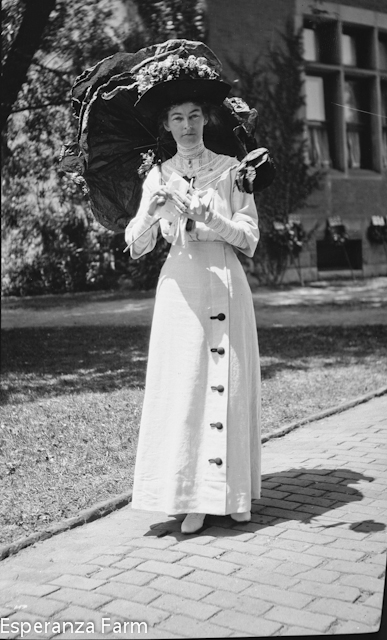
Lest one think we are well organized….We have an impressive run of photographs here, slowly being digitized*, however; it is not well labelled.  Actually, it really is mostly unlabeled.**  Now, family members can usually be sorted out, there are enough pictures connected to enough other information that patterns can be combined with elimination with some level of success.  Visitors and such are a headache but marginally possible, in theory.  The impossible ones are those one-time photos at a special event.

This photo is an example of that, taken in 1911 at what appears to be a school graduation (unknown).  Who is it? Clearly, someone important to the photographer (also an unknown).  I must admire the clothing though, and the parasol, and the gloves, and the fan, and all that white lace on the cuffs and the neckline! In summer.  Can you imagine the work?

*funnily enough the current gaps in the digital record are from the late 1800’s, prints and glass negatives, and the late 1900’s, also prints.  The majority of the 1905-1930’s negatives have been scanned and after that slide film was used into the 1980’s, which has all been digitized.  Post 2000, most of the print film was also on CD’s, and then shortly thereafter we went completely digital.

** Yes, that is a hint for some help with keywords…

Energy Transfer or Snow on the Mountain Wednesday, Mar 7 2012 

It is always interesting to take a walk up on Yellow Mountain.  Currently, although we have had a dry winter with only a little snow, it is quite wet.  It is also unusually quiet, with only a few deer tracks and some coyote tracks.*  What is particularly interesting, however, is that the snow (all of a few inches) is a solid blanket in the woods.  However, it has melted almost completely off of people’s lawns, fields, and other areas of human activity.  The fields with the most snow are those that weren’t cut last year, our hay field has largely melted, a neighboring, uncut, field with a similar exposure has more snow.  It is well established that areas of concentrated human activity, such as lawns and intensively used agricultural areas, have much higher levels of storm water runoff.  What I don’t know is whether any one has looked at their temperature changes. 

The woods in March have about the highest amount of sun levels hitting the floor that they will get all year.  Yet, the limited amount of shade that does exist, combined with the changes in air movement, must substantially lower the temperature.  Thoughts anyone?

It is also rather interesting to observe what plants are making effective use of the sunlight, despite the snow.  In particular the Princess Pine, a small evergreen in the club moss family, has just the right shape to pop up through the snow, while its dark stems effectively melt the surrounding snow quickly.  It therefore can absorb huge amounts of light and water for a few weeks, before the other plants start leafing out.

*No people activity either.

« Previous PageNext Page »