Ego Stroking Saturday, Mar 31 2012 

It is always nice to have a professional admire the place.  In this case our arborist, who really appreciates our trees; since he has also worked at some arboretums, he has a certain standard of comparison.*  In any event, incidental to getting a quote on some preventive maintenance pruning in the big oaks and the Japanese maples.  The trick is to balance aesthetics and health.  It is straightforward with the oaks, take out the dead branches, give the young red maple some space…well, except all the branches in question are fifty to eighty feet up.  The Japanese maples are more of a challenge.  Thinning the crown a bit to let the smaller one have more light and to remove unhealthy branches that use more energy than they bring in or removing vigourous but structurally weak branches.  Very logical: if this branch is cut then this branch will do this.  But it requires thought and more skill than I have, especially with old Japanese maples.  I’ll stick to the apple trees and various shrubs; not only because I can reach them, but because they are much more forgiving.

*Of course, it shouldn’t be my ego, I didn’t plant those trees!

Electricity! Friday, Mar 30 2012 

Sometime between 1914 and 1920 electricity came to Esperanza, along with the plumbing and the telephone.  Lucy Creevey later wrote:

“suddenly we had bathrooms and washstands with hot and cold laid on all over the place. It has, of course, been an immense convenience; and one wonders how we ever got along without it, but we did, and happily, too.  Never a gadget to get out of order.  Now when things go wrong, I am told the fixture is “obs’lete.”  

We had a telephone too, and soon after this Esperanza blossomed out with innumerable electric lights.  Just in time to save ‘Daddy Will’ (WWE) from nervous prostration: he had the household job of keeping about thirty kerosene lamps going, a grim job.”

Somebody thought ahead when they put most of the wiring in; running in the walls and ceilings, almost all of it is sheathed in metal.  This reduces the rodent problem and the fire-hazard.  The safety concerns are further addressed by the continued use of protected glass fuses instead of circuit breakers.  This gave us a headache with the insurance companies (until we found the right one) as dingbats apparently use pennies to replace blown fuses or use unprotected fuses which allow for too high an amperage.  Circuit breakers are theoretically harder to tamper with, but you can continue to flip the breaker and continue to send current down a problem wire.*  With the fuses, if it blows, you have to fix the problem.

This leaves fixtures.  My faithful handyman (Jamie) was fixing one the other day, it having correctly blown the fuse.  That prompted me to look at the styles of wall fixtures.  I somehow hadn’t realized that there are at least five different styles. The Dining Room has its unique style, two slightly different styles in the stairs/halls; a very distinctive tulip style in two of the bedrooms; and then miscellaneous one-offs. What you don’t pay attention to!

*I’ve done this.  I had a flat where a certain light-bulb lasted about two weeks on average, every time it went the breaker would trip off, the routine was to replace the bulb, turn the light on and then reset the breaker.  If you left the light off while resetting the breaker, it would trip the next time you turned it on and blow the light.  What the short was exactly and how that worked, I don’t know; but I do know it probably wasn’t smart.  God loves fools.

Meditations on Climate Change Thursday, Mar 29 2012 

I am not a fan of the Global Warming School, mostly for the simple reason that I don’t care for deliberately perverting scientific theory in order to advance an ideology. 

That being said, I do recognize that the climate does appear to be somewhat erratic, for whatever reason, and that it may be more erratic than it has been in the last century (a blink of an eye for the climate time scale). The case in point: a dry, snowless winter, followed by zero rain in March, the watercourses look like it was August.  Additionally, the temperatures rose well above seventy for two weeks in a row.  Followed by an overnight drop to nearly eighteen.  The result is not unexpected.  We are now back in ‘normal’ March weather of forties, windy, and finally a small bit of rain.

Many of the New England native plants are hesitant, they respond to daylight length more than temperature, so if the dry spell has really ended and normal rainfall patterns occur they will be alright.  Their main growing period is April, the dry winter will stress them but not unduly.  But anything from farther south, or other continents, will start growing in March here, if the temperature is high enough; additionally such plants are utterly unable to deal with a hard freeze.  This includes: peaches, magnolias, forsythia and numerous garden plants.  Whether or not the peach’s blossoms have been killed by the freeze earlier this week is as yet unknown, one has to wait a week or two.  Most people’s magnolias, and some forsythia, have turned a rather unattractive brown, however.  Also stressed by the lack of March water and accelerated by the heat are the various bulbs: crocus, daffodils, tulips, snowdrops.  The hard freeze didn’t hurt them, but their bloom time has probably been halved.

So, I am complaining about flowers, nice to be me?  Well, yeah. I’m lucky, it could be a tornado or severe drought, I know that very well.  But, if the peach tree is frozen, that is about two hundred dollars of peaches and 24 pints of canned peaches that won’t happen.  It is a maple syrup run that was the same as last year, despite an extra 150 taps.  It is an unexpectedly frozen faucet and burst pipe, it is damage to plants that would otherwise not need replacing.  This is how the cost of climate change begins to add up, even amongst the Western world’s middle class.

A and B Wednesday, Mar 28 2012 

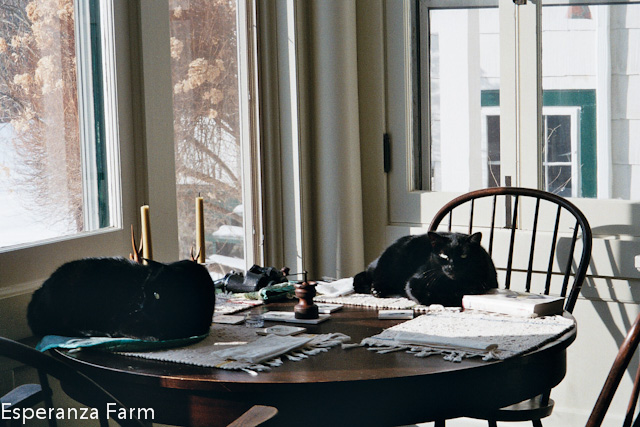
The house has a long tradition of cats; and, while I have no fondness for outdoor cats, I do like our indoor cats.*  Without further ado, therefore: A and B, brother and sister, A is the one on the left.  A more typical pose for them is curled up under the dining table, immediately above the furnace; but it makes for a poor picture, since you can’t tell where one ends and the other begins.

They are almost, but not quite impossible to pat; you certainly cannot pick them up; and a guest is unlikely to even see them.  On the other hand, they like to know exactly where we are, get terribly bothered if we leave unexpectedly, wait to eat dinner until we are eating although B requests that I put it down so she can check it earlier, and A firmly believes the lawnmower attempts to eat Jamie and will come find me if I am in and request that I save him, now. 

*Not least, I admit, because they are a practical solution to the mice, even more so because they are terribly ineffective at the actual rodent dispatch bit, giving me plenty of opportunity to remove the critter before they attempt to eat it.  My dislike for outdoor cats partly stems from this indoor usefulness.


Cast of Characters Tuesday, Mar 27 2012 

I figure that I probably ought to quickly sketch the family line for Esperanza.  Through the accident of biology, the family name has changed repeatedly.*  This has nothing, absolutely nothing, to do with matriarchies and everything to do with a preponderance of daughters. 

In any event, it is easiest to think of overlapping groups.  Group one is Julie Palmer Smith and Morris Smith, 1870’s-1880’s, and their four daughters: Carlotta, Fannie, Helen, and Lucy. Julie dies in 1883, Morris dies in 1901.

Helen and Lucy marry: William Webster Ellsworth and Fred Davis respectively.  Lucy dies shortly after giving birth to her son Carl, 1881.  While Carl Davis does visit as a child, we have lost track of that branch completely.

Helen and WWE begin to take over Esperanza in the late 1880’s, WWE dies in 1936, Helen in 1945.  Esperanza as we know it is largely their creation.  However, Fanny and Carlotta also lived at Esperanza throughout their lives.

Helen and WWE had: Lucy, Bradford, Helen Adelaide, and Elizabeth.

Lucy married George Creevey in 1901, they would continue the ‘Esperanza’ line.  Bradford married Juliet Inness and had a son, George, from that marriage but we have lost track of that line.  Helen Adelaide married Maurits van Loben Sels in 1905, starting a vibrant family of their own in California.  Elizabeth married Frederick Goucher in 1913, but died childless in 1917; however Frederick Goucher (Shandy) as his second wife, Louise, remained close friends, frequently staying here during the summer.

Lucy and George Creevey overlapped with Helen and WWE for much of their marriage.  George died in the 1940’s, Lucy in the 1960’s.  It was after WWII, under Lucy’s guidance, that the house slowly transitioned from a summer house to a year-round house.  George’s sister, Elizabeth (Beth) Creevey Hamm (married but widowed in WWI), was along with the Gouchers a frequent presence at Esperanza.  Lucy and George had: Carlotta, Kennedy, and Eileen. 

Carlotta married Francis Harrison and had three children, all still living.

Kennedy married Margaret Brundadge and had three children, all still living.

Eileen married Newman Hall and had two children, still living.  Eileen and Newman take over Esperanza in the late 1960’s.  They lived here until c.2003 when it was passed along to the present two generations.

*Starting with Eileen and Newman Hall the last name stops changing, as the title passed to their son, Jamie.

Cries in the Night Monday, Mar 26 2012 

It is relatively quiet here, traffic on the road drops off almost completely late at night, leaving the background hum of the odd, distant car, airplane and mechanicals either in our house or the neighboring vineyard’s cooler.  Quiet enough to be able to track a motorcycle, say, coming up or down the hill for an easy two miles.  Sound carries.

However, there is still plenty of noise at night.  Squirrels or mice in the walls, the shifting of the house, trees in the wind.  In the spring, frogs in the nearby ponds.  Nearer to dusk and dawn there will be birds, a turkey looking for a mate in the grey light of a warm morning, perhaps.  The middle of the night is reserved for the predators: the rare times the owls or coyotes call to each other.  While weird, the coyotes are hardly spooky.  They don’t instinctively unsettle one; I listen, of course, and wonder what they are doing, but nothing more.  

On the other hand, sometimes the predator is revealed through its success.  Something the other night took a very long time to kill what sounded like a rabbit.  It was interesting to observe the deep-seated response to such a distress call.  You have to pay attention to such a noise, ignoring it is entirely impossible.  Somehow, that sort of sound makes one immediately aware that right outside the window is a very large, very alive nocturnal world for which humans are astonishingly ill-equipped.  We harnessed fire for a reason.  We also domesticated animals partly as a way of extending our senses into that world.  Dogs come to mind first.  But actually, I have found that the most effective early warning system is a horse.  Useless for people, of course, but for weird night noises excellent.  Coyotes far away, rabbits being hunted outside the window, no reaction from him at all.  A bear in the yard, dogs or coyotes in the yard, a definite reaction.  Unlike a dog, which will react to the rabbit, a confident horse only reacts to things that might be real threats to it.  In other words, an untrained dog will falsely raise the alarm at times, an alarmed horse is always reason for concern.  Now, if I could just get him to react to strange human activity…

Daffodils Saturday, Mar 24 2012 

The show must go on! Friday, Mar 23 2012 

In an age before movies, TV, radio, and most assuredly lacking in the internet, the theater was the main entertainment venue and the opera was the main type of performing art.  Many of the letters by family members comment on operas they have gone to see, as they also comment on books they were reading, or pieces of music they were learning.  Sometimes, there was an element of comic relief evident, and the wry humor of the writer who knows they oughtn’t have laughed, but did, shows through.

Julie writing to Carlotta in 1875, from New Orleans:

“Saturday evening went down to L’Affricaine.  The soprano was sick- seven months in the family way- and in the third act when Vasca is looking at the mop, she stood on the other end of the stage singing, when suddenly without warning she fell over backwards in a dead faint. I thought it was part of the role but wondered how she could fall so awkwardly with her feet towards the audience- because her feet were Not her strong point. Then they came near crushing her with the drop curtain and it took six men to carry her off the stage. And yet she came out and tried again- and got on somehow till the last act, when she gave out and they had to stop the thing for good.”


Meditations on Garlic Mustard Thursday, Mar 22 2012 

Certain tasks, in their simple, semi-repetitive nature, let the mind wander.  Sufficient physical activity focuses or perhaps distracts the surface thoughts, allowing the inner mental activity more room.  A recent study on workplaces found that if workers got away from their desks and did some sort physical activity they were more creative.  Nothing new there, at least not for someone who developed pretty much all of her essays and theses will away from any sort of desk.

Why does this lead to Garlic Mustard?  Well, I spent the better part of the afternoon pulling the stuff, trying to eradicate from several areas.  It is an easy weed to pull, despite its long taproot, easy to identify; but the physical activity of paying sufficient attention to not pull everything else, to duck under tree branches, and so forth gave me plenty of time to think on other things. 

One of the lesser thoughts was why pull the Garlic Mustard?  What is the justification for pulling it and not the Greater Celandine or the Dame’s Rocket?  All three are considered weeds and, worse, the Dame’s Rocket and the Garlic Mustard are both banned in Connecticut. Does pulling one and not the other make me somewhat hypocritical? If not, why not?  Yes, I can have moral angst over a plant.

All three are historic plants, the Garlic Mustard actually is a vegetable garden escapee.  The primary answer was actually quite simple, relying on science rather than legal definitions.  Garlic Mustard is a whole different level of invasive plant from Dame’s Rocket.  While Rocket will spread and form large clumps, it doesn’t actually alter the surrounding ecosystem appreciably.  Garlic Mustard however, chemically suppresses the mycorrhizal fungi found in North American forests as well as putting out other chemical growth inhibitors.  This prevents other woodland species from growing, allowing the Garlic Mustard to become a monoculture and the dominant plant in the understory.  It also is unpalatable to our white-tail deer and is poisonous to several butterfly species, which mistake it for their host plants. A self-fertile, biennial, a single plant will produce several thousand seeds; additionally, its main growing season is fall and spring, giving it a serious edge in the woodland environment.  In other words, it is a perfect example of plant capable of not only out-competing, but of permanently altering an areas ecology. 

So, it gets pulled.  The Rocket, equally illegal, stays.

On sentiment and value Wednesday, Mar 21 2012 

I spent an amusing afternoon this last weekend helping to host an antique appraisal fair (think Antique Roadshow).  As expected, the mix of items was dominated by three sorts of objects: collectibles, old but inexpensive, and sentimental.  Also as expected, there were mild protestations and disappointment when an object, perceived by the owner to have monetary value (but it was Grandma’s, but it is pretty!) turned out to have little financial worth.

Objects can be classified as belonging to several categories at such an event: the genuine antique, the oddities, the collectible, the tag-sale item, and junk.  These five categories* are then modified by what one might consider the sentiment variable.  The genuine antique is the rarest category as it generally requires a substantial hand-crafted element, demonstrate a high level of quality for its type, and (despite the legal definition) to be over the century mark.  Oddities tends to cover the interesting tools, trade paraphernalia, and easily shades into the collectible and the antique.  Collectibles have imposed value: the object itself may not be worth much, but because a sufficiently large number of people have decided to amass groups of like items, monetary value is created.  If they stop being collected, their value drops.  The tag-sale item is just that, as is junk.

What about sentiment?  Sentiment is a modifier.  Object x would be classified by the disinterested party as a common, tag-sale item.  But, the invested party grew up with it and remembers Grandma was very proud of it.  Grandma was important, therefore object x is important, therefore its value ought to be commensurate.  We all do this; it is a form of attempted affirmation of our own social value.  Unfortunately, as any honest historian will grudgingly admit, most individuals aren’t that important to society.  Very few people are so important that their ownership or presence adds monetary value.

Where does that leave Esperanza?  Well, its items represent all of those categories, probably with a fairly even distribution.  Sentiment, plays a huge role, as do two other modifiers: context and provenance.  Objects in Esperanza have both context and provenance.  Background and stories add social value to an object.   The more detailed and rigorous the background, the more value.  Provenance travels with an object, as long as there is a paper trail.  Context does not.  Like sentiment, these modifiers, will generally not add financial value.  In rare cases provenance can, but like sentiment it requires really interesting people or events. 

And so forth.

*Take as read that the categories are fluid and not exclusive.

Next Page »