The refinishing of floors Thursday, Sep 20 2012 

I am actually not the person that did the work, Jamie did it and well; I just ran off with the rug that was in desperate need of repair…thereby exposing a section of the floor.

Hard to say what the wood is, it may be hard pine.  Originally coated with shellac, making restoration fairly straight-forward.  Shellac is suspended in alcohol (you can actually get shellac in flake form).  Clean it, then rub it down with denatured alcohol which re-amalgamates whatever shellac was left, then two coats of shellac with some areas needing three (heavy traffic, sun, water, or tape from a taped down rug).  No sanding required.
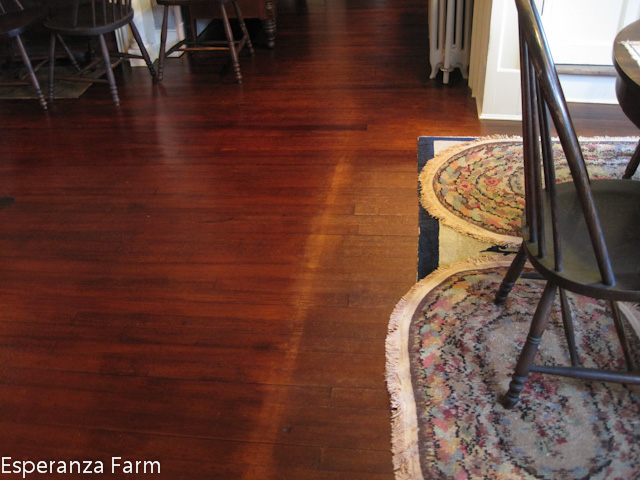
This photo is about as close as we come to a ‘before’ image: the floor on the right is not yet done, the light mark is a where a rug was taped down.  You can see the difference in the quality of the color/light.
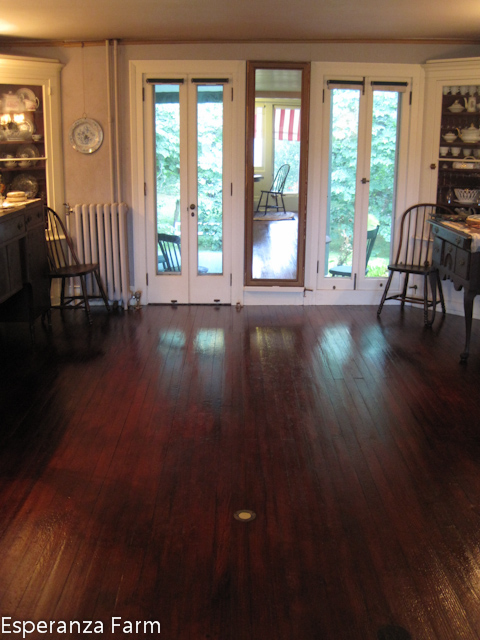
The floor refinished.  The circle in the center is a floor outlet.  This picture is also a nice illustration of the standard tendency for old houses to be built less than straight: look at the wall, the plaster is not cracked, the ceiling height really is that different!

Diffuse light Wednesday, Sep 12 2012 

As part of the project which has me working on a rug, Jamie has been beautifully redoing the dining room floor (note: do you realize we didn’t take a ‘before’ picture yet again?).  This is a both trickier and less work than one might suppose.  It is less work than a modern floor for several reasons.  The first is that the boards, long, narrow tongue-and-groove; are rock hard and absolutely not in need of any sanding.*  Secondly, they are shellac floors.  This means that striping them is neither needed nor desired.  Clean them, rub them down with alcohol once or twice, and then a new coat can be put on.  It is tricky, however, because a shellac floor is very hard to get evenly reflective.  In an area such as the dining room, where low angle sunlight is common, and where the eye has a large expanse of floor to look across, any mistake or miss is easily seen.

However, the end result is a floor the colour of dark amber, not a solid colour but a shifting array of hues with a mirror shine.  This of course brings one to the diffuse light thing.  Mirrors are a well-known method of bringing more light into a room.**  I have observed with other rooms that once the floors are redone, the light level goes up: the floor bounces a warm light back up.  It will be very interesting to see what the effect is in the dining room.  It should be even greater than other rooms, because the ceiling is a smooth white plaster, unlike the other rooms which are painted or coloured rough plaster.

*He who sands old floors (beyond more than a light hand sanding to remove) ought to be summarily disposed of. 

**This can be taken to far: there was a memorable entirely mirrored, entirely round bathroom in Graz, Austria that I encountered.  It would have been too much at any time of day…never mind on a night out.