On Context Tuesday, Sep 13 2011 

One of the astonishing things with history is how easily and how quickly information can disappear.  We are accustomed to an overload of data in our modern world, but even that information can vanish.  It isn’t a matter of erasing the data, it is a matter of forgetting why the data matters.  Photographs are the classic example.  

The photograph is fine, that data set is complete.  But it carries none of the ‘obvious’ information.  The photographer and the people photographed knew who they were, so why write it on the back?  (With the computer it is even easier to seperate a photo from the context) Maybe the person is a casual friend, their name forgotten after a few years; or maybe it is a close family member, but two generations on nobody is alive to recognize the only picture of Uncle Joe, even if they have heard stories about Uncle Joe.

Every historical society probably has at least one file drawer, or more, of unfiled photos.  Hundreds of people who were important to someone, somewhere, stare out at the frustrated archivists in silent anonymity.   And I daresay that the Facebook is probably beginning to accumulate ‘who is that guy in the back?’ photos as well.   Esperanza is no different, its photo archive contains many ‘who is that guy’ photos,  some are relatives, some long time guests, some here just for the day.  Those unknown people were important, there is a whole life story there, just outside the picture frame. 

In some ways the unfiled photographs can be the most haunting ones.  The disjunct between the desire of the person photographed to be memorialized and the anonymity that happened despite their efforts is sobering.  The silent voices of the millions that have gone before who have faces but no names.

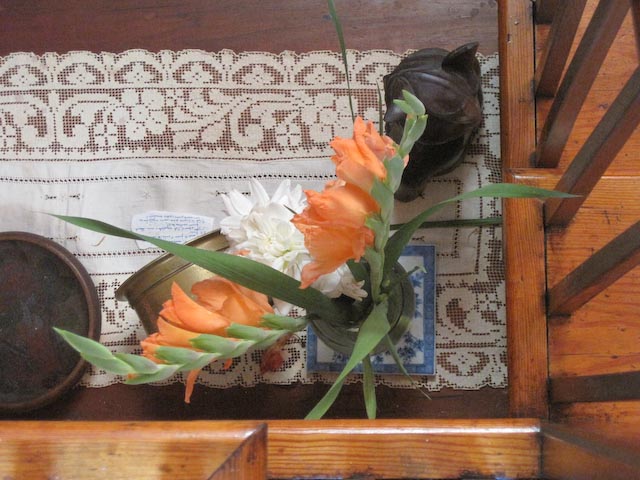
Still Life Saturday, Sep 10 2011 

As seen from above, main stairs.

You live where? Friday, Sep 9 2011 

Or what is to love about Connecticut?  Let us be honest, loving Connecticut is hard.  At least a few people I am related to despise it.  I am more than capable of holding it up as an example of all that is wrong politically, culturally, environmentally, etc.

This bit of Connecticut earns no ‘cool’ points: it isn’t a chi-chi Berkshire town, it isn’t chic urban, it isn’t dramatic mountain/ocean/’wilderness’ vacation escapism, it isn’t romantic Southern charm, it isn’t even genuine rural or genuine ‘small-town’.  In general people look at Connecticut and say (usually the same person) it isn’t chic urban and it isn’t quality ‘wilderness’ so why care about it?  And history?  It is the center of the industrial country that won the North that dispute of the 1860s, that made the West possible, that drove America’s rise for nearly 150 years.  Webster, Whitney, Winchester, Colt, Pratt, Sikorsky, Ovation…  but industry is a dirty word…

Well, you don’t fall in love with it immediately.  It isn’t the sort of place with jaw dropping vistas.  Maybe you have to have bad, uncorrected vision, because you fall in love with it through little incremental things.  The structure of brickwork in an old mill town, the multitude of architectural and cultural types, the mist on the river, hoar frost in the winter, foggy mornings, the rain lifting off the blue hills, the hundred different greens that change through the season, you have to fall in love with trees first, Connecticut is 68% forest even though it is one of the most densely populated states.  Fall colour and spring flowers, asters to daffodils, goldenrod to trillium.  Fireflies and migrant warblers, the horned owl deep in the sharp winter night.  There is great beauty, but it is fleeting.  In Connecticut familiarity breeds love, contempt is bred by inattention.  The mist lasts for an hour, the fall colour shifts and is gone.  These are scenes that demand constant attention.  You blink driving down the road and the astonishing vista of New England is gone, a trick of light, of space and time.

It has all four seasons, but never brutal; you can’t earn macho points for living through them, but you don’t need to either.   And perhaps that is part of its attraction.   Connecticut doesn’t offer you excuses or convenient images to hide behind.  There is no romance, so you can’t pretend to be romantic.  If you plant something, and it is in the right zone, there is no excuse here for it not to grow…on the other hand, it won’t grow without some effort on your part.  No casual tropical flowers here, but also no excuses of heroism in the face of the climate when you get only a single rose. 

Connecticut is a human sized landscape with enough land that a person’s stewardship or lack of stewardship has direct results.  In an urban landscape, the land is ‘other’ elsewhere, one’s actions seem to have no visible effect; in areas of the West, the land is a constant force so great that one can feel that one’s actions will not even be noticed by that greatness, even if they are visible; in Connecticut the land is a partner for good or ill.

The coming Fall Wednesday, Sep 7 2011 

We tend to think of Fall as the end of the growing season.  Yet, in New England or farther south, it can also be a last flourish and a promise to the coming year.  In more southern areas, late fall (November) is a time to plant many seeds that need a bit of extra time in the spring.  The frost cracks in the soil work the seed downwards.  Here in Connecticut, late fall is a time to plant dormant trees.  From October through November, planting trees at this time allows them to establish roots without having to support their leaves.  For the planter it means far fewer trips with the water bucket.  Early fall is a last flourish.  The lawn, which has sulked through the summer heat, suddenly starts growing again; the asters, goldenrod, chrysantheums all put on a spectacular show; the garden can produce another round of lettuce and spinach, while things like kale grow much larger.

Early fall is definitely here, the ashes have begun to turn and some of the early birches.  A few of the shadblows have started to turn, jewels of gold, amber and crimson floating in the dark green understory.  The horse has shed his summer coat and now grows fuzzier and glossier, darker.  It seems, always, to happen overnight.

September 1910 Tuesday, Sep 6 2011 

From a newspaper clipping found in one of the guestbooks:

“A delightful musical and tea were given by Mrs Wm W. Ellsworth at Esperanza in the afternoon. On arrival, the guests, some fifty in number, were invited to the studio which was arranged for the occasion as a concert room where Miss Beebe pianist, of New York presided at the grand piano, accompanying (this is underlined with a notation: Not much she didn’t!!) Mr Dethiere (this has the last e crossed out with the comment: Two E’s are enough, even for him!), the celebrated Belgian violinist in a number of choice and varied musical selections rendered with wonderful technique and expression.

The delight of the audience in the playing of these accomplished artists was evinced by enthusiastic applause. After the concert coffee and refreshments were served in the dining and living room and the guests were introduced to the performers whose playing had given so much pleasure. Mrs Ellsworth was assisted in recieving by her daughters, Mrs van Loben Sels and Miss Ellizabeth Ellsworth and by her sister, Miss Carlotta N. Smith.”

The studio was across the lane, at the dairy farm, and is long gone.  However, the piano was the Steinway upright grand piano built in the late 1800s, currently still quite playable, if a bit sticky when humid.

The pieces played were: Handel, Sonata in D major; Schumman, Sonata in D minor; Grieg, Sonata in C minor.  Edouard Dehier was a teacher at Juilliard as well as a soloist with New York Philharmonic, New York Symphony and the Montreal Symphony, in addition to extensive touring.

Mr. Dehier was stayed for the entire month of September; Carolyn Beebe was a guest from July through October, while Helen E. van Loben Sels, and two of her children, HAE and Lucy Lois, stayed from July through September. A crowded house!

Gardening in time Saturday, Sep 3 2011 

Gardens are generally classified by types of formality (cottage vs parterres), cultural (French, Italian, English), use (vegetable, perennial, cutting) and so forth.  Yet, gardening (as opposed to gardens) divides itself by time.  There is, of course, the relentless seasonal clock.  This yearly cycle’s implacability is both a frustration and comfort.  The seasonal change is often a relief for the garden.  Winter, at least in New England, cleans the garden; fall and spring clean-up is as vital to its health as division, planting or trimming.  It means that the evil looking squash bed will soon be swept away, and maybe next year will be better.  The seasons guarantee a constantly changing landscape, always something new to look at.

But time is also a much larger construct in gardening.  A garden can be a seasonal, decadal or generational construct.  A vegetable garden or cutting garden can be created for a season, from bare earth to bare earth in less than a year.   It doesn’t have to, of course; it can have a permanence in the use of borders or perennial herbs, horseradish, rhubarb, wormwood, thyme, tarragon…so forth.  A perennial garden needs a decade at least, it changes yearly as plants expand or die, but the best results are about five years in on a plan.  The master gardener is one who can continue to plan within the existing garden, they don’t need to start fresh every few years.  But then there is the landscape gardener.  They work with, and must have the patience and vision for, shrubs and trees.  The results of what they plan will usually  not be seen by them, but they know it any way.  Here the master is one who not only can work in the existing structure, but whose plan is pleasing at all stages of its growth.  While a perennial bed can look odd in its spring that lasts but a few weeks, a landscape’s spring lasts for decades, it must always work, even if its ultimate triumph is a century in formation.  Ideally, all gardens (landscapes) should incorporate the three senses of time, from the vivid flash of the impatiens to the oak’s centuries. 

If only!

Photo of the Day Friday, Sep 2 2011 

The first of the small ponds beyond Julie’s pond.  A year ago that would have been dry leaves there.  The floating bits of green are duck weed.

Storm water management Wednesday, Aug 31 2011 

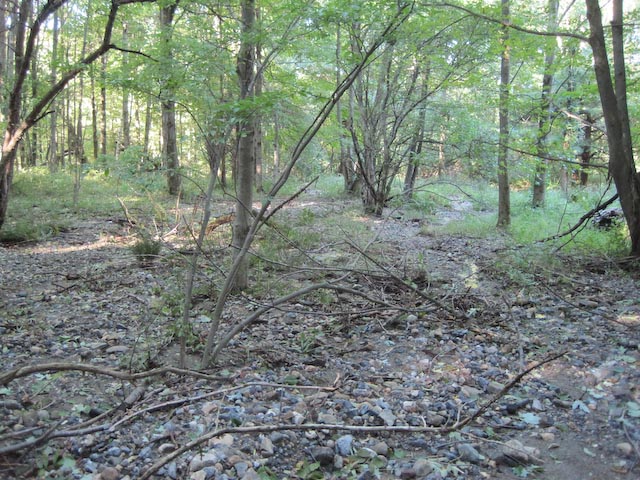
Contrary to the belief of at least one visitor (yes, let us have a full house while it rains!), we actually did have some damage from the non-event, for us, of Tropical Storm Irene.  I don’t object to the fact that our preparations were not needed, I prefer to look like an idiot rather than be an idiot.  In any case below are pictures of what water can do, a mild case. 

The damage done to the woodlands is extensive and would be very costly to resolve.  Thankfully, due to the heroic efforts of those involved and the luck that the water’s first preference is to go just a bit farther down the curve (the one bit of proper engineering on that stretch of road), it was kept out of the pond.  A thousand feet of dirt road, stripped to the sub-base in sections being dumped directly into the pond (shallow, spring fed) would have destroyed it beyond repair.

Royal Oak woodlot

This picture shows the bottom of one of the two flows from the lane, about 400 feet down hill from it.  I am standing where there had been one of the few remaining colonies of wake-robin trillium in this parcel, now a drift of rock about 8 inches in height.

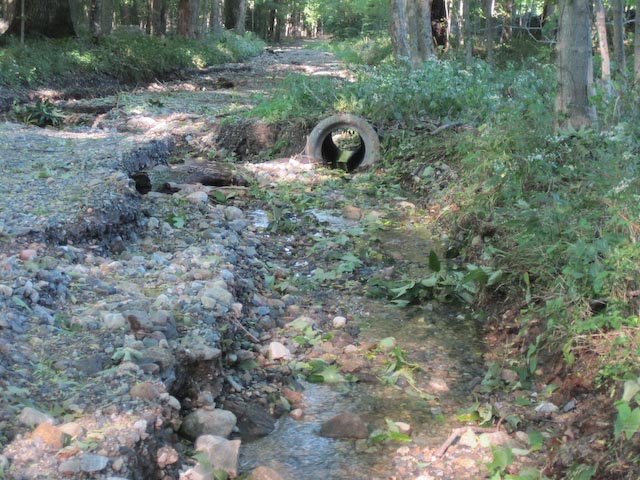
This shows the first failure, the culvert simply isn’t sized correctly and is also too high in relation to the stream.  Consequently, in flood conditions the water jumps into the road bed.  From here on down, about a 1000 feet, the stream used the road as its bed, taking essentially all the fine sand and much of the rock.  It did not return to the ditch because the grading actually tilted the road away from the ditch in this section.


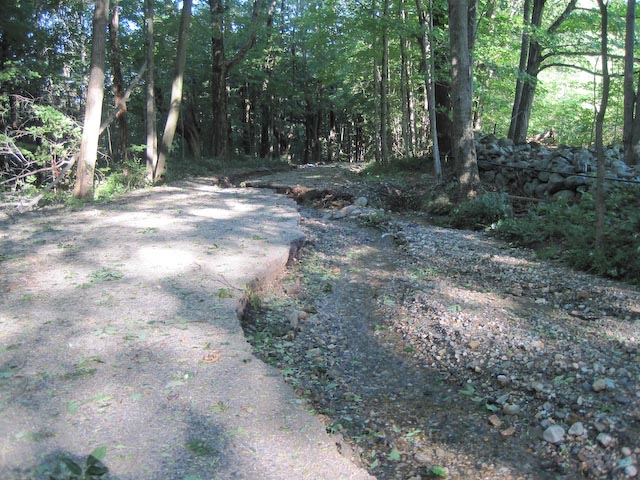
The pond is directly to my left in this photo, and is actually about 2 feet below the modern road bed.  The water doesn’t go into it because at this point the road is graded correctly, into the the inside of the curve and the ditch at the right.  Consequently, the ditch widened to take out about half of the road on the ditch side through the curve, which is the worst that should happen.  We were also able to keep about a quarter of the flow, which did want to go into the pond, from heading in that direction by some fast shovelling.  The ditch should go into a culvert, but that was obviously not capable of handling the water, let alone the road debris, again due to improper sizing; so the water cut across the road, as it had with the first culvert, finally going into the Royal Oak woodlot to the left just about where the break of the hill is in the photo.

Helen Ellsworth van Loben Sels 1904 Saturday, Aug 27 2011 

Helen Ellsworth van Loben Sels

Helen was a daughter of William Webster Ellsworth and Helen Smith, Julie P. Smith’s daughter.  She move to California and married Maurits van Loben Sels.  They developed a very successful farm, Amistad, in the Sacramento Valley.  The farm is still in operation today, though the house (which was very much a California version of Esperanza) no longer exists.

This picture, taken in 1904, is located on the top of the lane.  One of the interesting things is how much the lane has sunken between its banks in the last century, today it is nearly a foot lower..  The horses would have been primarily used for driving,but were also broke to ride.  Clearly of Thoroughbred ancestry, they probably stood between 16 and 17 hands.  From letters and stories it is known that Helen was quite comfortable around horses, as was her mother and grandmother; and she clearly seems to be confident in this picture.

A Fungus Among Us (and a slime mold) Friday, Aug 26 2011 

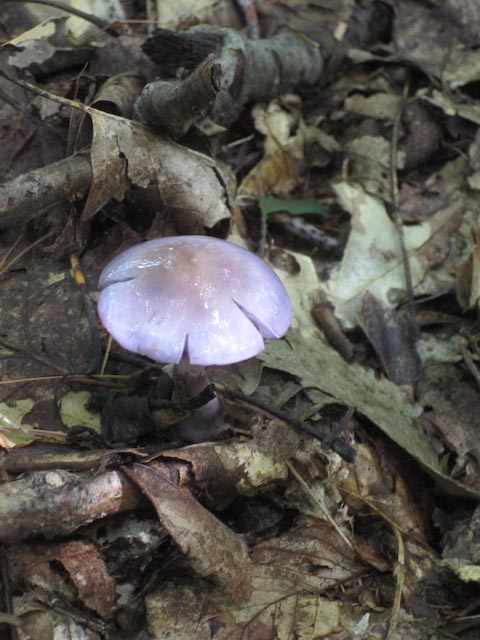
Yellow Mountain’s woods, in the warm wet weather that happens just after a bit of rain in August, have an amazing variety of fungi.  There were a multitude of representatives for the classics: bright red, bone white, lichen grey, mahogany red, tan, fluorescent yellow and so forth of toadstools, along with a few Indian pipes.  There was also a profusion of bright purple toadstools, which quite frankly were rather a bit much. 

I think my favourite of the fungi, I have also seen this in vivid purple.

Much more purple in real life!

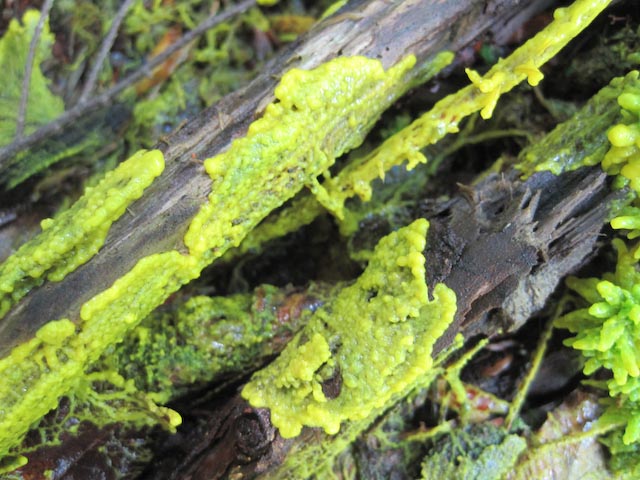
A happy slime mold, one has to have one!  Happily in the bog, not far from where I saw another this year.

Toadstool par excellence!

« Previous PageNext Page »