Traffic Patterns Tuesday, Nov 22 2011 

One of the interesting things when examining houses is the floorplan and what it reveals about the intended use of the house.  Usually, large houses of the nineteenth century tends towards circular traffic patterns, often with multiple circles, or semi-circles, orientated around a central focus.  This central focus is usually an entry-hall with a grand staircase.  The houses may have large amounts of outdoor access/windows but you can usually see no more than one view at a time, and people can avoid each other in the house due to the multiple circular patterns. 

Two examples more than a century apart illustrate the lasting attraction of this circular, inwards looking plan.  Gore Place in Waltham, MA was built in the late 1700’s.  An entry way has three interior options: directly ahead into the dining room, turning left past the main stairs, through a library, and into the dining room; turning right through a parlor, past the entry to the servants’ wing, and into the dining room.  Hillstead in Farmington, CT built c.1900 has a similar pattern: the large entry containing the stairs leads directly to the dining room, swing left in front of the stairs and you can make a circuit through the libraries before popping back out under the stairs in the hall again just before the dining room’s hall entrance; swing right and you make a circuit through the main drawing room and parlor before entering the dining room.

In both cases there is only one ‘public’ stairs to the second floor (Gore has another due to an addition), but other stairs from the servants’ quarters also exist.  Traffic must cross through the central hall, but the two wings of the house are utterly separate, as is the dining room/hall concept.

Which leads us to Esperanza…Circles don’t work.  Unless you are using the porches as exterior rooms, at which point you can make rings.  In fact, this was almost certainly part of the plan.  The house functions extremely well if the east porch and all four of its doors are used, even more function is gained when the four west door are used as well.  This is because the ground floor is essentially one giant hallway, only one interior circle is possible and this involves only one room. (leaving aside the butler’s pantry).  There are three ‘public’ staircases, so vertical circles are possible; a fourth staircase is something of an anomaly for the house: it runs from the kitchen (private) to what was a library (public).  In all but two rooms you can see through the house, and for most of the length you can see 270 degrees, with views to the east, west and north (actually in one spot you can also see south).

This creates a house that has no strong tendency towards division, unless you use the stairs (or outside) you cannot avoid people.  It also creates a house which lacks a central gathering spot.  There is no entry way, each room has its own access to the exterior.  The downside of all this is perennial confusion for the deliveryman, but also that the house can handle two wildly different group sizes depending on whether or not the porches are in use.  Fifty people is nothing in the summer; fifteen is crowded in the winter, not because there isn’t space (there is ample to lose fifteen or fifty) but because if a cluster forms getting out of or through a room becomes difficult.

On Fences Sunday, Nov 20 2011 

Until recently fences were emphatically local in style and type.  Immigrants may have brought house styles with them, but a fence was made of the local materials at hand and for local purposes.  You might dream of the fences in a country you loved, but you built yours with what was there before you.  Before the tumultuous advent of wire, fences were built of two materials: wood, living and dead, and stone.  Yet the variety is endless: stone might be the end-set Caithness sandstone slabs in Orkney, eerie echoes of the great standing stones in the mundane world of the sheep farm; mortared ashlar walls of England; the dry laid walls of New England some of which were linear rock piles and some four feet wide and five tall built of boulders with footing deep beneath the frost line. Wood is even wider ranging: the living walls of beech, hawthorn, acacia, rose, osage orange; any species that will grow quickly, some which must be annually sculpted, some which can simply be a hedge.  Then the wood: the wood/stone zig-zags of Ontario and sometimes New England, the cedar/juniper stockades of the western states, the five or six rail split hickory fences of the mid-South, the early stockades built from up-ended tree root balls, both formidable defense and formidable amounts of work.

Until recently wood and stone fences were local creations, you used what there was a lot of on hand.  Picket fences were an extra expense: planed lumber rather than simply cut or split  Importing lumber was an unheard idea. Iron was used in gates, but rarely elsewhere.

I have continued the tradition of the locally sourced fence, sort of…I confess the metal t-posts and the wire come from God knows where.  But the poles are primarily sugar (rock) maple, which isn’t good fence material since it doesn’t last more than a decade or so, unlike hickory, chestnut or locust; but I have a lot of it following the thinning of the south wall of the meadow.  So, the fence at the corner of the highway is getting extended and will run around the corner from the end of the stone wall into the brush pile fence.  Building fences takes, like all else, practice, and learning by trial and error means I already want to go back and redo the sections I did sometime ago.  Thank goodness it isn’t stone!

Julie Palmer Smith Friday, Nov 18 2011 

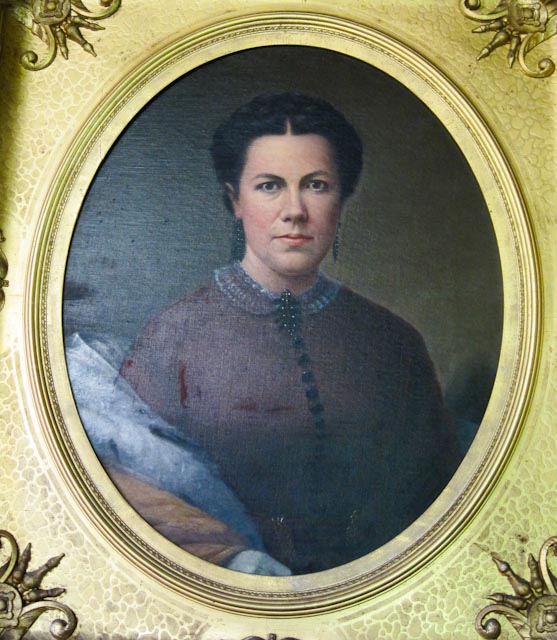
It occurs to me that pictures are always useful.  This is a portrait done of Julie early in her marriage sometime in the 1850’s, when she was in her 30’s. A matching portrait of Morris also exists.  The artist of this oil painting is unknown; there may well be a signature, but if so it is under the frame.

Melvin Hathaway Hapgood Thursday, Nov 17 2011 

The architect who designed the North Ell of Esperanza in 1893.  I found a rather decent short bio of him here: http://www.iwwwp.com/sghrl/images/Winter2008-09.pdf

One serious typo in it though: Julie was dead.  Hapgood designed the North Ell for WWE!  But the rest is fairly accurate.  Though it is somewhat uncertain as to whether all of those people visited Esperanza, WWE definitely knew them and was friends with them.  Family lore has it that Hapgood built the big fireplace himself, as the bricklayers had refused to try such a low, long arch.  He was right, it is perfectly stable.

Sightlines Tuesday, Nov 15 2011 

A house is, ideally, placed in its landscape.  There are a number of aspects to this which can go beyond the straightforward engineering to conform with zoning or health regulations.  For most of us a landscape may be more properly considered as a streetscape where the house’s position is dominated by its relationship to the neighboring structures.  This is can call for some remarkably innovative ideas: creating a cell tower that appears to be a church steeple in an historic district or an ultra modern building in a 17th century street which utilizes elements from the 17th century designs but is emphatically modern.  In the streetscape the lot is generally ornamentation, functioning like the paint and trim to express both individuality and the house’s relationship, or lack of relationship, with its neighbours.  It is absolutely critical to the house; but it is part of the house and is best described as an outside room.   

However, if the lot size is large enough the focus is shifted towards the landscape as an entity.  (It should also occur with the creation of subdivisions, though these are rarely done with an eye to design.)  While it is a rare property that does not pay some attention to its neighbors, either in the form of completely blocking the view or by using them as part of the view, a large landscape is more than an outside ‘room’.  Rather it is character and structure equal to the house in complexity and importance. 

Landscape design is a formidable topic, but one goal of the designer is to balance stopping the eye and encouraging the idea that there is something beyond that would be interesting.  Over time, because landscapes are comprised of things that grow, these views can be obscured.

This change in the landscape can be quite profound, I mentioned in the post on WWE washing windows that the far hills were fields in that photograph.  Today they are trees with a sprinkling of houses, most only visible at night.  The immediate landscape has also changed, the property’s own fields have grown into woods, and in particular, the clear definition of hedgerows, stone walls, and the promise of something beyond the next field has been obscured.  We are slowly working on restoring the hedgerows.   There are two reasons for this work: the first is aesthetic, restoring the concept of a larger visual space that ties the house not only to the far view from the top of the hill, but also to the more intimate view of the pond, stone walls, fields and woods.  The second is environmental: the removal of invasive species and the encouragement of quality young maple, oak, hickory as hedgerow trees and native shrubs, mostly apple, vibrunum, dogwood, sassafras, etc.

It is slow going, mostly done by hand since stonewalls and stock wire do evil things to chainsaws, but we will get there!

Historical Excerpt Monday, Nov 14 2011 

An historical excerpt from before the creation of Esperanza (though the center of the house would have been about fifty years old at this time!), from a letter written by Julie to her parents.  At this time she had just moved to New York City, age 27, from Brockport, New York.  From a long letter written between Nov 10th and Nov 17th, 1845, describing the evening of Nov 14th, 1845.

“went with Mr L. to the Battery (on the Hudson) to see the Sunset, and most glorious it was- that gorgeous mingling of colors and those dazzling reflections in the deep blue waters- and then the refreshing sea air. Mr L is an enthusiast and a dreamer just the one to walk and romance with on still sunset times. He looked with artistical eyes into the still depths of the blue water and talked smooth things. He has very fine eyes by the way and knows how to use them. I watched with unmingled pleasure the vessels in the distance and the little sailboats- gliding along so calmly- nearer were little skiffs with ‘gallant sailors’ ‘merrily rowing’ and then the little busy ferry boat hurried along with its full complement of passengers, luggage and never stopping to breathe though it panted and puffed ever so much.’

Despite the description of Mr. L (Lazerous)’s eyes, it is clear from the rest of the letter that Julie was already spending much of her free time with Morris, her eventual husband.

On the water’s edge Saturday, Nov 12 2011 

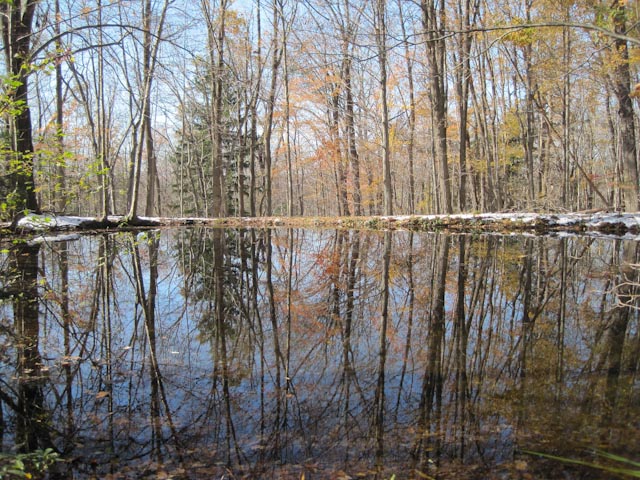
Julie’s pond a few days ago.  Bit of a difference from exactly a year ago!  The repaired dam is that far edge. 

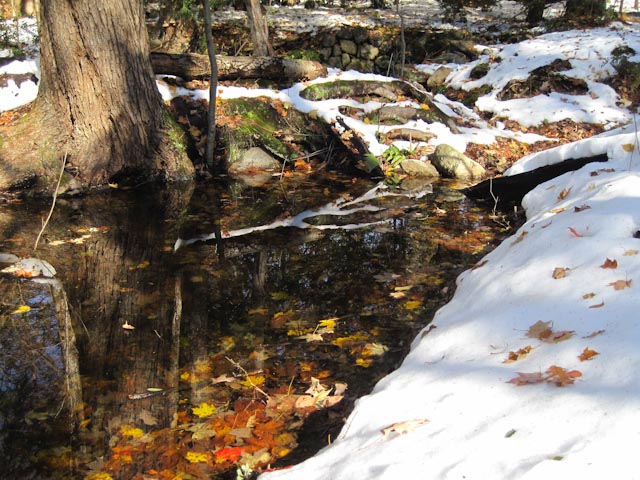
One of the smaller ponds.

walking down to the pond, the bridge over the outlet is just ahead of the person on the path.

Seasonal jewels Wednesday, Nov 9 2011 

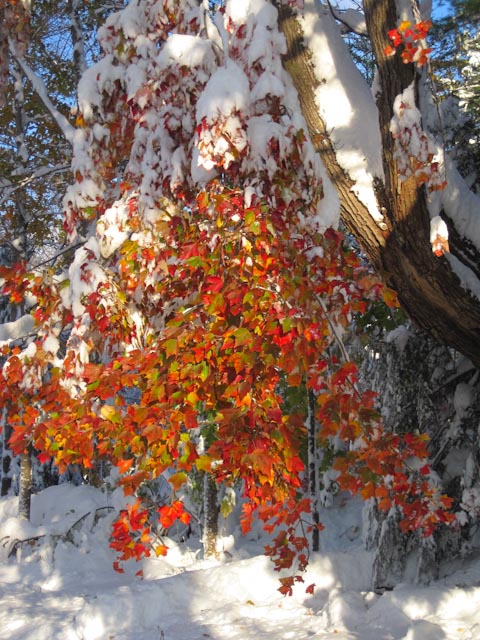
A Red Maple branch after last week’s storm

After the storm Wednesday, Nov 9 2011 

I know, well over a week later!

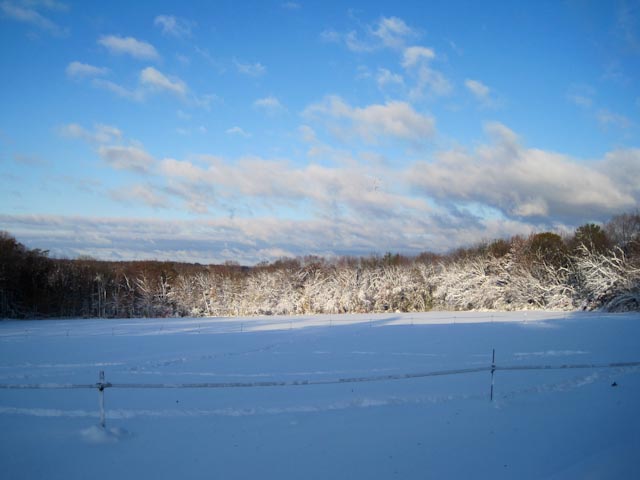
Note that there is no lower wire evident on the fence, that wire is about 14 inches off the ground and is two inches wide.  The day before that was all green grass.

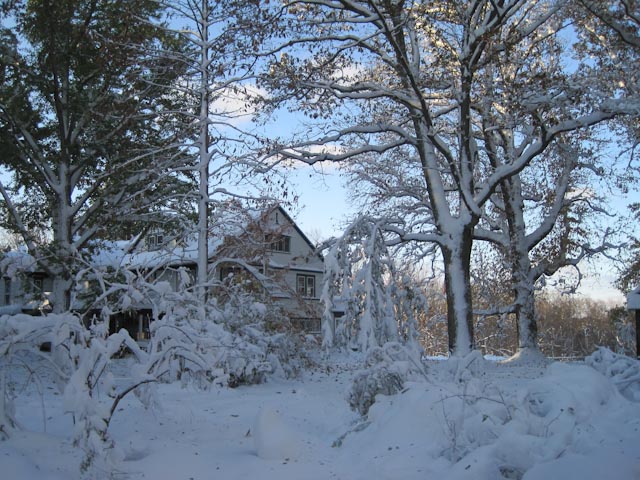
The arch in the center is actually the elm tree, bent double with its top touching the ground.  You can see how the snow came mostly from the north-east.  Less than 24 hours previously the lawnmower was out on the lawn picking up leaves and I was weeding the garden.


Freak Storms Sunday, Nov 6 2011 

Which in some ways aren’t that freakish, a genuine Nor’Easter, just early..very early.  To the tune of eighteen inches in 20 hours.  Now, one might say, “what is the problem?”  That is where it gets interesting, at least if one is interested in why trees fail.  The primary problem was several common species had yet to drop their leaves, in particular the Black Oaks.  Black Oaks, in the right conditions, grow fast and thick.  Leaves plus snow, well you know your physics.  This was also the case for the Star and Saucer Magnolias, both of which don’t tend to grow this far north in a ‘natural’ environment.  It was also a problem for the Japanese Maples, though both they and the Norway Maples could take more bending than the Oaks and Magnolias and so suffered less damage overall. Both species, non-native, don’t drop their leaves until very late, the Norway has yet to turn; I rather wonder if they are therefore more capable of handling leaf + snow loads.  The Black oaks were late this year as we had not yet had a frost.  Dogwoods, including the Kousa, are very flexible and weren’t bothered.  (I worried, but they could generally take it, which makes sense: their branching structure predisposes snow capture regardless of leaf cover, so flexible wood is a necessity).  Evergreen losses were confined to those with unstable root systems: snow load plus unfrozen ground…physics again.

We lost relatively few trees and shrubs, only one (a Black Cherry) completely.  Frankly a minor miracle.  Severe damage to some trees and shrubs, but not what it might have been.  Though that Gingko limb made a lovely Thump on the porch!

« Previous PageNext Page »