Dec. 7-16, 1856 Monday, Dec 12 2011 

We shall jump a bit in historical excerpts, with over a yard of shelf devoted to the printed copies of letters, it isn’t hard!  My rule is simply that the month/day must be a close match to when I post this. 

At any rate, the excerpt below is from December, 1856, from a letter of about three printed pages.  It was written by Julie, who was then at her stepfather’s house, Red Cottage, in Brockport, NY, to Morris who was in New Orleans for the winter, overseeing his business.  They had three daughters by then: Fanny Morris, born in 1851 in Brockport, Carlotta Norton, born in 1853 in New Orleans, and Helen Yale (whom we last heard of in Europe in 1873) born in 1855 in Hartford.  Morris and Julie had married in 1850, throughout their marriage Morris spent the fall and winter months in New Orleans, while Julie established their home in Hartford, where Morris’ business had its head office.    

“We have just finished making silver cake and pound cake as a preparatory measure to more company of which I will relate to you the event in due time. The weather is clear and cold and the sleigh bells sound merrily on the frosty air- there goes a load of tremendous hogs to market- winter reigns.

…While you stand on reclaimed swamp-land, and I walk over these snow-crusted streets- a little wanting in J’ne sais what- divided in all things. My Boy I love you above all- beyond all- in all- ‘Thou are my soul’s bright shining star.’ Dear Lottie (Carlotta) comes in just here with a kiss and says ‘Mama I love you- tell Papa I was a good girl last night and had some ice cream’. Fanny says ‘tell him I have got Lottie’s doll dressed and I want a nice book with colored pictures in it andthat I send my Love and tell Papa that I want to know if he is lonely without me.’ I am writing in the dining room and both children are climbing on the sofa behind me- and pulling and twisting the cloth in all directions- all which proceedings are highly conducive to finished epistolary style- fine penmanship- as behold!”
On the face of the waters Friday, Dec 9 2011 

We are accustomed to storm water; that water filled with sediments, road dirt or other material running loudly down a ditch or brook, capped with white. In New England the natural storm water runoff wouldn’t carry much sediment due to the nearly complete tree cover, but even an undisturbed forest watershed will have large amounts of debris, or tannin, colouring the water after a storm.  The rain the other day was no exception.  The ditch by the lane was steadily increasing in turbidity on its way down, with a massive jump in sediment levels below an area of washing on the dirt road.

It was, therefore, a slight surprise to turn away from the stream to look at the pond.  There was no wind and there is never a visible current in the pond, though a leaf will make a slow circuit.  And so, in the rain at dusk, the pond was a slate gray mimic of the sky.  A rain shadow could be seen, smooth water beneath the tree branches which were catching water; but over most of the pond the raindrops made the surface opaque and apparently rough.  From some places the water appeared to be dark, broken and then refrozen ice and from others it looked more like stone, if you had stone that flat.  Water in such a setting can be a little spooky, the usual clues that say ‘water’ are movement, reflections, sediment.  Frequently, the pond is sufficiently clear that its depth (which isn’t much) is uncertain, but on those days the reflection of the trees and the color of the water helps tell the eye that it is looking at a body of water.  Wind ripples do the same.  But to see a grey, featureless surface, with no wind ripples and no reflection of trees, nor any ability to see down into the water, that was distinctly different.  It really did give the impression of a hole in the earth that was filled with the storm.

November Roads Tuesday, Dec 6 2011 

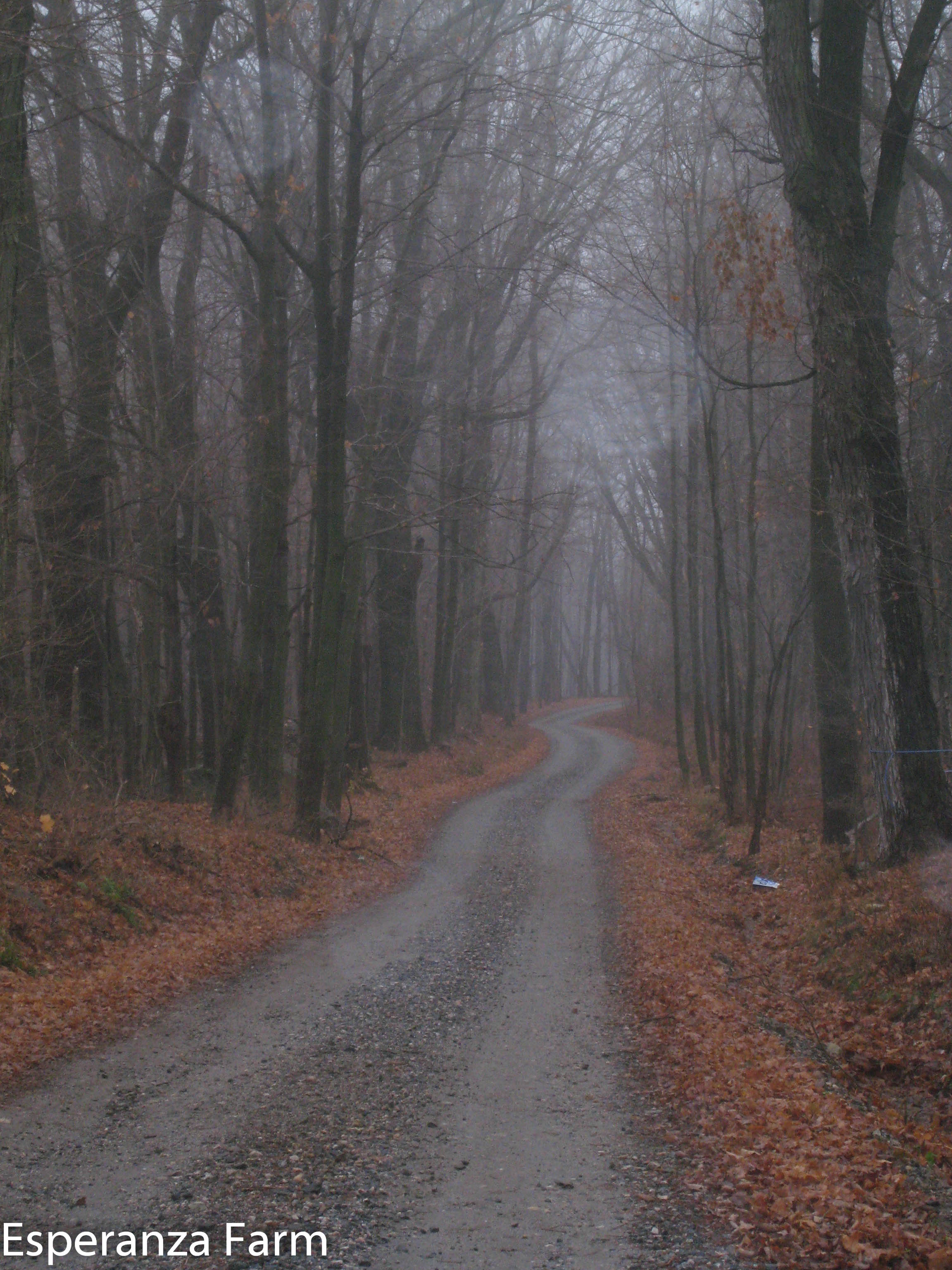
The lane winding down into the woods.  Actually taken last year, it looks a little raw this year, what with being rebuilt following the hurricane.  Julie’s Pond is off to the left of the curve at the bottom of the picture.

Fire on the Mountain Monday, Dec 5 2011 

Or the difference between a skidder scar and a fire scar on a tree.  Most people are aware of the science of dendrochronology: the interpretation of past events through the reading of tree rings; but we tend to associate this with long-past history.  We tend to forget that a living stand of trees can actually tell us as much, or much more, about the past century or so. 

The woods on Yellow Mountain are deceptive, the lack of invasive species tends to imply an undisturbed area.  And indeed, the numerous small woodland plants, such as the club mosses of all types, sheep laurel, the wintergreen family, etc., all are good evidence that the ground has not been compacted or disturbed in the last century or so.  But the preponderance of beech and the lack of fully mature oaks, or declining oaks, or other hardwoods in any quantity indicates logging in the last half century, and is correct to do so.  While the mountain has always been dominated by beech, hence its name; they oughtn’t be quite so dominate.  That oak is found on the hard to reach ridges but not on the flatter (within the meaning of the word) is also evidence for this disturbance.  The clincher is the occasional cleanly cut stump.

So, to skidder scars.  Three things leave similar marks on trees: deer, skidders and fires.  The deer scrapes are usually only on trees under about four inches in diameter, usually between six inches to four-five feet off the ground.  Deer scrapes are somewhat irregular in shape and not infrequently wrap more than 90 degrees around the trunk.  Skidders are at the same height, but they are sharp, they don’t wrap around the tree and are not oval.  Which makes sense if you consider how a heavy piece of machinery might be pulled past a tree.  Fires burn to the ground or below, leaving a rounded top and often wrapping around the trunk, they are highest and deepest on the uphill sides of trees, where forest litter has piled.  Skidders and fires tend to scar trees over five inches in diameter, under that the tree probably will not have survived, especially with skidders.

The mountain can seem like a place far from the crowded Connecticut landscape, an oasis.  Yet, it is also a testament for the ability of the forest to grow and change.  And in this growth, paradoxical as it might seem, trees remember.  They record everything that has happened to them.  A fully mature tree, standing above all others, will still indicate on which side the heavier tree cover was when it began growing, it will indicate prevailing winds, it will record all damaging storms.  A tree is a witness, an incorruptable witness, and this may well explain part of the reverence some cultures hold for them.  For this record, this decipherable record, is created apart from man but is readable and changable by him.

Dec. 2, 1873 Saturday, Dec 3 2011 

From Helen Yale Smith (later Ellsworth) to her father Morris; written in Darmstadt, Germany.  Helen was in Europe from 1873 to 1875 both going to school and on a Grand Tour of sorts.  Mrs. Bean was a chaperone for Helen and her friend Mattie.

“Dearest Papa,

I am almost wild with joy. I am at last going to Italy and in the right way too….Italy, Italy, Italy, the golden land. The land of dreams, oh! Isn’t Mrs. Bean delightful? I think she is an angel! And what is better than anything- Mattie is going too. Oh, I am so glad and happy over it, and I have the greatest difficulty in sticking to my studies over it and to be proper, sober and sedate. So, we, Mattie and I, will have such a jolly Christmas in Rome- where the air is thick with shadows of the past and every stone has its story.

…. (discussion of Mattie’s mother’s and sister’s illness and arrangements)

I asked about the Vienna trip- how you liked it but I have not yet received the letter containing the notes of your approval but I hope it is all right- and oh, I am going to Italy. I had given it up as lost and now it comes again ten times brighter than before- for Mattie is going now. Think of me, dear people, as carousing around in Rome, perhaps dancing at the grand ball at the banker’s Christmas Eve.

And your Christmas? It will be so broken up, won’t it? I hope you will have as happy a one as I anticipate….How good every body is to me! How can I ever be thankful enough? Now, Papa, I will try hard not to be extravagant, but the temptation is fearfully strong sometimes. It is very late and I must wind up my studies. So goodnight, dear Papa. A merry Christmas and a happy New Year to you.  Your own, Nelly”

Squish! Thursday, Dec 1 2011 

Yellow Mountain is decidedly soggy this November.  The old Yellow Mountain Highway, now wood road, was either soggy, or running water, all the way to the north property line.  Witch’s corner and the vernal pool were passable only with a detour into the woods.  Interestingly, our great October snow did almost no damage.  Actually, this is absolutely not surprising.  Trees growing in a forest situation can not make either extravagent or unbalanced growth…ergo they can withstand much more loading than most trees people encounter.

This year there was little evidence of either deer or turkey, relatively speaking, which is not surprising for the acorn crop is poor this year in comparison to last year.  This may discourage my friend, who I was showing the property lines to so he might get at least a few days of hunting in before the end of rifle season.  I did mention that avoiding the bog was a good idea, since every time I go into that area I find sign of the black bear.

Yet, being up there at sunset was very instructive.  I generally go up midday. However, towards sunset the light picks out the ridges, the bog and the varying tree cover with far more detail.  These are New England woods as they ought to be in the mind’s eye.  Semi-open, with the periodic impenetratable laurel/witch-hazel thickets, soaring beeches, oak and pine; hemlock groves hanging onto bedrock ridges, bogs of fern and moss.  It was an enjoyable hike.  But no deer!

The woods of November Thursday, Dec 1 2011 

Most people equate fall in New England with vibrant colours; but I tend to prefer November, when the stormy weather is somehow wilder than any other time of year.  Not in the strict factual sense but in its darkness, the trees are bigger, starker, and the earth and the sky closer and more alive.  Maybe too many Victorian gothic illustrations in my youth?

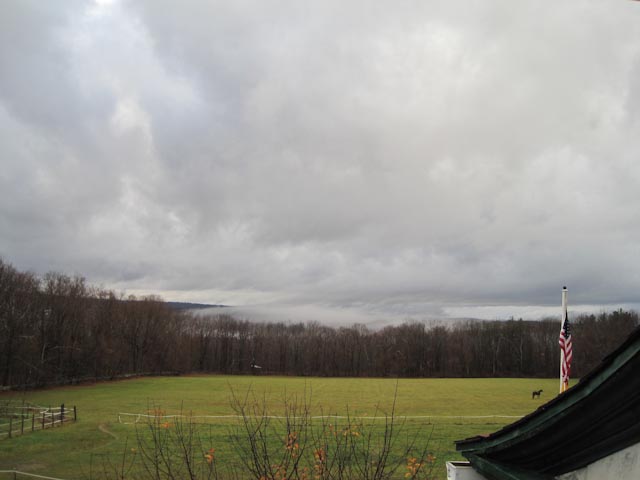
Anyway, a view of the field and forest just after November rain:

Esperanza 1880 Tuesday, Nov 29 2011 

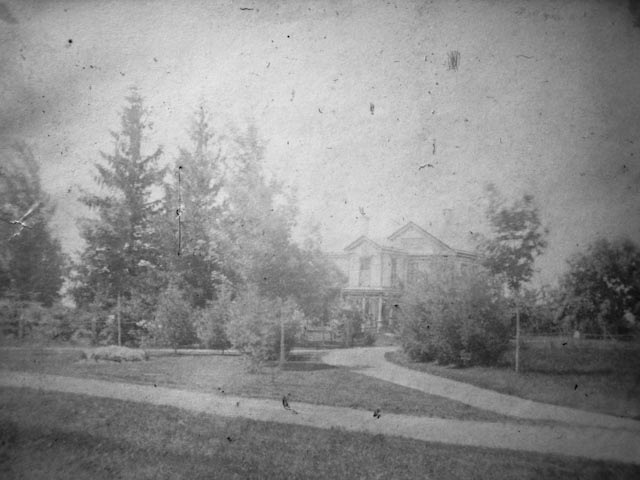
One of the earliest known photos of the house taken in 1880.  The house’s original c.1800 center section is clearly shown in this picture, prior to the 1893 northern addition. The original driveway alignment is clear here.  Today the small dirt road has been moved about a hundred feet farther away (thank heavens) and is now a state highway.  The highway was shifted in the 1930’s when the state took over the road.  The Y entrance no longer exists; the south arm has vanished, though you can find it in the woods with a shovel easily! One of its last vestiges was the location of the mailbox at a seemingly anomalous point half-way along the property’s front line, apparently unconnected to any house, that was finally changed just this fall.  The northern arm has been slightly straightened and extended and is now the drive (the Rabbit Hole).

Obviously the title of Rabbit Hole doesn’t apply yet.  (No I don’t know if it was supposed to refer to Alice or not, I sometimes think it ought)  All that open space is now a fully mature stand of Norway Spruce, pine, maple, and oak.  The taller of the two Norways, to the left, in this picture still stands at 109 feet tall and probably 150-160 years old at the least, since it was clearly well over twenty years old in that photo, so at or before the Civil War.  The small maples you can see in a line going across the Y are now old trees, they are no longer immediately obvious as a line of maples because they are buried in the woods, but once you look it is clear.

Lost Arts Sunday, Nov 27 2011 

Much to my satisfaction, I turned that ash tree mentioned in yesterday’s post into genuine split rail fencing.  Not the greatest job, and it took me a fair bit of time, but I did succeed in splitting several 11 foot sections into four rails a piece.  I have sinced learned a trick regarding the starting wedge placement that should aid future attempts.  You apparently start a wedge in the cut end (just as one would for firewood) and then leapfrog your wedges down the section, this first wedge controls the split better. I hadn’t done that and had problems controlling the angle. You do need at least four good big wedges and having a chainsaw or axe to hand to deal with incompletely split fibers helps.  Have at least one extra wedge hanging about, when the things get stuck…they get stuck.  It also helps if the ground is flat and hard since if the log shifts or bounces you lose much of the maul’s force.

It is also d—ed good exercise!

One Man’s Vision Saturday, Nov 26 2011 

or why we spent the day dropping a sixty foot ash into the pond and then hauling it back out, a task made somewhat fraught by its attempt to swing over into a key laurel bush, jam on the bank, and otherwise hang up.

Why did we take the ash out?  Well, for one it was rooted in the stone wall of the bank; two that it was shading a perfectly lovely black oak; and three…it looked bad.  While the two, much larger, trees (a black cherry and a maple) stood back from the curve of the bank; and the black birch leans far out over the water in a graceful manner; the ash was a perfectly straight pole that broke the curve and stood too close to the cherry disrupting the picture.  It also had a bad top and was thoroughly surplus.  That the long term aim is also for the area to be oak/hickory with a laurel/ilex understory also factored in happily.

Some landscapes aren’t managed by man, parts of the North American north for example, though there a sense of pathos is often created in a piece of artwork (as opposed to the actual experience of being there, when it tends to be an unwanted intrusion) by the careful placement of a man-made structure in the foreground.  Connecticut, however, is much like Europe or Great Britain…man shapes and reshapes the landscape.  Current thought is that even before the colonists, the Native Americans extensively managed the area through the use of fire and hunting patterns. 

Landscape design often deliberately attempts to create something that looks natural, even when it isn’t.  Or that emphasizes certain natural elements and uses man-made elements to draw the eye.  To do this well is fiendishly difficult.  The pond on a lesser scale reflects the same sort of picturesque, shaped landscape that was a signature feature of the movement in the nineteenth century that was best realized in North America under Olmsted’s creations of Central Park, the Boston Fens, Mont-Royal in Montreal and other places.  That it happens that such places can be ecologically as well as aesthetically pleasing makes it even better.  The pond has played host to several groups of migrating wood ducks, teals and mallards, as well as the ever present wood-peckers, the innumberable amphibians, turkeys, deer and many others.  It has healthy , if small, populations of partridge berry, pippiwessa, ilex, laurel, highbush blueberry, three or four fern types, and hopefully will have trilliums, Indian cucumber, native sweet flag and cardinal flower.  By taking the ash out, the dominate feature of that bank (oak/hickory) will hopefully be given emphasis…it is what would primarily occur there anyway, but without any distractions.  The trick is figuring out what counts as a distraction and what is integral, either ecologically or aesthetically.

« Previous PageNext Page »