Tile Drains Wednesday, Dec 28 2011 

Rearranging the drainage of land has an old history.  It was one of the hallmarks of the High Medieval period in northern Europe, opening up hundreds of thousands of acres of former wetlands for cultivation across France, the Netherlands, and Great Britain.  Creating drainage varies from the reclamation of land, taking impassable swamp, as it might be in the fens of England, and turning it into land that is consistently workable surrounded by ditches and dykes or it might be a matter of carefully choosing how to plough so that over time the land drains faster. 

North America also has seen the wholesale rearrangement of drainage.  One of the problems with New England was the combination of rock and water.  The Berkshire hills are a mixture of bedrock outcroppings, glacial debris, swamp, and the occasional hillside and valley of extremely fertile soil.  There is a reason why Connecticut farmers left in droves for the mid-western region in the 1800’s.  The Connecticut valley may have some of the best soil on the continent (now mostly buried under shopping malls) but it isn’t a large area, and the land in the hills requires hard work to even get a usable field.

You can, of course, find those fields.  We have an extremely good small hayfield of about 15 acres.  A west-facing, stepped hillside, the bedrock outcropping is some way from the surface and two centuries of cultivation have reduced the rocks (reduced only, if you plough it the average is about one fist sized or bigger rock per yard…every year).  But, it is also a good field because a big tile drain angles across the middle, draining the upper half.  The lower half has no such drain, and the lowest corner is permanently wet to the point where it cannot always be mown.  Head down the hill another hundred feet or so and the bedrock comes nearly to the surface. 

This drain was put in place sometime in the late 1800’s and takes mostly subsurface water, which would otherwise collect and stand at the bottom of the first steep section of the slope.  This would make about a third of the flattest section of the field unusable.  It is a tile drain, sections of terracotta pipe with open joints, beginning on the neighbouring property and daylighting on the lane where it joins the lane’s ditch.  Unfortunately, the joints have gradually shifted farther apart.  So, I spent today filling the gaps with rocks.  Why? Not for the tractor I assure you.  Rather, for the horse.  A depression might cause a stumble, a hoof-sized hole dropping down six inches to two feet…well, better not to consider it.  It isn’t a permanent fix, but it is better than it was!

Bald Eagles Monday, Dec 26 2011 

Connecticut is on the major migration path for many birds, lots of warblers in the spring, shore birds on the coast, and any number of year round/summer species; but it isn’t really known for spectacular, high-profile species.  However, for the past few years a bald eagle pair has nested on one of the drinking water reservoirs nearby.  These reservoirs are some of the largest blocks of completely undisturbed forest and water in the state, owned by quasi-private companies and off-limits to the public, they are not only drinking water reservoirs but increasingly valuable travel corridors and breeding habitats for animals ranging from the odd moose, the black bear, fishers, osprey, innumerable woodland birds and smaller animals, and the subject of this lay, the bald eagle. Towns lucky enough to have water company land have a good jump on open space, though since it is not formally protected as such, complacency is unwise. 

In any event, we have bald eagles nearby, but not close and not many.  I have seen them to know them only twice in the wild, both times in the same spot, here in northwestern Connecticut, and the second time was today.

I was out doing some yard work and just happened to be looking east as a big male rose up just over the tops of the trees, so close you could see the individual wing feathers fully lit by the setting sun, and went soaring down across the meadow.  We watched him for some time as he worked his way higher and then angled off to the north, back towards the river valley and the reservoir.  The first eagle was on the same flight path earlier this year, so it may well be the same one. I am glad they are back.

On Christmas Day Sunday, Dec 25 2011 

Deep in the woods, the partridge berry creeps amongst the wiry grass and the arched ribs of the Christmas fern; and hard against the frozen ground, the eye is caught by the occasional scarlet flash of its fruit, nestled in dark evergreen leaves.  Having come down the hill, where the emerald moss betrays the small spring even in winter, I looked up at the burnished steel sky and the forest crown composed of clear ink lines against the light.  And there, in the silence, I watched the two hawks, spiral upwards, stoop and dive out of sight on unseen wind.

Dec. 23, 1877 Friday, Dec 23 2011 

From a three page (printed)  letter by Julie to Morris, Julie was spending the winter in Hartford, Morris was in New Orleans overseeing his business, which had not recovered from the depression of the 1870’s.

“I have just come in from church, a good broad sermon from Mr. Burton. Almost everybody is to be saved- perhaps everybody, ‘not a stingy elect squeezed into heaven, making Christ’s redemption a magnificent failure in the eyes of hell’s vast unnumbered population.’ Pretty good doctrine that for a calvinist preacher. These ministers are stirring up eternal punishment a good deal just now, and Mr. Burton takes occasion to speak up his views- and very proper views they are.

Nelly (Helen) is not to act in the great tableaux after all. Mr Ellsworth developed a strong feeling on the subject of his fiancee’s ankles being seen by a promiscuous crowd. They being in a manner his ankles after this. Marie could not be dressed in long petticoats, therefore I retired from the whole thing and wrote a refusal to Mrs. Colt…I laugh internally a good deal, but he is nice- and he is over good true, right-minded boy, and we will have comfort in him.”…

…We have had dinner and Mr. Ellsworth is here. I hear his chuckling laugh, as lighthearted as if there was no care or responsiblity in the world. I wonder how he will meet life?”…

Mr. Ellsworth, was of course William Webster Ellsworth, better known to the family as WWE. Lest one think he was a marionette, the letter has a note appended by his grand-daughter: “Grandfather, WWE, had indeed the most infectious chuckle. His amusement at his own and other foibles was delightful. It continued through his lifetime. I remember his vast amusement, when he was about eighty, at one of his great-grand-children recieving in a report from he nursery school, ‘A for sandpile, and C for skipping with both feet.’ He thought it was perfectly ridiculous.”  He was, at the time of the letter, 22.

Julie’s comment here on religion is fascinating, despite reading through her letters I have not come to a satisfactory decision as to what religion she practiced.  She and her daughters both went to church fairly often, but they did not belong to any one denomination, references to Congregational, Episcopalian, and Catholic practices are all mixed.  Clearly, however, she had little appreciation for the fire and brimstone Protestant branches.

*if you were wondering, Mrs. Colt was the wife of one Mr Colt…best known for a certain firearm…

Reflective Arts Wednesday, Dec 21 2011 

We try to do as much of the house’s repair/maintenance work ourselves as we can; it saves money, I have (fortunately or unfortunately) the time, and I enjoy it.  I probably don’t do enough of it.  There are, to my way of thinking, three types of work arranged on a sliding spectrum of required focus: the intense physical/mental work that demands all of your attention: this might be using a chainsaw or doing research, in either case that is what you are doing, thinking about something else shouldn’t be happening.  If you are thinking about something else, the work is not being done.  At the other end of the spectrum there is the truly repetitive work that needs only minimal attention, not much really falls into this category, if only because minimal attention usually ends up with minimal results, some assembly line work is probably the closest, where the same action is simply being repeated. 

Then there is the middle.  In some cases the work being done is boring and really can’t be improved on, maybe because you have reached the highest level of skill the job needs: mowing the lawn, vacuuming, cleaning stalls…you can only get so good.  You need to pay attention, but not really focus.   Those jobs give you plenty of time to think, observe, work on something else; I wrote many essays in my head cleaning stalls.  In other cases, you can always do it a little better and because of this the job becomes a challenge (eventually the challenge is great enough to move it into the first category).  I encountered the prospect of a mild challenge the other day, reputtying some old, very old, windows that are being used as a cold frame.  Because the glass is old, I wanted to ensure that it was solidly in the frame, so those windows got the same treatment that a window on the house would get.  The added advantage was that because they aren’t on the house, no one will see them, and so it was a great opportunity for improving my technique.  Setting my mind to a task that was not exhausting, but did call for attention to detail, experimentation, and kept my hands busy resulted not only in a pleasant few hours but also let me think about an article I needed to have written.  Doing some chain-stitch embroidery the other night also had the same effect. 

One sort of wonders then, so many times you hear of an author being admired for managing to write despite being busy with their other jobs.  But did their jobs give them the distraction that allowed them to write?  If they had nothing but free time, could they write? (some can and do of course) Julie was a prolific writer, how many of her books, I wonder, were written while sewing?

July 14 1880 Monday, Dec 19 2011 

After the tennis game

This is one of ‘those’ photos wherein identification is difficult.  The man seated on the far right is Morris Smith, Julie’s husband; interestingly, he almost always appears in photos seated and in profile, he clearly didn’t care for informal photographs of himself.  The woman seated in front in the dark dress is Carlotta Norton Smith, with a hat in her lap.  Beyond that, things get difficult.  The guest book does tell us that in the few days before the 14th, William Gillette (of Gillette castle fame), Helen Foster (a close family friend) and two men with the last name of Bartlett, one from Hartford and one from New Orleans so presumably business associates of Morris or friends of Carlotta, came to visit.  It doesn’t tell us how long they stayed.  And there were any number of other people visiting in July of that year according to the guest book….no doubt if I work at it, I will figure it out a bit more…sort of like those infernal puzzles about the girl in the blue house has pet x and the boy with the dog lives in the house of y colour.  (all of which assumes the date on the negative is accurate)

So what else? Well, corsets, bustles and hats were clearly in fashion.  Women’s hair was always up.  Tennis was played with a tie on.  Note the terrarium on the right, a wonderful Victorian piece of furnishing.  Note the impeccable edge of the path and the lawn…  Now, where are we? Believe it or not, they are sitting just about where today the grill is just outside the dining room, where the current east porch narrows.  The porch in the photo is Queen Anne style, and was added in the 1870’s.  It appears to have been at least two different colours, though what we don’t know.*  The porch and the room above it were extended out and above the old, original farmhouse entrance, which was a very simple Greek Revival house.*  The Queen Anne porch had a short life, in 1893 the north ell is built and the east facade gains its current appearance with classically inspired square pillars without ornamentation on the nearly full length porch.  The tree is long, long gone.  It looks like it was a member of the buckeye/horse chestnut family.  Since then an elm, and now a Japanese maple have occupied that spot.

*The choices include Pink.  Slightly unbelievable, but one of the cottages was originally painted in pink and cream…

*This is one of the headaches of the house’s history.  It appears that the facade when they bought the house in 1873 was Greek Revival, an architectural style which is generally dated as beginning around 1825.  However, the deeds and interior evidence firmly date the house to 1805-1810 or 1790-1800.  Why two dates? Well, an 1805 deed doesn’t mention the house, an 1800 and an 1810 deed do.  So? Why is the facade wrong for the date of the house?  What is wrong with the deeds? Something, somewhere is askew in the history.

Windfalls Saturday, Dec 17 2011 

One of the unseen benefits of gardening on a large property is that you can gather many materials that you would otherwise have to buy.  A gardener working on a small urban property can, with care, make excellent compost and a fair bit of mulch; however, other types of material are generally not possible.  Although, I suspect that with a bit more space materials for woven fencing, either from willows or pollarded trees, would be possible.  Pollarding trees is, however, a decidedly labour intensive task. 

That being so, I am rather appreciative of the fact that pretty much every year I can count on a literal windfall: enough pine or other evergreen boughs to cover the garden areas and shrubs most sensitive to winter wind and sun burn.  It does require time, of course, but not much else.  Sometimes it is a tree that had to be cut down, a blue spruce the other year, this year it was pine boughs broken in the big October snow storm, another year it was a thoroughly unexpected pine that snapped in the woods.  It is a very satisfactory feeling to collect from the land what you need, one is perhaps even more blessed if one is in the position to do so, but not in the position to Have to do so…

…now if only I could get the pine sap out of my jacket….

Cloud Shadows Friday, Dec 16 2011 

On windy, partly cloudy days such as today, watching cloud shadows from the house can be somewhat distracting.  One can see the shadow come down across the hill to the west, through the valley, and then sweep up the woods and finally across the field, where the edges of the shadow are sharp and clear.  The woods shift between the purple-brown of the shadow and the gold-brown of the sun.  Bands of light will pick out the tree-tops in the valley below the field, sometimes the west hedgerow will be briefly backlit, each tree suddenly defined.  The varying light not only highlights individual trees, it also makes the change in elevation more apparent, especially when the valley has sun and the hilltops do not.  The landscape, on days like today, is alive with motion and color. Very distracting.

Your trivia for the day Thursday, Dec 15 2011 

Selimus omnium imper Turcarum/ Terribilis sophim vicit ac fugavit cam/ Sonum et tomobeum multis delevit/ praeliis Aegyptu Arabiaq suo adiecit/ Imperio reversus Constantinopolim vl/ cusim renibus contraxit, quod cancris/ in morem serpens eum extinxit Ann/ Regini 7

Got that? U’s look like V’s, everything is capitalized and the right-hand side is missing a centimeter or so, where the inscription is broken off.  It is inscription Latin, which is notoriously weird.  However, a quick and dirty translation runs roughly: ‘Selim, emperor of all the Turks, of terrible wisdom, fought and conquered…with many battles added to his empire Egypt and Arabia and returned to Constantinople. He contracted a cancer of the kidney in the manner of sirpence (a skin infection of anthrax) and died in the year… the seventh of his reign.’

Selimus I was a real person: http://en.wikipedia.org/wiki/Selim_I

He also had a dubious play written about him in 1594 by Robert Greene called ‘Selimus, Emperor of the Turks’.

You are probably wondering what exactly this has to do with the house?  Well some of you may know of the dark painting lurking on the mantle, the guy in the turban?  While cleaning the other day, curiousity drove me to grab a flashlight and figure out the almost illegible writing on it.  The result is above.  Of course, none of that answers the questions of who picked it up and why? I am sort of wondering, given the literary inclinations of the house, if it has more to do with the play than with anyone’s propensity for picking up odd souvenirs of dubious quality while travelling in the Middle East in the late 1800’s.  But I simply don’t know, I do know it has been on the mantle for at least sixty years, but that doesn’t help.

Now aren’t you glad you know all that?!

Mouse Ice Tuesday, Dec 13 2011 

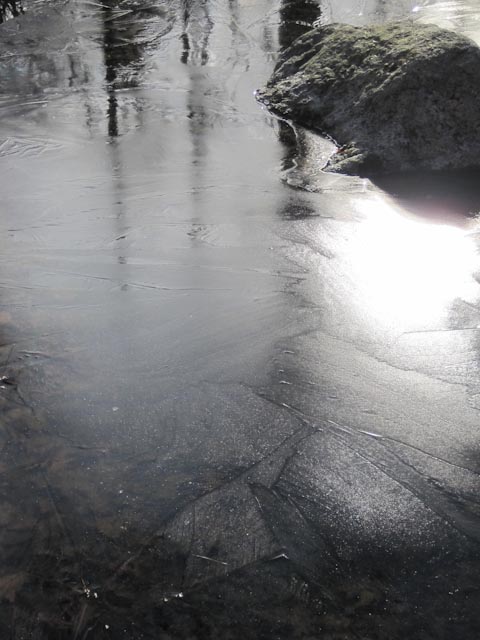
Ice on one of the little ponds.

Ice on the main pond, the spring is in the center right of the photo and is not yet collecting ice.  Not that the ice is exactly thick! Hence the name, though that may also come from the way the ice forms whiskers and patterns. I don’t know if one could ever skate on the pond, it only appears to have the one spring in the corner; however, it wouldn’t be much fun to go through the ice: three feet is quite deep enough. The animals are willing to walk across it in the winter, but a fox is lighter than a man…

« Previous PageNext Page »