Fog break Friday, Jan 13 2012 

The fog broke in a matter of a moment or two, the world suddenly shifting from white, to gold, and then there was the meadow and hills.  As the sun broke through, the clouds appeared, low slung ranks of blue-gray, shading up to white and above them patches of robin’s egg blue sky.  Out of the fog the earth and sky had returned or I had returned to them; they had been out there, of course, but out of sight, out of mind.  The mist blew off the pond, drifting across the meadow, the trees red, grey and the startling lichen green, bright in the darkest corner.  

And then the event was over, the world outside the window was simply a wet January day, the clouds, the woods and the wind exactly as they ought to be.  The sense of wonder passed. 

Such sudden shifts in the world outside the window could be anticipated by watching the weather forecast.  But, somehow to know such a shift is about to occur takes away the vibrancy of it.  Knowing the future in detail takes away from the present and the ability to pay attention to the moment.  Not that I enjoy unpleasant surprises, mind!

Archival Memories Thursday, Jan 12 2012 

A discussion elsewhere on whether or not the e-book had conquered the book for once and all led me to contemplate this library of not inconsiderable size (around 15,000 volumes) and what it can tell us. 

 Books are multi-level artifacts.  The first level is the information within the book, the actual words as they are written down.  The second level is why the book was written and printed in the first place, this is usually bound up in the identity of the author, the edition, and the publisher, is it a reprint, if so why was it reprinted, and so forth.  The third level is the history of that particular book: the amount of wear, the marginalia, any personal  inscriptions, bookmark, sale history: who are the people buying the book, why did they buy the book, why did they read it or not read it, what did they think of it, why did they keep it.  Combined with this and the previous level is the quality of the edition: what is the quality and type of binding, is this a presentation volume or a pocket edition, what other editions of the book are printed at this time; those questions tell us about the wealth of the society, of the buyer, the level of technology, the status of books in the society.  Lastly, the fourth level: the book in relation to other books in the library, how is the library organized, what other books on that subject are there, what are the other subjects, other books of that era, are they mostly high quality bindings or standard, well read or not, written in or not? So forth.

Looking at the library as a whole can tell you a great deal.  This is more obvious with a private library, but public and even copyright libraries can yield a great deal of information simply by looking at the patterns of acquisition.  Esperanza is a case in point: the books greatly inform our understanding of the people.  I can identify several sub-collections, for example: Julie’s books are primarily literature of the 1800’s, and primarily of the Victorian morality rather than the more avant-garde of the era (no Mark Twain, but Harriet Beecher Stowe) and has a heavy emphasis on other female authors.  Most of these books are heavily used.  WWE’s sub-collection is dominated by two sub-groups: well read books on or by poets from the 1800-1930’s, mostly American; and a large number of high quality presentation volumes, most by Century company, not all of those are read, some still have uncut pages.   Lucy’s collection: mostly travel, mystery stories, literature.  Newman’s collection of science and language.  Then there are other sub-collections: travel, art, gardening, history: these subject categories cross over and can be resorted by person, time period, etc.  And so forth. 

For the historian, it is a good thing that this wasn’t all on ebooks…

Snow or lack thereof Tuesday, Jan 10 2012 

Having had Snowmageddon* back in October we now have no snow, on the other hand it isn’t cold.  This isn’t especially good for plants, though it would be much worse if it was very cold and there was no snow.  Yet, it is also an interesting reminder of how plants react to light as much as temperature.  Most trees for example are primarily attuned to daylight length, and will wait for spring regardless of the warmth.  Temperature does play a role, of course, especially in how sap is released; this year will be terrible for maple syrup.  Furthermore, early warm spring once the daylight hours have really begun to shift will cause them to break dormancy.  But fifty degree weather in January doesn’t flip the chemical switch.  Some perennials, however, are attuned to soil temperatures with little attention to light; these are a bit confused and are not quite dormant or are almost dormant.  The hollyhocks, parsley, kale are all sort of still trying to grow.  I haven’t a clue as to whether this is good or bad. 

May you live in interesting times, indeed!

Jan. 7, 1910 Saturday, Jan 7 2012 

From the local news column of the New Hartford Tribune, the source of perfectly delightful gossip.

“Miss Smith, manager of Esperanza Farm met with an accident Tuesday morning while delivering milk to her neighbors. The sleigh turned over near Miss Kate F. Holcomb’s throwing out the contents. The horse continued on its way to G.C. Kellogg’s where it was caught and placed in the stables. The damages were slight. The cold and high winds were severe with zero weather.”

Miss Smith was Fannie, (Julie’s daughter).  What is interesting about this comment is that it conclusively shows that Fannie at least was living here year-round.  She lived in the cottage across the lane.  This parcel, since sold, was the site of successful, model dairy farm run by Fannie.  She was very interested in the science of improving dairy farming and held a voluminous correspondence on the subject with the various state agricultural stations, Cornell University and other institutions.  It must, however, have been something of a change from her earlier career with Steinway (pianos).

Ghosts Thursday, Jan 5 2012 

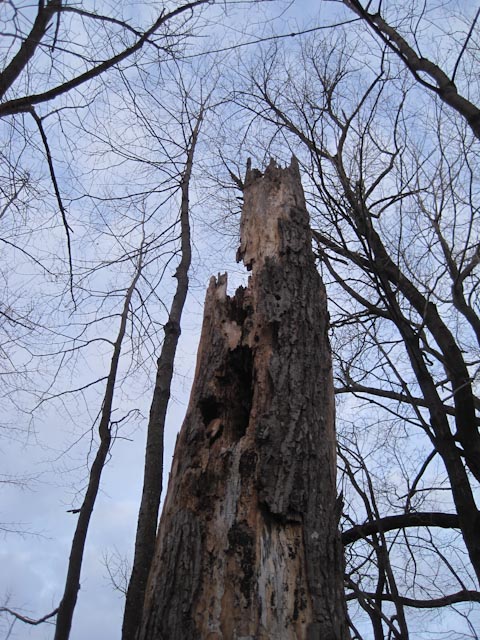
Does a tree make a sound when it falls and no one is there to hear?  As for the metaphysics of that question, I don’t know.  The science says ‘yes’ by the way.  But in any case, a tree does leave an afterimage.  This tree fell many, many years ago and the picture was not intended to show its afterimage, the angle is all wrong.  Yet nevertheless, even decades later, the space where that tree once was remains.  Branches have begun to fill in, but the trees around it were already grown when it fell, and no saplings have filled the hole, and so the image remains.  Consider the tree just to the left of center and the one in the top-right corner and their complete lack of branches on the side of their trunks facing the camera, and facing the old tree.

Pergolas Tuesday, Jan 3 2012 

And the building thereof.  There was a pergola at Esperanza at the turn of the last century.  It had square white pillars, echoing the porches, and appears to have had few vines.  It had as a south focal point the bust of the faun; as such it was more of a structural ornament as opposed to a structure built for the vines first.  It didn’t last long, it was probably built around 1900 and seems to have vanished by 1930.  One of its main uses was in the enactment of tableaux scenes generally of a vaguely classical theme.*

We are contemplating a new pergola on the same location. However, this one is going to be dual purpose: both growing grapes and creating a structural element.  Figuring out how to make it visually work from all angles: the south lawn, the driveway entrance, the house, and built so that it can take the vines is a bit of project.  Part of the difficulty is the house’s outward looking architecture: as mentioned previously the house looks to its surroundings, its rooms are designed to immediately connect to the outdoors and the porches blend into the lawn.  This means that structural elements outside have to work with the house even when they are not physically connected to the house.  Their style must compliment the house’s style.  Sketches have ensued, as has a small forest of poles to determine which edge lines up with which other edge.  I think Photoshop may become involved…

In addition to space for grapes, the pergola will also add an edge to the south lawn, so that beyond it the lawn can gracefully transition to the woods through a bit of meadow grass.  The area has a tendency towards some of the wild flowers already: paintbrush, pussytoes, violets, bluets, blue-eyed grass, wild dianthus, wild geranium, wood sedge, etc. are all present.  But most of the south lawn is formal and structured and simply stopping regular mowing at an arbitrary line looks peculiar.  Yes, shrinking the lawn is a goal too!  Along with the pergola, a replacement for the pear tree will also be planted. 

Assuming we make the transition from planning to reality…always the hard part!

*It is interesting to note that the word ‘pergola’ doesn’t enter the English language until the 17th century.  It is slightly different from the word ‘arbor’ from Middle English.  They essentially mean the same thing; but arbor’s etymological roots give greater weight to the vines or trees whereas pergola, coming from the Italian word for a projecting roof, gives greater emphasis to the structure.  You can create an arbor out of trained living vegetation, you can’t create a pergola.  So, if the vines become more important than the structure (which they will) it should be an arbor, unlike the c.1900 one which was always a pergola. 

*I could write quite the post on the tableaux, a form of entertainment that has vanished quite completely from today’s culture.

Snow showers Monday, Jan 2 2012 

A snow shower is a terribly misleading term, even if it is the technically correct term for today’s weather.  A shower suggests a gentle, passing bit of rain with little wind.  Thanks to Chaucer, it tends to be irrevocably associated with April.  Yet, snow showers have none of his floral, April life promising virtue.  Here in early winter snow showers come racing across the hills; the light blue sky suddenly turning gray, the pines black against the crest.  The clouds promise wind-shear and turbulence, their edges cut and sharp, puzzle pieces of cloud on a blue board.  Sunlight as the cloud moves east, bright beneath the shadow.  These are squalls, gales, flurries, all words suggesting the wind, not showers.

Isn’t English fun?

Jan. 2, 1879 Sunday, Jan 1 2012 

One day early, I know!

In any event, a letter from Morris Smith to William W. Ellsworth and Helen (Smith) Ellsworth written Jan. 2, 1879.  Morris was in New Orleans, while Helen and WWE were living in New York City, having been married the previous year, their daughter, Lucy Morris Ellsworth (Creevey) would have been seventh months old at the time of the letter.  Lucy had married Fred Davis in the fall of 1878.  Lucy and Fred were setting up a household in New Orleans.  The fourth daughter, Fannie, was teaching piano in Rochester, NY. 

“Our good people- Mama (Julie), Carlotta and Lucy arrived today in splendid health though fatigued by three nights travel. They were fully installed in their new quarters by noon- but will not make a public appearance until their baggage arrives- which is now the subject matter of Correspondence with Chicago- I think they will receive it day after tomorrow- in the mean time they are bewailing their experiences and threaten when they return to go by sea.”

Things don’t change!  I do like the capitalized ‘C’ of Correspondence though.

Christmas Cactus Friday, Dec 30 2011 

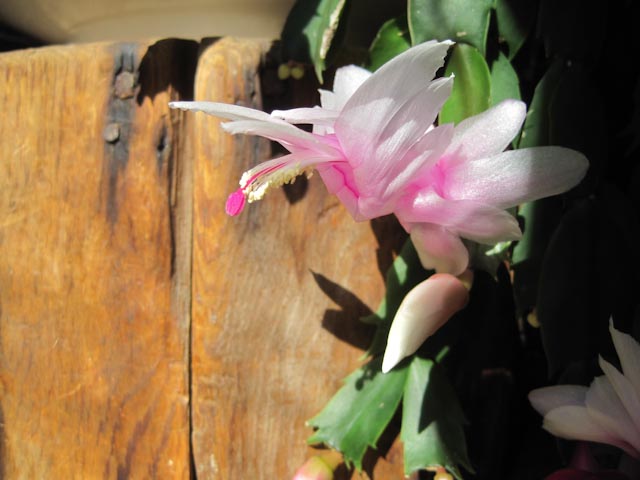
Actually, this one is technically a Thanksgiving Cactus of the Schlumbergera truncata group, as opposed to the S. buckleyi group as shown by the pollen colour, leaf shape, and flower position.  See: http://en.wikipedia.org/wiki/Schlumbergera

We have a very large Christmas Cactus as well, my grandmother had it for years and it now has branches several feet long.  They are ideal house plants, not minding partial darkness, occasionally forgetful watering, and so forth.

Indoor plants are remarkably useful in a house, they add a living touch as well as potentially ornamental/sculptural effects.  They are also an innovation of the mid nineteenth century for the majority of the population, a combination of central heating and the colonization of the neo-tropical regions from which most houseplants hail, including the Christmas cactus group which comes from the coastal mountains of southeastern Brazil.  While the use of southern exposure and walled gardens to extend the growing season and to fiddle the garden’s zone one or two levels dates back to the Classical World, the idea of a Glass enclosed, heated environment wasn’t possible until the modern era.  That a house could have enough light and heat to grow plants which needed longer days and temperatures staying above fifty must have been a revelation for the frustrated gardener.

Your random picture of the day Friday, Dec 30 2011 

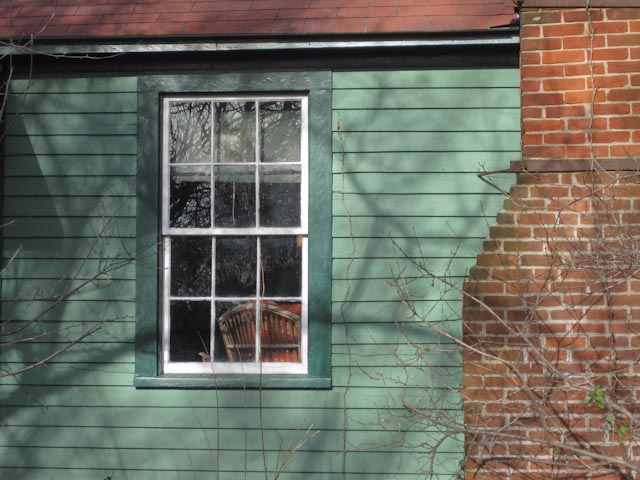
The side of Minnietrost, one of the summer cottages, in winter sunlight.  It was quite a struggle to decide on the color when they were repainted a few years ago.  Appropriately, for the genealogists amongst us, it is Webster Green, a nice subtle grey/green.  Winter light always has a sharper air to it, as if looking through glass rather than water.

(yes that is an iron strap holding the chimney in place…no it is definitely not usable at the moment! someday?)

« Previous PageNext Page »