Man Hours Friday, Jan 27 2012 

Almost everything major in this house, exceptions would be the kitchen and mechanicals, was created predominantly by hand.  Granted, most of the time machine power amplified human muscle power,  for example a circular saw replacing a hand saw, but truly automated assembly has a small presence in the house.  This means that the house and its contents are an absolutely immense monument to man’s capacity to work, even leaving aside the staggering time investment of the creative work represented by the book, music and art collections.  We take our ability to do this sort of work for granted, yet how completely it sets us apart from the rest of the animal kingdom!  To build, to plant, to create and then to exchange those goods for something else, at the root of it creation is our means of survival.  And that has evolved into a remarkable work ethic, I think of the willingness to carve and to paint gargoyles and decoration high on buildings (both religious and secular) which no one, before the era of flight, would ever see, simply because that was how it ought to be.  

This work, of course, is the case with any building, but it is brought closer to the surface when one can find the traces of past work: carpenter’s marks, slight irregularities, or perhaps most impressively when one is faced with repairing something.  I was contemplating this while working on my off again-on again project of repairing the binding of a rug, which requires upwards of ten or more whip stitches per inch, each carefully placed for the correct tension and strength while obscuring as little of the pattern as possible.  Even if you have the hang of it, it simply takes time.  Some of the rugs record previous repairs, in all cases the wear records the pattern of feet, time after time.  And as I repair the rug, I wonder, ‘who was the person who wove it?, what did they think of?, was it just a job that they were thankful to have?, did they enjoy what they had created?, did they wonder about the people who would buy the rug, who lived in a world so very different?’    Maybe they cared little for the rug, maybe they thought it ridiculous (surely some of the carvers of the gargoyles must have grumbled at the architect) but they did it nonetheless, and did it well.  I can’t pretend to grasp what the lives of the people who wove, and still weave, the rugs we lump under ‘Oriental’, but in my repairs, I can, for myself, weave a connection.

The Winter of the Spring * Thursday, Jan 26 2012 

This year, when winter has been a fleetingly erratic guest, though there are still a few months to Spring proper, the signs of new growth have never been far.  I was very glad to see the other day that the crocus (croci?) that I planted last year are beginning to appear.  It was a bit nerve-wracking to plant some 1200 bulbs.  One can’t help but wonder if the shipment was good, since I have had an entire shipment get fried before, and, of course, one doesn’t know till after they are planted, long after.  But it looks like they will come up, probably even many of the ones that my horse stepped on.  (it is slightly ridiculous, I have resorted to spraying Deer-off along the fence, because out of 15 acres that is where he Must walk and eat)

And hopefully, they will look like they ought…though the mutant in the pot we forced has me worried; it is about five inches tall and is a set of white sheathed spears, unfortunate at best.

*Shamelessly stolen from John Greenleaf Whittier’s poem: ‘A Dream of Summer’

Reactionary Behaviors in a Magnolia acuminata Wednesday, Jan 25 2012 

I have previously commented on trees as living records, generally a tree’s growth is mildly affected by its surroundings; sometimes, however, it can be quite dramatic.  The biggest of the cucumber magnolias is such a dramatic actor.  In the woods cucumber magnolia (magnolia acuminata) tends to be a very straight tree, with few small branches low down and a high canopy crown.  In an open area, the tree can be spreading and irregular, generally producing a broad rounded crown.  Think large here, this species routinely hits 80-100 feet in height and in an open area can spread 40-60 feet without trouble.

Our big tree has always had full western exposure, but it has always had trees to the north and east of it.  Currently there are two black oaks, but there have also been a succession of red maples.  Now the tree probably has had some of its eastern branches trimmed off, but it has primarily developed on one side as an open-grown tree, on the other as a tree with competition (if in a generous space).  It has also reacted to the house, which is south and east of it. 

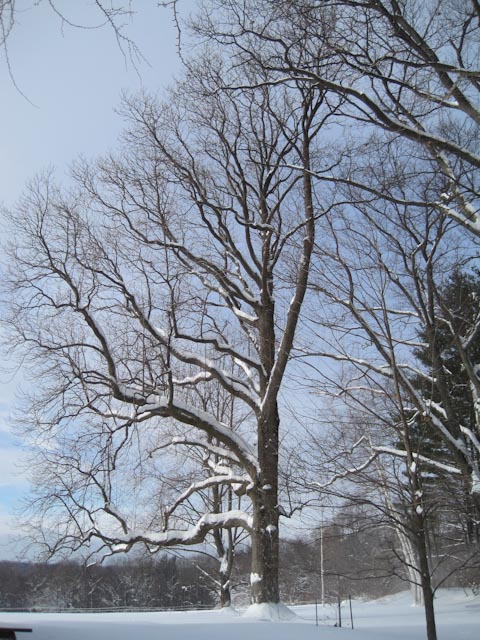
This picture taken this last October’s freak storm clearly shows the magnolia from the southwest.  Here you can see the magnolia’s rounded growth pattern (it has no leaves, the oaks behind it are still in full leaf).  This is the open growth side: spreading branches that reach from nearly the ground (the lowest branch reaches down to within four feet) to the crown, currently at about 85 feet and nearly as broad.

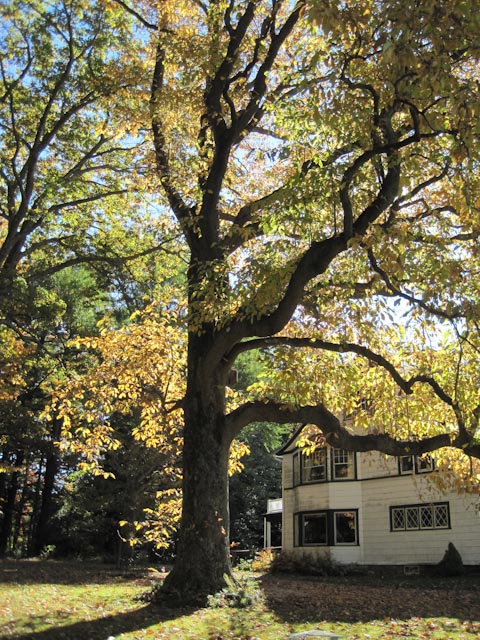
This picture is taken from the east (last winter) and shows the open crown side, but also the tree’s reaction to competition on the north and east: fewer branches and one major eastern branch that did not waste time going out toward the big oak, but rather aimed for the thinnest piece of canopy between the magnolia and the oak.  This branch has since created a topknot effect, punching through the canopy, and reaching about ten feet above both the main trunk’s crown and the oak.

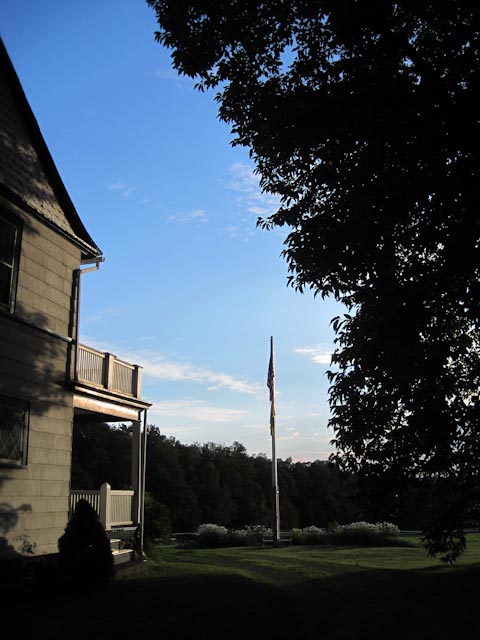
This photo from the northwest also shows the ‘up’ versus ‘out’ behaviour of the two sides of the tree.  Observe the different growth pattern of the main eastern branch and its western counterpart at the same height.

Finally the last picture shows a remarkable growth pattern that has only become evident in the last few years.  The tree has never been trimmed in order to keep it out of the drive, but because of the wind and the shadow of the house you can see how the lower twenty feet are not growing out as fast as the section which is above the house’s roofline.  The tree is now expanding south as much as it is west, but is doing so starting above the house’s roof, since those branches are not being shaded.

Trace sign Tuesday, Jan 24 2012 

While working on a lecture concerning conservation for a garden club, I had occasion to consider soil types.  For many people in suburbia, the history of the ground has little reason to intrude upon their conscious.  The North American appetite for the bulldozer means that most house lots created after 1950 have been regraded with topsoil taken away and/or added.*  This tends to create a uniform surface, the whole lot is one type of soil.**

However, Esperanza has generally lacked in the bulldozer department and it also happens to have a rather large lot and a fairly complex history.  This history is recorded in the soil and does not vanish.  The soil is predominantely a heavy clay till with a good scattering of rocks.  However, there are other pockets. The old abandoned road-bed is a compacted sand/gravel mix, well draining and low in organic material, despite the surrounding area growing up to trees this road-bed remains open. On the other hand the two old tennis court areas demonstrate very different tendencies. The most recent one is a fast draining sand/clay mound created artificially and abandoned circa 1930, that has happily regrown as pine trees.  But the early one was a packed clay court, probably created simply by rolling the native clay, and it reverted to Norway maples and multiflora rose, both invasive species capable of dealing with that type of compacted clay.  It continues to be a difficult area to grow plants on, despite over a century of organic material having been laid down.  Elsewhere, the less disturbed soils tend to revert to oak and birch, with cherry, red maple, and cucumber magnolia also appearing.

And then in the hayfield…the two ploughed sections, the horse’s paths, they will probably continue to show up on Google Earth’s imagery for decades.


*yes, I actually saw one house lot where the builders took away the soil, and the house-owner later (no doubt at great cost) re-imported soil.  Someone’s genuis at work there.

**For those of us with a bent towards archeology, it is also somewhat worrisome: one bulldozer can, in a matter of minutes, remove thousands of years of stratigraphy, leaving one with a blank slate, no doubt appropriate for today’s culture.

Jan 23, 1854 Monday, Jan 23 2012 

From Julie to Morris; Julie was at Red Cottage in Brockport, NY, Morris was in New Orleans; taken from a letter that was some forty handwritten pages long (surely some sort of record) though some pages have gone missing.

“It is a very cold evening, no soft southern breezes fan our cheeks with perfumed breath, no flower odors greet us, no rich green leaves wave and whisper and nestle; but the fierce wind rages and roars and sweeps along with majest. It is very cold. Courageous is the soul that ventures abroad this day. I shall sit by my ain fireside, that is to say my own stove (what a miserable substitution as far as poetry is concerned) and sew, ‘stitch-stitch-stitch-gusset and band and seam’.

Lottie is in her waggon playing with divers and sundry odds and ends such as half an apple core, a bit of shingle, a tin cup and such like. They are just as pleasant to her as if they were worth solid gold. She is in a very conversable humor and says constantly, ‘Ajax-see there!’  These two words being her stock and trade in the conversation line.  Where she made the acquaintance of the said Ajax it is impossible for me to determine. I suspect however he must have been an adorer of her’s in some former life away back in olden times when the world was young. Perhaps she helped him ‘some rocks vast weight to throw’. Perhaps she walked and talked in the sweet moonlight with Clytemnestra, before she did the fatal deed which wrote her murderess. I often think there is a deep spirit in her dark eyes, which we cannot fathom.”

Set-piece or collection? Saturday, Jan 21 2012 

Having spent the morning in a lovely Arts and Crafts home, in which most of the furnishings match the style, I got to thinking (again) about one of the oddities of this place.  There is a strong sense of continuity on one hand: that of ownership, so the house has a closely linked textual and visual history and context.  On the other hand, the house is a evolved structure.  It was not built of a piece: there are four distinct expansions and modifications, none of which completely erase the previous layer.  The one possible exception is that the exterior, true Queen Anne Victorian facade was removed and replaced with an early Shingle style, but the interior Queen Anne style is still findable.  The furnishings are equally layered.  They all belong to the same family, but the range spans almost two centuries, multiple styles and at least three very different regions.  The house is not in the style of x, nor furnished in the style of x. 

This may be part of why the immediate reaction of the visitor is that it has a museum-like quality.  Museum furniture collections tend to show a wide range of style, taste and time period.  They are not of a piece in the way that historic houses tend to be. 

This gives a wider opportunity to tell a multitude of diverse stories.  Each piece of furniture is a hook to a person or a place in a different time period.  It does mean that telling a single story is harder, unless that story’s line is dominanted by change over time.

Random photo Thursday, Jan 19 2012 

Sunset at the pond.  One of the things that is so intriguing about the pond is how it is set: the drop to the south-west is so great that it almost hangs on the edge of the hill.  The location was chosen for the consistent spring, running at about 5-10 gallons a minute for at least the last 140 years; but the hill is also important, by building the dam up, so that the spring is at the highest original elevation and enters the pond at the original ground elevation, (the spring is in the far NE corner) rather than digging the pond down, you get a much greater sky/water effect with far less earth in the view.  Had they built the pond primarily east and south of the spring, the effect would have been lost because the hill’s slope would not have been turned into a vertical drop and so there would have been hill in the foreground.  This way there is water, a thin strip of land, then a distant hill and the sky.  It must have been quite startling before the forest returned.

Gripes about weather Tuesday, Jan 17 2012 

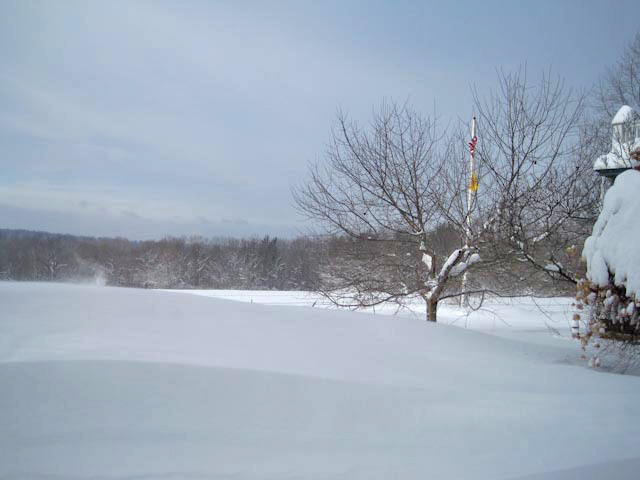
There is perhaps, if I am generous, two inches of snow on the ground right now…in comparison consider this picture taken January 15, 2011…


That is a drift, something over four feet tall, you are looking at.  The lawn is actually sloping down, and the picture is taken looking straight out from a porch which is about two feet above ground level.  Overall, non-drifted snow was about two feet.  It isn’t much snow in comparison to some areas of the country, but a fair bit for here.

Climate change science may have its complications; but, whatever it is doing, extreme weather patterns seem to be part of life.


On Choosing a Plant Monday, Jan 16 2012 

It being January, I am naturally flipping through a stack (it really is a stack) of plant catalogues, with the added dimension of surfing a series of garden websites.  The number of plants I would like to plant is rather large, the bank account not so large, and so a selection process occurs.  In the process of that, I am also considering why I want this plant or that plant.  What is that attracts me to it?

Two things it seems.  The first is a strong desire to re-establish as many native species as I can.  This was an almost reasonable urge when I was eyeing trees save they take a great deal of space and take quite some time to grow, having gotten intrigued by the woodland herbaceous types….well.

The second is a more complicated one: that is the history of the plant in relation to man.  Names are the beginning of this: if a plant has succeeded in getting an intriguing common name it is of more interest to me than if it is still a straight botanical name.  In this I betray myself as a humanities scholar and not a botanist; this means that Trillium recurvatum, aka ‘Wood Lily’ or ‘Bloody Butcher’ is more interesting than Trillium pusillum, aka ‘Dwarf White Trillium’.  Both are equally elegant natives, therefore attractive on that alone, but the former’s common name suggests a longer human awareness of it.   Plants such as Goldenseal, Mayapple, Solomon’s Seal, Shooting Stars, the list is endless, are not simply beautiful natives; they are also living reminders of the rich relationship man has had with the natural world.

This interest in the human/plant relationship is not limited to names and botantical folklore.  Art enters into it: I am eyeing a perfectly lovely double columbine called ‘Ruby Port’.  Why? Because it is precisely the same flower as shown in an illuminated manuscript from the late 1400’s.  I have a thing for the medieval plants; but I also have an interest in the plants of the late Victorian period.  Why? Because they are, dare I say it, ‘period correct’ for the landscape….of course, it also is an excuse to sometimes go after the eye-catching Asian species!

So can one come up with a healthy, primarily native plant landscape with accent plants of medieval European and nineteenth century American garden heritage? Well yes, but knowing that doesn’t help me narrow the list down…grr.

Mid Jan. 1877 Saturday, Jan 14 2012 

From a letter by Julie to Lucy, Julie was in Hartford but it isn’t clear where Lucy was.

“We have all finished Mark Twain’s new book- it is very entertaining- but not very high toned- not such a book as I should think he would want his little girls to read.

…Carlotta is reading Dickens. Mattie Kilbourne is coming here this afternoon. I do not like Mattie Kilbourne very much. I can’t go out driving this afternoon because- the snow has melted so as to let the horses’ legs down through and I am afraid they would break off and leave me nothing but two bodies on top and I don’t much like bodies.  Now here comes a dun. I have paid the bill, it was not an honest bill but I paid it and I hope the money will bring Mr. Linus Fern into trouble as I have no doubt it will.”

This is a rather interesting letter on several accounts.  It comes from a group where money, 1876-77 was overall a bad economy, was a constant concern and colored the correspondence.  What is particularly interesting is the overall tone of the letter, despite being about two pages long (handwritten), the letter has a stream-of-conscious style which is very revealing of Julie’s mood throughout the day she was writing it.  Her ‘voice’ is very clear.  Unable to get anything written but letters, she was also feeling trapped by Hartford’s society demands and, physically, by not being able to get out thanks to the weather.  A whole paragraph states how she would prefer to be at Esperanza.  Lucy was essentially a confidant for Julie for more personal matters than the letters to Helen or to Morris; Lucy was in frequent correspondence with her mother and the first section is social advice from Julie on how Lucy might select a proper gift for Mrs. Davis (Lucy’s future mother-in-law). 

This sort of letter has almost entirely vanished from the current record, the phone has replaced the ‘sounding board’ aspect, email the social advice aspect.

It also neatly summarizes Julie’s attitude towards literature.  I do wonder what she would have thought of the modern television show….

« Previous PageNext Page »