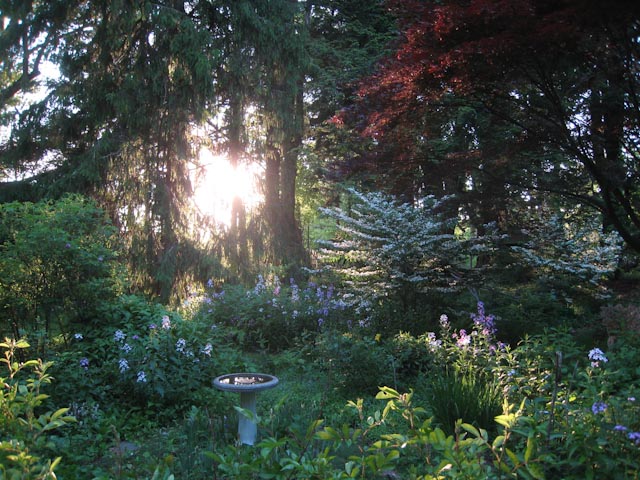
It sometimes seems incredible that in three months time, images like this will be commonplace around here. Especially this year, when everything is dry and brown. Waiting, impatiently!
That picture is a corner of the north garden.
gardening and Modern Photos 07:31
It sometimes seems incredible that in three months time, images like this will be commonplace around here. Especially this year, when everything is dry and brown. Waiting, impatiently!
That picture is a corner of the north garden.
Projects 13:25
Furniture repair in a house is an ongoing process, and for me a learning curve. The first rule is, as in the medical profession, do no harm. Figuring out how the piece was originally built, with what, and how it is supposed to work are the first steps. Patience and the proper tools are also critically important. And then, prompt repair: if you have the tools on hand and something breaks you can fix it immediately, reducing further damage, loss of broken parts and growth of the attic of broken furniture.
So in the last few days, as I am working my way through the house cleaning furniture, I have also had fixed (I am not the furniture fixer) a rocking chair and a massive veneer failure on a sideboard. The rocking chair had been a slow failure of two previously fixed breaks in the legs and rocker. Theoretically it could have continued to be used in its wobbly state, but by repairing it we don’t have to warn people to be careful (never something one wants to do). The veneer was a potentially more disastrous failure: an entire drawer face split in diagonal cracks. Because the veneer is a flame pattern and matches the other drawers, replacement would not be possible. So the careful application of glue and clamps for a full 24 hours was undertaken, which looks like it will solve the problem. Unfortunately in both cases the problem will reoccur. All of the sideboard’s veneer shows the diagonal stress, indicating a stress built in to the original attachment of the veneer. The rocker is weakened by a rather kludgy fix early in its life (about a century and half ago).
I liken it to a an olden wooden ship: it floats just fine if you routinely fix the leaks. Still it is nice to know that both fixes will allow those pieces to remain in use for another few decades.
Comments Off on A Stitch in Time
Modern Photos 13:02
Connecticut is 68% forested; consequently finding a decent view of the countryside is complicated. One can climb all the hills one wants…and not see anything aside from trees. The exceptions come from either manmade clearings (roads, house lots, towers) or from the rare rock outcropping. This is a view from the latter, looking north of east down the Farmington River valley as it winds through New Hartford. Esperanza is off to the right of picture, outside of the frame, on the range of hills that forms the horizon line on that side.
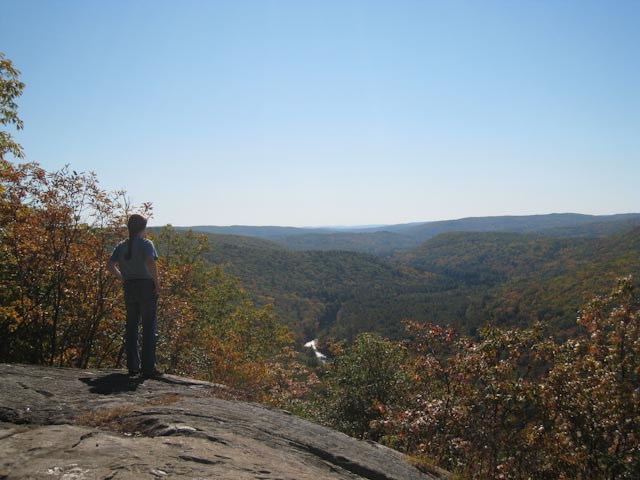
Connecticut will never win any points in the ‘My home is more rugged than yours’ contest*; but this picture does give a good sense of what the landscape is like: not flat, if you are walking across it the constant small up/down, stream/rock/tree is surprisingly time consuming, and despite being the third most densely populated state, comprised almost entirely of small private landowners, astonishingly full of trees. Those trees hide a great many sins of course, as they tend to obscure the amount and spread of development. The picture also points out precisely why rivers are the main highways of early exploration. The Farmington is not a big river, but for a guy with a canoe it would be much faster than the hill/swamp/tree/rock dance.
*One of the more fascinating, and irritating, characteristics of American culture is the macho point-scoring of the contest, ‘because I live in either a) a ‘harsh’ environment or b) city x I am a stronger/better person than those who have not had enlightenment, namely you.’ To be fair, it may be a colonist thing, I have known Canadians, Aussies, and Kiwis to indulge in it as well, but never quite so consistently and arrogantly. Europeans take the tack of ‘I am living in the place where the Enlightenment happened, therefore…’ so perhaps I ought to chalk it up to human nature.
Esperanza 10:49
The valuation of antique furniture these days tends to focus on original condition, thanks, mostly, to the rise of shows such as Antique Roadshow and to the rise of investment collections, that is antiques bought and sold because of their value rather than their personal appeal. If it isn’t ‘original’ and/or in ‘like new’ condition, a piece of furniture is substantially devalued. I could discuss the rather interesting psychological and economic drivers behind this preference for original purity, but I think it better to leave the philosophy aside. Suffice it to say that it seems to be driven more by status concerns and less by personal preference.*
In any event, it was rather nice to be at a well-known house museum (Hill-stead) the other day, where I am training to be a docent, and to have a sane discussion of the history of furniture. The furniture there is primarily in the Colonial or Colonial Revival styles, a fair amount of Sheraton and Chippendale influences; most of the furniture is from the nineteenth century but there are some fine 18th century French and late 17th century English as well. What is strikingly different from today’s antique collectors is that the Pope family was quite happy to buy a late nineteenth century reproduction to match an original couch or chair of the style they wanted, to buy pieces that had been modified with added carvings and embellishments, to re-upholster pieces, and so forth. In other words, while correct style and quality of workmanship were of paramount importance, ‘original’ was not important. There is more than one piece of furniture there that has been modified, sometimes heavily, over the centuries, according to taste, needs of repair, or changing function. This is to be expected when the items are, for lack of a better term, working items. Today, of course, because the house is a museum the emphasis is now on preserving what the pieces looked like when the Pope family lived in the house.
The incredible mish-mash of furniture in Esperanza also reflects the concept of working furniture versus collected furniture; though, it lacks the same coherency of vision, since it was not put together by one person and only used for fifty years. Much of the furniture in Esperanza, as in Hill-stead, has little value in and of itself, if valued on the antique investment market. However, the pieces and the collection have great value as a descriptive picture of historical styles, tastes, and uses of furniture. Unlike Hill-stead, they remain in use. This tends to appall both the investment type and the museum curator type, as for both antique furniture is too precious to use. It would however, make a great deal of sense to the majority of people before the late twentieth century.** Does it mean that the monetary value of the furniture is reduced? Yes. Does it mean the furniture is more fully appreciated and understood? Yes.
*I might also suggest strains of idol worship, ancestor worship, poor self-esteem, and elitism; in a more charitable mood I might suggest a strict adherence to the rational definitions of historical accuracy.
*Of course, one does have to have a little bit of common sense: throwing oneself into a chair, eating on a couch, or putting shoes up on a piece of furniture is verboten, as is picking a piece up the wrong way and so forth.
Comments Off on Value Judgements
Uncategorized 10:46
One of the issues that runs along with a property of any size, especially a property bounded by a state road and divided by a town road, is that of trespass. It is exacerbated by the fact that the pond tends to attract people and the town road has no other houses on it. While I would like the public to be able to enjoy the view from the road (indeed my horse and the pond both have local fan clubs), I take exception to odd behaviour late at night.
However, while I am passing friends with Mr. Smith and Mr. Wesson, I have no intention of confronting unknown numbers of unknown individuals in the woods when there is no imminent threat to my person or property, a matter of good sense and legal behaviour. Consequently, last night at about midnight I called the cops, seeing as there was a flashlight being waved around down by the pond in the oddest of fashions.
The state trooper dutifully came along after a time and requested that the individual proceed upon their way, which they did. He then came and asked me if I knew the person, who claimed (bear in mind it was now well after midnight) that ‘he was checking the lines’. This latter statement was said with some puzzlement. I retorted that a: I had never heard of the individual in my life, and b: who in their right mind checked maple syrup lines at midnight, full moon or no?
Assuming that was the end of it, and rather annoyed by the fact that somebody would attempt to steal the sap lines (not surprised…they aren’t cheap), I went to bed. This morning, however, my neighbor to whom the lines belong called all apologetic. It seems he had gone down to the local coffee shop this morning and was immediately accosted by everybody there, all of whom wanted to know what his partner’s son had done and what had been going on up on the hill last night? Poor man, I hadn’t called him yet. Police scanners are, of course, something of a hobby around here.
It turns out that the person in question had actually been checking the lines. The owner had asked him to, and he said he would after work….neglecting to mention that his shift didn’t end till 11:30pm. We agreed that no sane individual checked lines at midnight and I have added another name to my mental list of accepted people.
So a slight round of embarrassment all round, a good bit of gossip for the town, and a reminder that the house has eyes on that bit of road, no bad thing.
Comments Off on ‘He said he was checking the lines?…’
Historical Events 14:23
The vast majority of the correspondence over the years between Julie and Morris tended to be primarily concerned with necessary information, how the children, the business, the finances were doing, or the day to day activities. Very few letters are strictly emotional, though many will have one or two flying sentences. Only rarely is the entire letter devoted to it.
In the winter of 1878 business was not especially profitable and Julie was still living in Hartford, liking it less than ever, but busy planning Helen’s wedding. It may have been this that spurred a set of letters reflecting the strength of Morris and Julie’s, often long-distance, marriage.
An excerpt from Morris:
“I don’t believe that you will be satisfied till you see me, that I still love you, that the charm you bound about me years ago still holds. Wait a few short months and you shall judge. Perhaps it may do some service to say that I love you more than ever, which is the case, for I have not a thought or plan in which you are not dominant……
(description of the practical and the loving sides of their marriage)
….Have we not been through all the changes, from poor to rich and now again to poor and all with increasing fondness. Brockport to New York, Hartford to New Orleans, Chestnut Street to Carriage and Horses, and now to Esperanza with its quiet, its trees and sunny hillsides and one day we will sleep together in its quiet church yard, away from all the turmoil and strife of the world, you and I together. Lately I have often thought of this and Dear Julie, my wife, my love, my trust, I have no other wish but to be with you to the very last. I love to see you, hear you, to be sensible that you are by. Good night darling, you have my never dying love.”
Morris.
Esperanza and Historic Photos 16:38
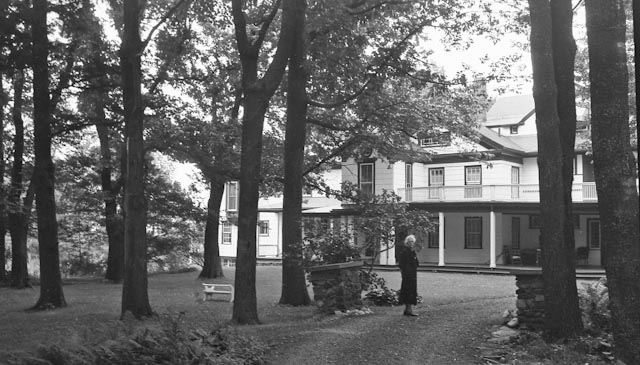
(no I don’t know why the picture is that small, probably the negative scan) In any event, a view of the east lawn circa 1935, possibly a bit later. It has to be after the mid-1930s because the house is sporting its white, asbestos shingles which it still has but perhaps not so Brightly white. The pines just to the right of the right pillar are still standing, as is the big Norway spruce (the tree second from left); they are a bit fatter today. All the other trees are gone, replaced with others. However, the stump remnants of several can still be found (the stump/hole of the one by the left pillar is forever tripping me) The fringe tree, the shrub in front of the left pillar, is still extant. As is the bench. The pillars, leaning rather alarmingly in this photo, were rebuilt in the 1950’s. The woman is Helen Yale Ellsworth, then in her 70’s or so.
It is interesting to note how the landscaping has changed, at that time the lawn was very, for lack of better terminology, much a lawn, kept short and coming farther out under the trees. Today, there has been a revision to a wilder look. This was partly due at first to the simple fact that if you stop cutting the forest down here…it grows back; today, however, it is a stylistic choice. While I appreciate the aesthetics of the lawn, the fact that a lawn is a monoculture of an invasive species just puts me off. I like my violets, my Indian paintbrush, mosses, ferns, ad infinitum, much more interesting.
gardening and Landscapes 18:16
Landscape design appears to revolve around the point of visual aesthetics. However, as any good gardener, architect, stage designer, etc. can tell you function trumps beauty. They can coexist, of course, as equals; but if it doesn’t work…you probably ought’nt build it.
Well, ok, but what does that mean? For landscape design around a house* it means several things: first, all sides of the house need to be accessible with a long-bed pickup truck: that means a path eight feet wide and at least eight (ideally ten) feet tall that is driveable. No retaining walls, no low limbs, no shrubs. The path can be meandering, but it needs to be there. Why? Because someday the roof will need to be redone and they will need to put scaffolding up. You don’t need access to all of the side, but at least to a corner.
Secondly, all garden beds need to be accessible with a small lawn tractor, they also need to be designed so that the radius of curves and the widths of the paths are at least the width of the lawn mower…not an inch less than the width.
Third, emergency vehicle access (also the same as UPS truck access). Yes that may be a very pretty tree limb romantically stretched across the drive. However, it will be a pain if UPS refuses to scratch up their paint job and drops the package on the roadside, it will be more than unfortunate if it blocks the fire engine.
There are other things of course….
But the above explains why I spent some time carefully trimming the River Birch, the climbing Euonymous, the Burning Bush, the Wayfaring tree, and the Cucumber Magnolia along the drive…in order that the UPS truck would cease its peregrinations upon the lawn…only to watch them stop by the road (at least they walked in with the package though).
* Please note, I am thinking a house of this size and complexity…a small bungalow or ranch may well be a different proposition.
Comments Off on Ease of Access
Historical Events 10:40
Historically, the house has sometimes been known as ‘Esperanza Farm’. Today this title is not used, as the hayfield (as decent a crop as it is by Connecticut hay standards) is hardly a central point and certainly not an economic one, though its existence does save us around a thousand dollars annually.
However, time that was… During the late nineteenth century and through WWI, the farm made a decent income for itself. Morris states in an 1874 letter that he has just instructed Mr Beaney, then the winter caretaker, to sell the potatoes…all hundred odd bushels of them. While again, not much by modern standards, a hundred bushels is a respectable amount to have produced on a hilltop farm. Unfortunately, he doesn’t record the price. But it is safe to say that a fair number of people in New Hartford ate potatoes from Esperanza Farm. Potatoes are mentioned other years, as are the sales of pigeons, vegetables, and later dairy products.*
Esperanza Farm fit into a class of farm to which modern agriculture owes a certain debt. These were farms run by people whose wealth came from other areas, but who had a deep interest in farming. Today we tend to call them ‘hobby farms’, but in this turn of the century era, that title is incorrect. For one thing, they added substantially to the local food chain and made actual money doing so. More importantly, in the overall scheme, they could afford to take risks and to experiment. They were interested in the science of it. It was this type of farm that supported, especially politically, the rise of science in agriculture. The nineteenth century subsistence farmer, amongst whom I include those whose entire capital got sown annually, could not risk an entirely new concept nor did he have the time, money and stock to selectively breed for improvement. In many cases he wanted to, but could not afford to until the risk of the unproven had dropped.
Esperanza Farm was not, as far as I currently know, ever closely connected to any of the cutting edge developments; but it was definitely a part of that movement. Were such farms those of hobbyists, dilettantes, dedicated amateurs, foolish risk takers, capitalist innovators? Depends…
*Project: dig through the odd ledgers hanging about for more info…
Trees 22:07
I have always thought that topiary animals are a bit bizarre, actually to be correct I think they are a bit creepy (especially giant rabbits for some reason)* However, I can see how the challenge of creation would be rather appealing. Trimming any tree or shrub is a very slow form of sculpture, what you do this year will affect the coming years and every single cut eliminates certain growth patterns permanently. You can’t glue the branch back on. Now in trimming an apple tree (today’s pastime) such a mistake is less a mistake and more a choice, since hopefully one is choosing the healthiest branch or simply choosing between two fairly equal branches. The goal is less about aesthetics and more about the overall health of the tree; though I am as concerned about aesthetics as I am with the apples from this set of trees, which is part of why it takes me forever to trim them. However, imagine making a mistake about a prospective topiary giraffe, how frustrating it would be to end up having to decapitate it a decade into the project because you choose the wrong branches for the neck! Though I suppose you could create an okapi out of it…
*weird recollections of Monty Python perhaps, though that rabbit was normal sized?
Comments Off on Topiary
 Acair Fearann