Through the black hills
The sun burned down
Into the darkness of night
The beaten disc of fire
Thinner than the gold
Of forgotten empires
Was gone in a heartbeat
And time turned towards time
Comments Off on Random scribbles
Uncategorized 22:51
Through the black hills
The sun burned down
Into the darkness of night
The beaten disc of fire
Thinner than the gold
Of forgotten empires
Was gone in a heartbeat
And time turned towards time
Comments Off on Random scribbles
gardening and Yellow Mountain 13:40
We finally got a few inches of wet snow on unfrozen, bone dry earth and the temperatures have meant that much of that snow has soaked into the ground. This is particularly evident in areas with leaf, grass, or other organic litter. Field grass, which was desiccated, has been softened, its light gold color picking up some deeper brown and ochre shades. The same effect has occurred in the woods: walking in the woods a few days ago was a noisy exercise, more reminiscent of mid-fall, today the rustle of leaves is muted and replaced with either the muted footfall or the crunch of ice.
Late winter or early spring snows on partially thawed ground have long been called the poor man’s fertilizer. It turns out that there may be some validity to this, as (if the conditions are precisely right) the moisture and possibly some of the nitrogen compounds carried in the snow may be leached into the ground in a slower and more effective fashion. Certainly, several rounds of spring snow is better than solidly frozen ground, large amounts of snow, and then an abrupt, fast thaw. But that may have more to do with the amount of water which is effectively absorbed into the ground rather than running off, and less to do with the chemical compounds in the water. Still no matter the science, the ground today has a kinder feel.
Comments Off on The Poor Man’s Fertilizer
Trees 10:44
Yesterday, the raven watched the wind rise across the western hills. The crows in their discontent circled below him, before leaving for the pines. From where he sat, unrivalled, he could see east as far as Avon Mountain, some 15 miles; south as far as the horizon line would bend; north up the valley to Massachusetts; west to the slowly rising hills of the Berkshires, as far as Norfolk, another twenty miles.
He was, of course, sitting at the very top of the greatest of the Norway spruces, some 109-110 feet tall. That the tree sways like a ship’s mast doesn’t seem to bother the birds. It is a favored perch for the crows, but when the raven is there he is utterly unmistakable. Much too big to be a crow, he (or she) is also a slightly different black, somehow deeper or richer in color.
Someday that tree will fail. Repeatedly struck by lightning, it also bears the full brunt of the wind. Its top thirty feet, where it is fully exposed above the other Norways, is thin and ragged, as would be expected in a tree of that age and height in that location. But for the meantime, the birds will watch the sun.
Esperanza and Historical Events 11:06
“Young people liked to go to that house in Edwards Street (Hartford), and liked to be invited to the family country home, known as Esperanza. Yale boys were apt to spend a week or two there when college was out, the latter part of June, and there were always girls to go around. Picnics, rowing parties on West Hill Pond, straw rides with the oxen to draw us, private theatricals, charades, horseback rides, general good times kept us busy. All this was before what we know as weekends, and Mrs. Smith was criticized for inviting girls and boys together. Only the guest-house, Happy Thought, where the boys lived, saved the situation.”
That description comes from William Webster Ellsworth’s recollections of his first introduction to the family in the summer of 1876. The gaiety of the college summer parties were a fairly short episode, really from 1873/4-1878. Between 1879-1881, the summer parties still retained the core of the group drawn from (as WWE refers to them elsewhere) the ‘Yale boys’; but with Helen and WWE married, things naturally began to change. Summer parties came to a near stop following Lucy’s* death in 1881 and then picked up again after Julie’s death in 1883. They were now organized by WWE and Helen, and were mainly friends from the publishing, theater and art worlds. The range of activities remained the same, but with an ever greater emphasis on the performing arts, which seem to have been Helen’s passion.
This passage is also very interesting in regards to societal roles; and the more one considers it, the more complicated Julie’s position on the role of women apppears. It is no wonder she didn’t get along with Hartford’s society. However, one should not overstate the radicalism. Julie was always at great pains to advise her daughters on proper behaviour, and dearly wanted all of them to marry; furthermore while she laughed at Morris’ concerns over proper dresses for the girls, she did not think he was wrong.
Of course, one also wonders what New Hartford thought of all this…
*Lucy Smith Davis; Julie’s youngest daughter, died in February 1881 following a long illness probably connected to childbirth complications. Julie never recovered.
Historic Photos 11:59
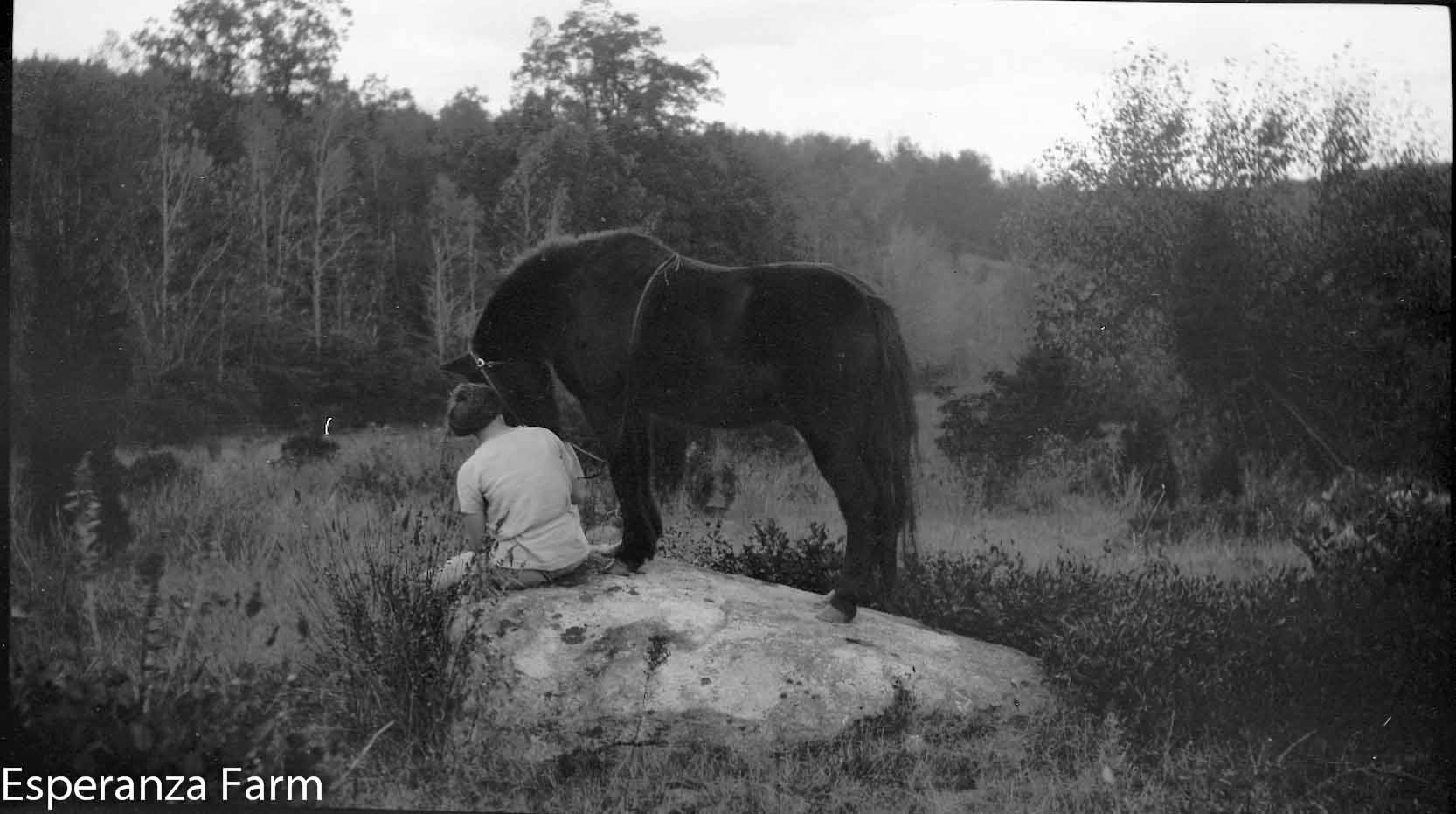
Eileen Creevey Hall and one of the black ponies, Nip or Tuck, in the fields below the Royal Oak. Taken from a negative scan of a set of photos long forgotten.
The picture was taken late in the 1920’s, so it was whichever pony was still around at that time (help Jamie or Betsy?). They were much loved by Eileen, who still spoke fondly of them eighty years later. They had been bought as a perfectly matched pair, the classic little black welsh pony type.
Comments Off on A Girl and her Horse
Esperanza 17:02
Esperanza has a large (very) book collection; it also has a large collection of artwork. Every reasonably available bit of wall space is used, and the amount in storage is close to double that. The multi-generational, eclectic nature of the artwork makes it very hard to categorize. Consequently, every bit of information helps. One of the issues with an historical collection is judging the significance of a piece. Unlike an art gallery, where the primary significance is based on the piece’s own quality and its relationship to other artwork, that is: art history and art criticism, art in an historical setting may be judged on a different set of priorities. Questions such as when it was bought and by whom, where has it been hung or not hung become more important: that is, the relationship between the art and the response of people to it.
Important pieces of information, therefore, can be found in old inventories, photographs and other written documents such as wills or letters. Some historic collections are relatively static, in that the collection fits the space and was modified only by one person. The idea of ‘it has always hung there’ can sometimes be literally true. I know of one house (Hill-stead Museum) where only one painting in the collection can fit above the dining room mantel and the room’s colours are designed to compliment that painting. On the other hand it is more likely that pieces move around quite frequently, as has been the case in other rooms at Hill-stead and is definitely the case at Esperanza. Knowing where they were and when therefore becomes a potential source of information for how people reacted to the piece.
The fun thing about all that is, of course, that there is no law…don’t like the painting? Swap it for another. Just record what was swapped, where, and when!
Comments Off on Record Keeping
Historical Events 10:24
From Julie, in New Orleans, to Helen in New York:
….
“The Esperanza paper is lovely and is so nice of you and our son Will. We shall enjoy it exceedingly- we like the design- and it is so ‘very swell’ as Nelly Bunce would say.
Last week I chaperoned the girls to the Ball of the Lousiana Club. It was a magnificent affair, and as some man said of the party, “I have not seen such sights since I was weaned.” Morris plumed himself immensely upon his daughter’s dress, because they had waists and sleeves to them, you must get Lucy to show you what he said to her. He put his nose close to her neck and exclaimed, ‘my daughter I am glad you dont parade your charms.’ Next week we are going to the Rex Ball. I hope to gather items there for my book to be laid out here and apropos, I shall not touch the story we talked of till I can talk with you….”
I would dearly like to know which wallpaper they were talking about. It is remotely possible that it is the wallpaper still in Opposite-To-It: a completely faded white with a floral border of yellow roses. That would fit the time period, but it could easily have been one of the other rooms that was modified in 1893, possibly the Little Parlour or the room that was completely redone as the Main Hall.
The balls Julie is talking about are, of course, some of the balls leading up to Mardi Gras in New Orleans. The Rex Crewe was founded in 1872 and is still active. We know that they also attended, or at least were invited to, balls held by the other old line krewes (Knights of Momus, the Mystick Krewe of Comus, and the Knights of Proteus) throughout their time in New Orleans, in the 1870’s-1890’s period. Julie, however, was clearly more interested in people-watching for her next book rather than partying, which is not surprising!
Comments Off on Feb. 19, 1879
Esperanza and Landscapes 13:43
In a certain sense one can regard Esperanza, as deeply uncomfortable as it is, as a forerunner of the McMansions. It was built as a second home, on a hilltop, with a commanding view, and is large… The differences, of course, are a) it wasn’t built on an ingenious scheme of credits and mortgages but on hard cash; b) it was architecturally designed for its location; and c) the size comes from being designed to house a multi-generational family as opposed to DINKs (lovely acronym that). It has also stayed in the same family for 140 years, rather than being abandoned after a decade for sunny Arizona/Florida. Age creates respectability. Or something.
Still, it was a little shocking today to realize that the people on the next hill over have cut down quite a number of trees, thus giving them and us entirely uninterrupted views of each other. The property in question is a hay-field currently (it looks like they took out a hedgerow), but it could easily sprout a house or five. This would be exceedingly unfortunate from our point of view, but my selfish side must wage war against my philosophical side: it is their property, and their right after all. That I think it would be criminal to turn a ridgeline hayfield, a rarity these days, into houses is my opinion only. (I’ll still whine)
Might consider some strategic white pines…
* Or not, several generations of settlers, and several Thousand years of Native American settlement demolish that conceit.
Uncategorized 09:53
For my other blog, updated once a week, on or around Wednesday. Not that most of my readers are in the area!
http://newhartfordcthistory.org/
The link is to the front page, not the blog.
Comments Off on Promotion
gardening and Modern Photos 14:32
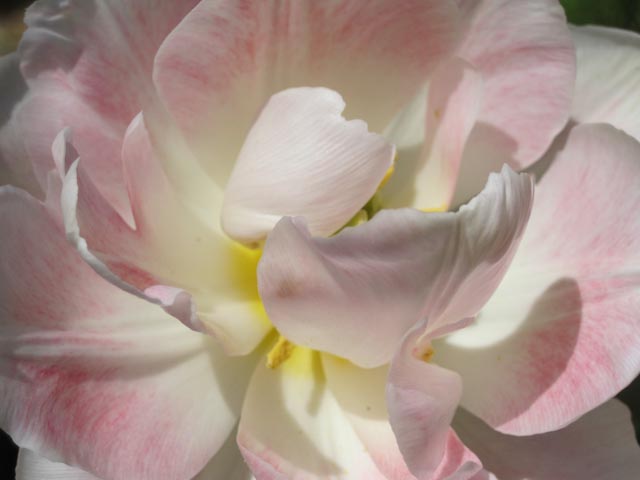
In honor of a certain holiday, a nice spring flower from last year, a double, parrot tulip to be exact.
Comments Off on A tulip photo
 Acair Fearann