Year Round Gardening Sunday, Mar 11 2012 

Theoretically, in mild years such as this one, you can probably find something that is in bloom throughout the year at Esperanza.  It does take a little bit of work, and a few non-natives: the Chinese Witch-hazels have a longer blooming period than either of the two native American ones, which tend to avoid January.  Heather, if correctly located, will also bloom throughout the winter, as will some of the Hellebores (which we have not as yet had much luck with). 

However, these are definitely oddities.  Spring here starts with the with the two snowdrops: the large Leucojum and the smaller Galanthus.  These like the wet, partially shaded woodland edges and have been in full bloom these last few days.  Also starting up are some of the species crocus planted against a south facing foundation wall.  From now through the end of October something will be blooming here.  Rather nice, that.

Label your Photographs! Friday, Mar 9 2012 

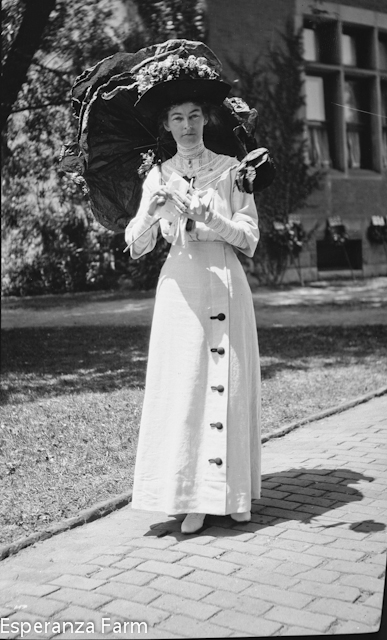
Lest one think we are well organized….We have an impressive run of photographs here, slowly being digitized*, however; it is not well labelled.  Actually, it really is mostly unlabeled.**  Now, family members can usually be sorted out, there are enough pictures connected to enough other information that patterns can be combined with elimination with some level of success.  Visitors and such are a headache but marginally possible, in theory.  The impossible ones are those one-time photos at a special event.

This photo is an example of that, taken in 1911 at what appears to be a school graduation (unknown).  Who is it? Clearly, someone important to the photographer (also an unknown).  I must admire the clothing though, and the parasol, and the gloves, and the fan, and all that white lace on the cuffs and the neckline! In summer.  Can you imagine the work?

*funnily enough the current gaps in the digital record are from the late 1800’s, prints and glass negatives, and the late 1900’s, also prints.  The majority of the 1905-1930’s negatives have been scanned and after that slide film was used into the 1980’s, which has all been digitized.  Post 2000, most of the print film was also on CD’s, and then shortly thereafter we went completely digital.

** Yes, that is a hint for some help with keywords…

Energy Transfer or Snow on the Mountain Wednesday, Mar 7 2012 

It is always interesting to take a walk up on Yellow Mountain.  Currently, although we have had a dry winter with only a little snow, it is quite wet.  It is also unusually quiet, with only a few deer tracks and some coyote tracks.*  What is particularly interesting, however, is that the snow (all of a few inches) is a solid blanket in the woods.  However, it has melted almost completely off of people’s lawns, fields, and other areas of human activity.  The fields with the most snow are those that weren’t cut last year, our hay field has largely melted, a neighboring, uncut, field with a similar exposure has more snow.  It is well established that areas of concentrated human activity, such as lawns and intensively used agricultural areas, have much higher levels of storm water runoff.  What I don’t know is whether any one has looked at their temperature changes. 

The woods in March have about the highest amount of sun levels hitting the floor that they will get all year.  Yet, the limited amount of shade that does exist, combined with the changes in air movement, must substantially lower the temperature.  Thoughts anyone?

It is also rather interesting to observe what plants are making effective use of the sunlight, despite the snow.  In particular the Princess Pine, a small evergreen in the club moss family, has just the right shape to pop up through the snow, while its dark stems effectively melt the surrounding snow quickly.  It therefore can absorb huge amounts of light and water for a few weeks, before the other plants start leafing out.

*No people activity either.

Camouflage Tuesday, Mar 6 2012 

One of the largest landscaping headaches at Esperanza is the presence of a state highway running across the front of the lot.  Although this road was moved about fifty feet away from the house in the 1930’s, the massive increase in traffic makes it a constant presence in the landscape.  One of the goals, therefore, in the landscaping is to build a barrier between the house and the road.  Now, you might ask: why not build a fence?  Two reasons: number one, a truly effective sound/light barrier is costly.  Number two is that a fence which can’t be seen through is an attractive nuisance.  People decide that there must be something interesting behind it, something that makes trespassing inviting.

So trees it is.  Besides I prefer trees.  It is a Slow process, but if you drive past at 60 and are not actively looking, you probably won’t see the house.  We still hear and see the traffic, but there is an illusion of distance.  I count as a success the bicyclists, who I recognized as having gone past all summer, suddenly yelling “there is a house back there’ one day in the fall.  I also count as a success the state highway truck that refused to believe the drive was a drive.  I say nothing about the individuals’ situational awareness.  In general, one can safely assume that people don’t see things.  But there is a trick to this, the trees can’t look ‘planted’; they have to read as a forest, which means it has to be a forest.  In this case, it appears to be a mature mixed hardwood forest with a strong evergreen component.  Furthermore, because we want to keep the concept of distance, the dense planting must be close to the road, with a mixture of trees, understory, and strategic but visually pleasing clusters closer to the house.* 

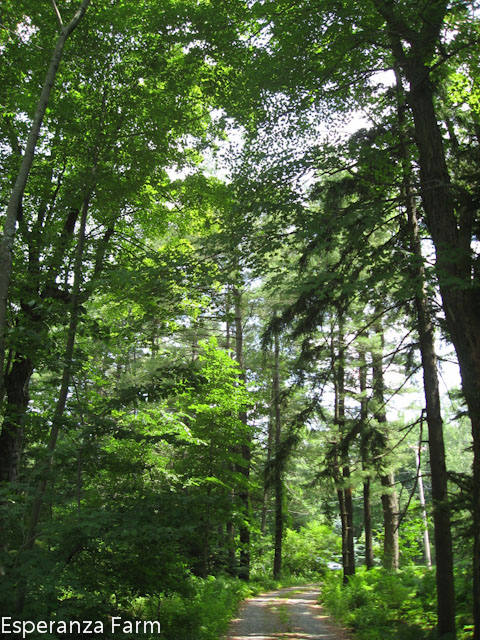
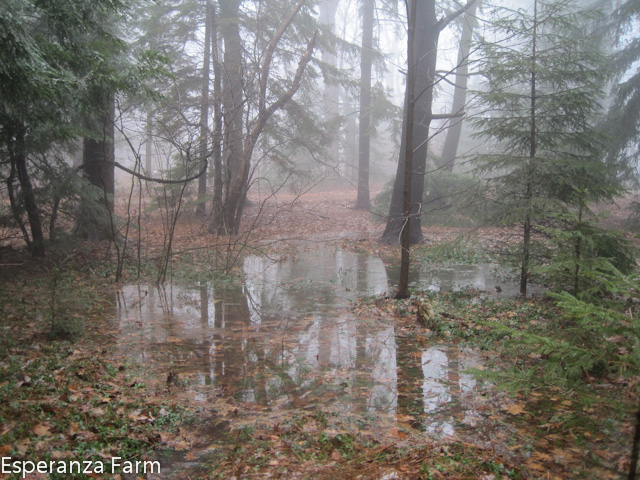
It is very complex section of the property, the description of which I won’t bore you with, but an idea is given by these photos which were all taken on the drive.  We obviously have the advantage of a century here for the large trees, but the strategic understory is a creation of the last decade. 

In the summer, the view from the drive entrance:

In the winter, looking out the drive from the pillars, at just about the farthest point of the drive in the summer picture. Here you can see how the barrier is still quite thin, the loss of one hemlock created that hole just to the right of the plow truck, the trees you see beyond are actually on the other side of the road:

And a view from in the woods, looking at the road but in fog, showing rather well the varied ages and spacing, much of which comes from nature being allowed to run its course:


*Mercifully, trees want to do this, forest edges form dense thickets, while areas under closed forest canopies tend to be open.  Transitioning the edge from ineffective, ugly and invasive Norway saplings to native, or non-invasive species, is a bit harder though.

Squirrels, phone lines and nonsense Monday, Mar 5 2012 

Like all old New England houses, the center of the house is a post and beam construction on a dry/minimal mortar field-stone foundation.  The southern section is even less airtight, as it rests on stone piers and has no foundation.  It also isn’t actually connected in any structural way to the rest of the house.  Consequently, Esperanza houses quite a few more inhabitants than the homo sapiens and felix domesticus.  All of the small furry kind.  The walls can be quite noisy at night.  However, the cats catch those that get above the basement, the electrics are all metal sheathed, and they don’t chew through plaster, so it falls under the incurable, endurable category.   Though the red squirrels have gotten to be a bit much, seeing as two of them were arguing with such vigour over the seed packets (that had been left vulnerable for about an hour) in the basement that they didn’t pay attention to the appearance of a person.  They also fight, roll acorns around in the ceiling, and are generally loud. They may, like the over-population of chipmunks last year, be reduced in number.

All of which is why, when the phones went out a few days ago we naturally assumed that it was probably a problem in the house, and probably a problem caused by a rodent.  The electrical lines may be sheathed in metal, the phone and cable lines are not.  It was rather nice to discover that while the problem was caused by a rodent…it wasn’t one of ours.  Rather, it was a nest in the switch box, several miles away, and one of the lines that was actually chewed through was ours.  Fun and games.

A view from a window Sunday, Mar 4 2012 

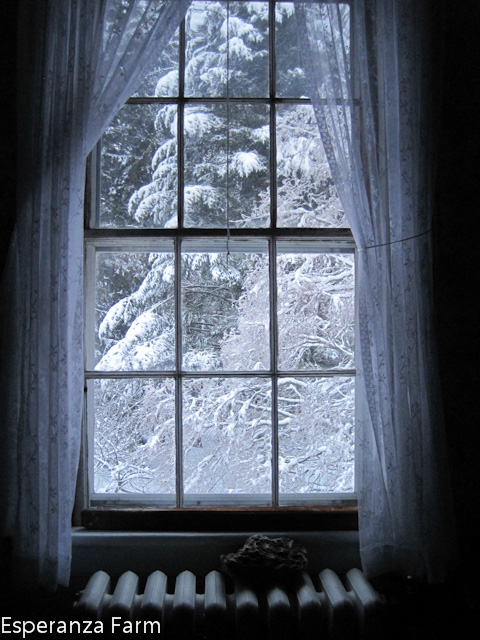
There is a strong tendency to look west out of the house, looking across the hayfield the view opens out towards the low hills that begin the Berkshires.  The view to the east is quite different… Here is a second story view during a recent snowstorm.*   If, of course, this was a hundred and fifty years ago, this would also be a spectacular view, but trees grow.  Personally, I rather like it, the trees have a great deal of character and the sense of enclosure helps to balance the western space.  Early morning light filtered through trees has a gentler, more subtle, feel to it, as well; partially, I imagine because we tend to sit and watch sunsets as opposed to sunrises.

*Please excuse the problems with horizonitis…in addition to my usually skewed view, I was dodging a very perturbed cat who thought I ought to be paying attention to him.

March 3, 1873 The Grand Tour, planning thereof. Saturday, Mar 3 2012 

From Julie in Hartford to Morris in New Orleans:

“I went to New Britain Monday. Mr. Kilbourn has got a list of sailing steamers. The Oceanic, which is a favorite of his, will sail on the 10th of May, and he intends to take passage in her for the girls. It is as yet uncertain whether he goes. If not, he will put them under the care of a friend and telegraph to Lizzie to meet them in Liverpool.

Mr. Kilbourn bought exchange on London, Julius Morgan, but he says he thinks it is cheaper to buy thalers, and Lizzie is banking now with Thode in Dresden. I don’t know if I have used the right words, ‘exchange, &c’ but if you will write to Mr. Joseph Kilbourn, New Britain, he will tell you all he knows. I told him to get the passage money from C.B. Smith and Co., New York, which I hope is right.  Nelly’s outfit I can furnish out of my own money, which makes me very happy. It will not cost you anything. Now I am sure you cannot say my books are no good anymore….

……Don’t borrow any trouble Darling about the European trip. I feel fully capable of everything and shall enjoy the details. Who would have thought that one of Julie Palmer’s children would go abroad. All that, and this, and everything, I owe to my Boy, with all love, and honour, and obedience…..

….Lunch is ready. Good bye sweet. Love me not as I deserve, but out of your plenteous goodness.  Your Julie.”

These excerpts from a longer letter are part of the planning for Helen’s trip to Europe, 1873-75.  Helen went with Mattie Kilbourn, a close friend.  European trips, the Grand Tour, were considered to be the ultimate ‘finishing school’.  But they were neither cheap nor easy to plan.  The slow nature of financial transactions is immediately obvious.  The Julius Morgan, referenced, may actually by Junius Morgan, father of the J.P. Morgan and the founder of the banking house, which would become JP Morgan.  The ship referenced, the Oceanic, was the first of the White Star Line’s ships built by Harland and Wolff and was, at the time, the pride of the fleet, being a major step forward towards the luxury liners.  http://www.titanic-titanic.com/oceanic.shtml

  I think one of the overlooked aspect of the Grand Tour was that of social networking.  For young women, in addition to a list of people to call on, there was the added complication of appropriate travelling companions, chaperones, and often teachers.   The introductory letter, now a completely extinct beast, was a critical part of any Grand Tour.  Tourism, as we understand it, was only in its infancy.  Instead of a network of anonymous businesses catering to the tourist trade, there was a network of expatriates, government, and business officials who would smooth the way for the tourist, if the tourist knew them, even in a distant fashion.  However, without access to that network, it would have been quite difficult.  In Helen’s case, the Kilbourns had familial connections in Europe, making Mattie Kilbourn an ideal companion for Helen.

Happy 140th Birthday! Thursday, Mar 1 2012 

“hundreds of nights on the white road have I passed it by, in my lonely walk, and stopped and listened to it, standing there in its lights, like a kind of low singing in the trees; and when I have come home later, on the white road, and the lights were all put out, I still feel it speaking there, faint against heaven, with all its sleep, its young and old sleep, its memories and hopes of birth and death, lifting itself in the night, a prayer of generations.”

Gerald Stanley Lee, writing of Esperanza in his book ‘The Lost Art of Reading’ published 1902.

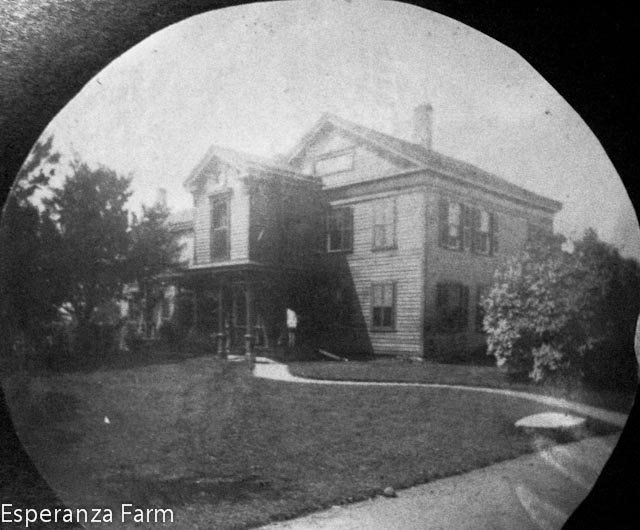
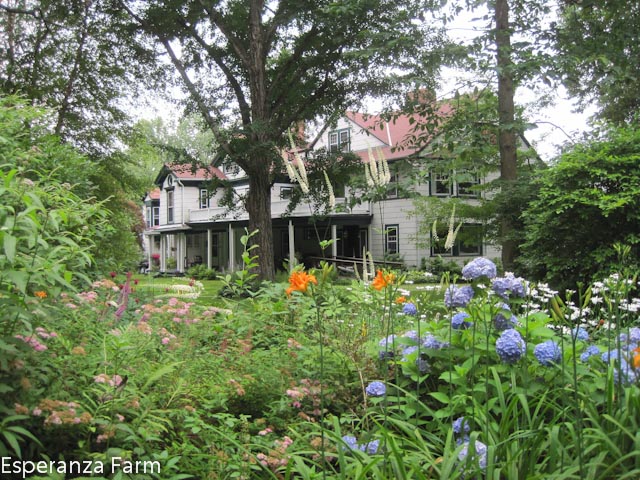
On March 1st, 1872, Julie took possession of the old Lyman house.  Morris had bought it over Christmas, 1871, as a replacement for the neighboring house, bought in 1871, which had burnt down in late November.   The Lyman house was not available until March, 1872 because it was being rented.

In January, 1872, Julie wrote to a friend, “Satis Bene lies in ruins, but I have become the happy possessor of the Lyman place, to which Morris and I have given the name, Esperanza-Anchor of Hope.”  Thus started the story.

Esperanza, circa 1875-1880, mid-summer.

Esperanza, July 2011

May it continue!

Typhoid Mary Wednesday, Feb 29 2012 

Most people who are interested in eastern North American forests are all too aware of the woolly adelgid.  This little critter was introduced from Asia sometime in the 1940’s (possibly earlier).  It didn’t become a significant problem until thirty years ago.  At that time major infestations were recorded in the Mid-Atlantic area; in the ensuing decades it has relentlessly spread along the Appalachian Mountain chain, with all of the Connecticut counties recording it for over twenty years.  Adelgid can kill a full grown hemlock in under five years.  The eggs and the insects easily travel from one stand to another on the wind, or by birds, deer, and other contact, especially human activity.  It is aided in its destruction by the presence of elongated scale, also an Asian invader, which doesn’t kill the tree outright, but substantially weakens it.  The increase in scale probably goes along with the increase in adelgid.

The only completely effective controls currently are some of the nasty insecticides, or if the entire tree can be reached, horticultural oil spray which suffocates the eggs.  Some biological control through the introduced predators of the adelgid is also possible.  But the predators are hard to bred and do not survive well in all areas. *  Thankfully, in northern areas (and just barely Connecticut) extremely cold, dry winters can substantially reduce infestations of adelgid, though not of scale.  However, in much of the Applachian range, the hemlock is going to become much rarer, if not locally extinct.**

All of which means that keeping a close eye on the hemlocks is very important.  For better or worse, Esperanza’s landscaping relies heavily on this tree.  Last year, the big trees were treated with insecticide and the smaller trees with oil.  Technically I ought to have the tree company come every year.  But, finance rules, and this year’s tree budget (we try for Balanced budgets around here, not being a government) is earmarked for the Japanese maples.  Although, I probably will spray the small trees myself.  I am reasonably happy with this decision, because while inspecting the hemlocks today, I found only one set of trees that clearly had adelgid.  It was probably brought in one someone’s clothes, or by a deer or bear, as the infestation was primarily on branches of the same height, weaving through the stand.  It looks quite pretty, by the way, when a branch is heavily infested with eggs: sort of like little white pearls or cotton balls at the base of every needle, a bit like artificial snow sprayed on a winter diorama.  These branches were clipped off and put in the trash.  Hopefully, we caught it in time. 

Now if I could only train a squirrel to check the tops…

*one is also, of course, introducing another alien…which tends to have unexpected problems…

**Ironically, it probably was originally a much less common tree in southern New England and farther south before the nineteenth century.  It was never a popular lumber tree, which meant it was left, and its seedlings could compete in the second or third growth forests easily, as it will grow in both sun and deep shade.

Tall trees Tuesday, Feb 28 2012 

I mentioned, the other day, the raven sitting on the very top of the tallest Norway Spruce.  That is the tree in the very center of the photograph, beyond the house, looking quite thin.  To give one a sense of scale: the big chimney on the farthest left of the house is approximately 38 feet tall.  The trees beyond the house are roughly a hundred feet from it, while the photo is taken from about 800 feet away.  The house’s elevation is exactly 1000 feet when standing outside the center section on this side of the building.

Other interesting things with this photo: you can see that it was taken after the October snowstorm, which is why the gingko is the weird, light green tree beyond the house to the left.  You can also see leaves on the oaks and tulip poplar to the left of the house, and leaves on the apples in front of the house.  The tulip poplar is the faint, light gold, pyramidal tree on the left, directly above the ‘nz’ in the watermark.  The height of the cucumber magnolia, to the left of the house, is also apparent: the faint outline of a slightly pointed top (directly beyond a very vertical twig in the foreground, or above the ‘rm’ of the watermark), shows that it is closing in on a hundred feet in height and that it is clearly well above the oaks.  It is also interesting to the note that the hemlock, the very tall, pyramidal conifer to the right, is beginning to look balanced, as you can see its left side is thinner than the right: it was originally paired with another hemlock that stood about eight feet away, which succumbed to adelgid eight years ago.

The lack of snow on the left end of the roof is not a major heat leak, by the way, rather that is the effect of the wind.

« Previous PageNext Page »