The show must go on! Friday, Mar 23 2012 

In an age before movies, TV, radio, and most assuredly lacking in the internet, the theater was the main entertainment venue and the opera was the main type of performing art.  Many of the letters by family members comment on operas they have gone to see, as they also comment on books they were reading, or pieces of music they were learning.  Sometimes, there was an element of comic relief evident, and the wry humor of the writer who knows they oughtn’t have laughed, but did, shows through.

Julie writing to Carlotta in 1875, from New Orleans:

“Saturday evening went down to L’Affricaine.  The soprano was sick- seven months in the family way- and in the third act when Vasca is looking at the mop, she stood on the other end of the stage singing, when suddenly without warning she fell over backwards in a dead faint. I thought it was part of the role but wondered how she could fall so awkwardly with her feet towards the audience- because her feet were Not her strong point. Then they came near crushing her with the drop curtain and it took six men to carry her off the stage. And yet she came out and tried again- and got on somehow till the last act, when she gave out and they had to stop the thing for good.”


Meditations on Garlic Mustard Thursday, Mar 22 2012 

Certain tasks, in their simple, semi-repetitive nature, let the mind wander.  Sufficient physical activity focuses or perhaps distracts the surface thoughts, allowing the inner mental activity more room.  A recent study on workplaces found that if workers got away from their desks and did some sort physical activity they were more creative.  Nothing new there, at least not for someone who developed pretty much all of her essays and theses will away from any sort of desk.

Why does this lead to Garlic Mustard?  Well, I spent the better part of the afternoon pulling the stuff, trying to eradicate from several areas.  It is an easy weed to pull, despite its long taproot, easy to identify; but the physical activity of paying sufficient attention to not pull everything else, to duck under tree branches, and so forth gave me plenty of time to think on other things. 

One of the lesser thoughts was why pull the Garlic Mustard?  What is the justification for pulling it and not the Greater Celandine or the Dame’s Rocket?  All three are considered weeds and, worse, the Dame’s Rocket and the Garlic Mustard are both banned in Connecticut. Does pulling one and not the other make me somewhat hypocritical? If not, why not?  Yes, I can have moral angst over a plant.

All three are historic plants, the Garlic Mustard actually is a vegetable garden escapee.  The primary answer was actually quite simple, relying on science rather than legal definitions.  Garlic Mustard is a whole different level of invasive plant from Dame’s Rocket.  While Rocket will spread and form large clumps, it doesn’t actually alter the surrounding ecosystem appreciably.  Garlic Mustard however, chemically suppresses the mycorrhizal fungi found in North American forests as well as putting out other chemical growth inhibitors.  This prevents other woodland species from growing, allowing the Garlic Mustard to become a monoculture and the dominant plant in the understory.  It also is unpalatable to our white-tail deer and is poisonous to several butterfly species, which mistake it for their host plants. A self-fertile, biennial, a single plant will produce several thousand seeds; additionally, its main growing season is fall and spring, giving it a serious edge in the woodland environment.  In other words, it is a perfect example of plant capable of not only out-competing, but of permanently altering an areas ecology. 

So, it gets pulled.  The Rocket, equally illegal, stays.

On sentiment and value Wednesday, Mar 21 2012 

I spent an amusing afternoon this last weekend helping to host an antique appraisal fair (think Antique Roadshow).  As expected, the mix of items was dominated by three sorts of objects: collectibles, old but inexpensive, and sentimental.  Also as expected, there were mild protestations and disappointment when an object, perceived by the owner to have monetary value (but it was Grandma’s, but it is pretty!) turned out to have little financial worth.

Objects can be classified as belonging to several categories at such an event: the genuine antique, the oddities, the collectible, the tag-sale item, and junk.  These five categories* are then modified by what one might consider the sentiment variable.  The genuine antique is the rarest category as it generally requires a substantial hand-crafted element, demonstrate a high level of quality for its type, and (despite the legal definition) to be over the century mark.  Oddities tends to cover the interesting tools, trade paraphernalia, and easily shades into the collectible and the antique.  Collectibles have imposed value: the object itself may not be worth much, but because a sufficiently large number of people have decided to amass groups of like items, monetary value is created.  If they stop being collected, their value drops.  The tag-sale item is just that, as is junk.

What about sentiment?  Sentiment is a modifier.  Object x would be classified by the disinterested party as a common, tag-sale item.  But, the invested party grew up with it and remembers Grandma was very proud of it.  Grandma was important, therefore object x is important, therefore its value ought to be commensurate.  We all do this; it is a form of attempted affirmation of our own social value.  Unfortunately, as any honest historian will grudgingly admit, most individuals aren’t that important to society.  Very few people are so important that their ownership or presence adds monetary value.

Where does that leave Esperanza?  Well, its items represent all of those categories, probably with a fairly even distribution.  Sentiment, plays a huge role, as do two other modifiers: context and provenance.  Objects in Esperanza have both context and provenance.  Background and stories add social value to an object.   The more detailed and rigorous the background, the more value.  Provenance travels with an object, as long as there is a paper trail.  Context does not.  Like sentiment, these modifiers, will generally not add financial value.  In rare cases provenance can, but like sentiment it requires really interesting people or events. 

And so forth.

*Take as read that the categories are fluid and not exclusive.

Peep! Tuesday, Mar 20 2012 

The peepers are going.  It is interesting to observe that the pond across the road, located in a field in full sun, starts up several days ahead of Julie’s pond, located in the woods.  The dance of temperature and light continues.

It is nice to hear the frogs though.  Now if we could just get the algae back under control in the pond.  Actually, it doesn’t appear to be growing denser at the moment, despite the temperatures, which suggests that the bio-balls may be able to bring it back under control.  Basically, they are basketball sized balls containing the bacteria* which naturally keeps algae in check, which is then spread on a time-release over several weeks.  We had to use them last year as well, and they did work.  Hopefully, in a few years the pond will restabilize…unless of course the vineyard’s** run-off does get into it.  We don’t think it does, but water does such odd things.  However, the nutrient load is probably still coming from the pond itself, since it is less than 18 months from when we rebuilt the dam and reflooded  a large area, which is not a terribly long time.  There is no option but to be patient with it though, even if it wasn’t located in a public water-supply watershed, I have no intention of dumping an algae-cide into it.  Somehow, even putting a targeted poison into a water-source strikes me as bad karma.

*That the bacteria doesn’t easily colonize a pond, despite adequate food, is a good illustration of how delicate bacteria can be, apocalyptic sci-fi not withstanding.

**Vineyards are about as un-green as you can get in commercial agriculture, right up there with any other intensive, finicky crop.  They pretty much have to be too if the farmer wants a reliable annual crop and a wine with the essentially the same profile every year.

Croci revisited Monday, Mar 19 2012 

As some of you may recall, I planted about 1100 crocus beneath the West Meadow fence line last fall.  So far, it appears that the experiment is reasonably successful.  The color balance is a bit off; right now it is dominated by gold and white, rather than the purple and blue shades, which is a bit baffling as there are more of the latter.  However, they may be a touch later in flowering.  I have at least five different species out there, plus the much later crocus vernus (the big one), so the bloom time should run for over a month.*  Rodents haven’t been too much of a problem, though something went along and tasted every single one of the light cream/gold ones.  They didn’t eat them, mind you, just bit the top half of the flower off and spat it out…repeatedly.

It will be interesting to know how they work in the long term.  They are interplanted with daylilies, which I have never seen anyone else do.  However, because crocus form new corms from the top of the older corm, rather than the side/bottom like daffodils and lilies, they should remain up above the root mass of the daylilies.  And hopefully they will spread out into the lawn and meadow.

One definite conclusion of course…I could use more.

*the HOT, dry weather is screwing over bloom times.

The Spreading Green Saturday, Mar 17 2012 

The transition of fields from their late winter, washed beige to spring green is both imperceptible and relentless.   You don’t see it occurring, and yet it occurs all the same.  One day, everything is brown; on the next day there is the faintest hint of green, a few days later, where the grass is short or there is a lot of water, there are tongues or fingers of green reaching out farther by every hour.  There is no pinpointing the exact time* when the eye starts to see green instead of brown.  It spreads in pattern not unlike low mist or fire, and the land turns towards spring with sure, unhurried grace.

*I am sure with time lapse photography and running it through a computer to look at the spectrum you could…what would be the fun in that?

March 15, 1875 Friday, Mar 16 2012 

Morris, in New Orleans, writing to his daughter, Carlotta, who was in Brockport, NY.

“That was a good long letter you sent me. I enjoyed it very much and then your Mother had a good laugh over it. It is undeniable that the bills of the Butcher and the Grocer were never so small, even making allowance for a short month and Lent at that. I renclose them with checks to pay, and when paid you can put them with the others in the desk drawer.

It has been a continual rain for weeks, yesterday we went to the French Market and had breakfast with Madam Eugenia, before the 15th April we will make an excursion to Carrolton, but not till strawberries are ripe.  And if it is ever pleasant we will go to the lake….

…Advices from Esperanza speak of horses as well in every particular. Mr. Kellogg offers his farm but wants more than I will give. I had rather buy his place than build a tenant house, if Ican get it at the right price. If he does not meet my views in his next letter, I suppose I must wait for his ultimate decision till July.”

The Kellogg place was Appleby.  This 1780’s house stands, though in poor shape, still.  The family did end up buying it, and owned it, along with a good apple orchard, for several decades, before selling it in the early twentieth century.  However, Morris also ended up building, or rebuilding, a tenant house on the plot in between Appleby and Esperanza, on the site of the family’s original purchase.


Either persistence or stupidity Wednesday, Mar 14 2012 

on the part of the chickadee that is.  Window reflections are horribly confusing for birds, but I did have to laugh at this instance.  One male chickadee, very sure of himself, had claimed the Japanese Maple and lilac as his.  The problem was the Other male chickadee, the cheeky one that kept appearing in the window everytime he shifted to the lilac.  His reflection, of course, which would set him off every few minutes and send him fluttering up and down against the window, trying to drive off the other bird.  He persisted for at least two hours, until the light had shifted and the reflection vanished.

A good looking bird, but definitely controlled by instinct and hormones….

Repeating Patterns Tuesday, Mar 13 2012 

One of the fun things about being able to study a fairly decent run of family history, in comparison to most middle-class families, is being able to pick out patterns.  One of the odder ones is where else in the country (and world) family members have lived.  While there are significant outliers: Vermont, New Mexico, the UK, Washington DC, Minnesota;* four places have been consistent either as places family members live or routinely visit in multiple generations: Montreal, New York City, Florida, and California.  While NYC, Florida, and California were all well known connections, Montreal was a bit of a surprise.  Today, three family members are based out of there, and I had assumed that it was only a single generation** connection.  However, on doing more research into the travels of the early nineteenth century, I found that the family had friends there and visited multiple times, furthermore that this activity predated Elizabeth Creevey’s marriage to Frederick Goucher, a Canadian.  One particularly interesting strand was the family’s relationship with Malcolm Fraser, a Canadian artist of some note.  Several portraits were done by him and there are two landscape oils done by him which appear to have been of Esperanza.  This raises a raft of questions, not the least being that Malcolm Fraser is not well known in the US, so why….?

*and elsewhere, there are relatives all over the country.  I was also not counting places where people who married into the family grew up, unless they became places people lived/visited after marriage into the family.

**technically two now!

On Galanthus and Leucojum Monday, Mar 12 2012 

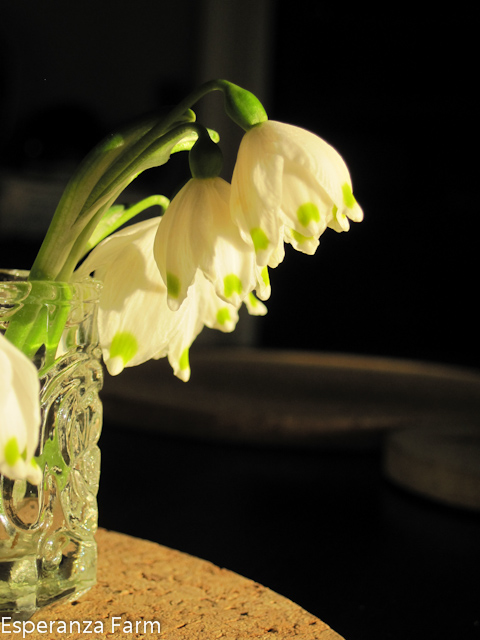
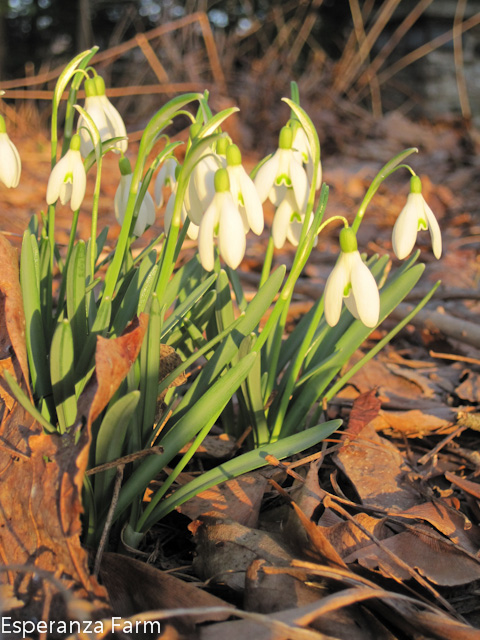
Or snowdrops and snowflakes.  As I mentioned the other day, we have both here.  As always, in a slightly perverse fashion, we have more Leucojum (snowflakes) which are the larger, bell shaped type.  They occupy about 30 square feet of ground beneath a hemlock, pine, oak area, which has western exposure.  Over the years we have gradually helped the patch’s expansion, though it mostly expands by virtue of its own seeds and divisions.  The Leucojum doesn’t seem to mind the intermittent streamlet in the area (winter flooding can sometimes dislodge the bulbs).  Nor does it mind the heavy oak leaf cover.  It is this latter issue that appears to be the downfall of the Galanthus, which generally are said to be the hardier type.  The Galanthus simply does not have stems sturdy enough to get through the leaves.  Possibly, I haven’t experimented.

In any event, they make a lovely white carpet beneath the hemlock, just as if they were a remnant snowdrift, only shining in the sun.  The leaves will stay as a good green groundcover well into summer, an added benefit.

Leucojum, on the table.


Galanthus, outside.

« Previous PageNext Page »