April 29, 1871 Sunday, Apr 29 2012 

From Morris in New Orleans to Julie in Hartford:

“I tried to find a ‘Brigand’ Hat, and was unsuccessful, but the Hatter said he had a style that none but brigands wore, so I bought one of them. Now I am a brigand, as well as a vagabond.

The pony phaeton idea is a good one. I hope you will be successful in carrying it out. The great requisite is a gentle horse.

What is Lottie’s (Carlotta) post address? I do not know the name of the school, of the Madame, street or number.

…Well I will be with you before long, only eight weeks more, and I fret for the time to pass. Shall we have plenty of flowers the coming season? I hope so. I enjoy seeing them in the parlor and dining room. I wish you would get Wetmore to put up the new grape trellis and move the one on the lawn back.

…Business is still discouraging, but I have one great comfort, and that is I have no one to report to. You are my only partner, dear Julie, and the best in the world. And Darling, I look forward to the very best of times with you this coming season. A real good old fashioned time. Good bye. Morris”

As always, Morris’ letters to Julie have a certain elegance, perhaps one might even say romance, to them.

All things end Friday, Apr 27 2012 

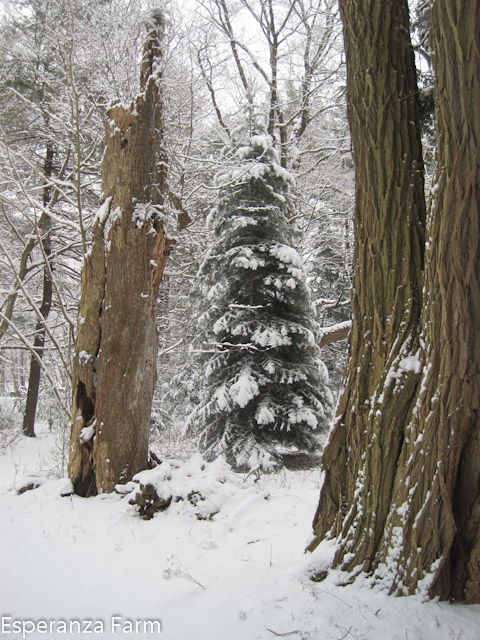
For decades the north path wove its way past the garden shed, beneath the great locusts and hemlocks, and crossed into the garden between the great square boundary pillar and the twenty foot tall remains of the big cottonwood.  The tree had been nearly three feet in diameter, after it fell about twenty years ago years the remant snag was left.  Totally hollow, it fit the image of the slightly spooky, slighty romantic ruined tree trunk; the imagination could run rampant, maybe a parliament of owls, maybe a racoon family, maybe bats, weasels, snakes, maybe a person could hide in it?  It was an elegant ruin, visible from several places in the garden, adding a sense of age, memento mori. In later years it was crowned by woodvine, crimson in the fall.  And it was the woodvine, which held it together, that in the end probably pulled it over.

I went out the other day to find that it had toppled, quietly, without fanfare, falling towards the heaviest weight of the woodbine, away from the path.  The shell had mostly crumbled, though it fell on soft ground.  The largest piece, about a third of the trunk, had fallen on a young conifer; but it was so light and thin that I could roll it off the little tree, which had only been bent.

From the path, it fell to the right, the young conifer is behind the locust’s trunk in the photo.

You can just see the trunk, directly above the middle of the viburnum (white shrub!) in this picture.

Drip, Drip Thursday, Apr 26 2012 

I tend to liken old houses to wooden ships.  One of the basic principles of survival is to keep the water out.  Actually, if you simply invert a boat’s wood hull, you have a structure not unlike some houses.  Indeed there are a few examples out there, on the northeast coast and along the St Lawrence/Great Lakes,* of building built by shipwrights, sometimes incorporating bits and pieces of boats into them.

In any event, leaks will develop.  This one is a minor one, in comparison to last year’s epic ice dams.**  An attic window, easily reached for once from a porch.  I am not in the least surprised; the roof isn’t a century old, but I bet the flashing is.  In any event, our friendly carpenter, who is a craftsman in the finest sense of the word, will come past and deal with it.  Another basic principle: develop a network of people who know how to work on the building and whom you can trust.

*I am sure there are others, I vaguely recall some in Scotland and Scandinavia.  Oddly, all the ones I can think of are churches, make of that what you will.

**There is absolutely nothing you can do with three feet of snow, frozen gutters, and a roof that is forty feet from the ground and inaccessible without scaffolding….except watch the water stain spread across the ceiling.  Until the summer, at which point you promptly repair the heretofore unknown leak.

April Showers Tuesday, Apr 24 2012 

Finally! A good soaking rain and the land has lost that sense of despair, of wrongness.  Still short on water, but at least the soil is no longer dust.

I always find it frustrating, we don’t get many visitors, family or friends, and when they do come; they almost always come in either July or January.  Entirely understandable given their schedules, but those are perhaps the worst months to visit.  Either drab grey and cold or flat green and humid…..

But April and May….The daffodils are still going, mostly the late white ones now, the fragrant Peasant’s Eyes,  Mount Hood, Sinopel, Princess Zaide; gleaming white with a touch of green.  The clove currants, suddenly fragrant after the rain, are arching gold sprays.  The apples are clouds of white blushed with pink; while on the other side of the house, in the woods, the redbuds and azaleas are almost too much pink, only the dark conifers balance them.  Beneath them, the sparkling white trilliums, bleeding hearts, forget-me-nots, violets, and a thousand ferns unfurl.

Thou shalt not… Monday, Apr 23 2012 

poach wild plants.  A bit of gospel I generally agree with, the survival rate of such transplants is often poor and most could be cultivated.  Unfortunately, the nursery business has only gradually begun to expand into rare native plants.  Many are also hard or slow to propagate, pushing the price up; it is often easier and cheaper to knick the plant, so no surprise that people do.

There is one form of which I approve, well two: the first is, of course, shifting plants about on one’s own property.*  The second is the rescue.  This isn’t that common.  Generally, unless you know the bulldozers are coming as you dig (we got most of our double daffodils that way) it is not a rescue but is theft.*  However, I could not resist today.  Last year the town, following the hurricane, widened the dirt road by almost a foot in some areas and raised it by six inches, creating high gravel shoulders where there were once dirt banks.  Now, the town doesn’t give up road width once it has created it; so those graded, gravel shoulders are here to stay.  In the stretch by our hay meadow, some Christmas, Lady, Marginal Shield, Interrupted, and countless eastern-hay scented ferns, along with a bit of Solomon’s Seal, were trying valiantly to come up through the two-inch sized gravel.  Even if they could live in the gravel, the annual grading and the snow plow will doom them.  I rescued some of them (not all, I would be out there forever).  I have re-planted them along our drive and in the woods, hopefully in the correct conditions.   I may go back for more.

*Even from distant bits to other distant bits; following the rule of never taking the entire colony, however.  If only so that if you screw up the transplant, you haven’t lost all of them.

*Actually, legally this is still theft…(well unless you have permission!)

April, 1872 Sunday, Apr 22 2012 

Julia in Hartford to Morris in New Orleans:

“Nell (Helen) has had a young friend staying with her, and they two went down to the station after a trunk with Lady Jane. An engine came up and she began to back, but would have done no damage had it not been for that drunken Charles Griffin, who must needs jump up and catch her by the nose. She won’t let anybody do that, and although Nelly begged him to leave go, he kept hold till she run the wheel into a post and broke it. He came up and said we need not feel any obligations for any little favours he had done, and wanted to borrow “Chris and Otto”. The wheel is mended now, and alright. That is the second time the carriage has been at the shop. The other time the axle was split,nobody knows how.”

Lady Jane was one of the horses, of course. I know of few horses that will tolerate their nose being grabbed as a means to make them stop backing up, especially in harness; most will, as Lady Jane did, keep backing up and usually do so with more haste. 

‘Chris and Otto’ was one of the novels written by Julie.

Eastern Redbud in full bloom Friday, Apr 20 2012 

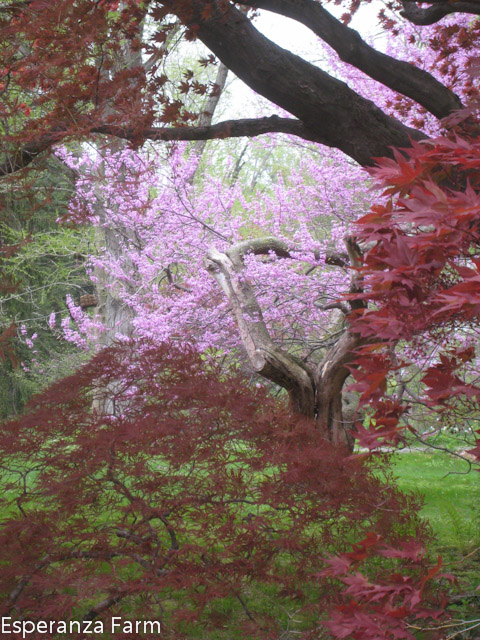
Redbud, cercis canadensis, in full bloom; as seen through the two old Japanese maples.  Trees from three continents in this picture, actually: Japanese Maples from Asia, Redbud from North America, background of Norway Spruce from Europe.

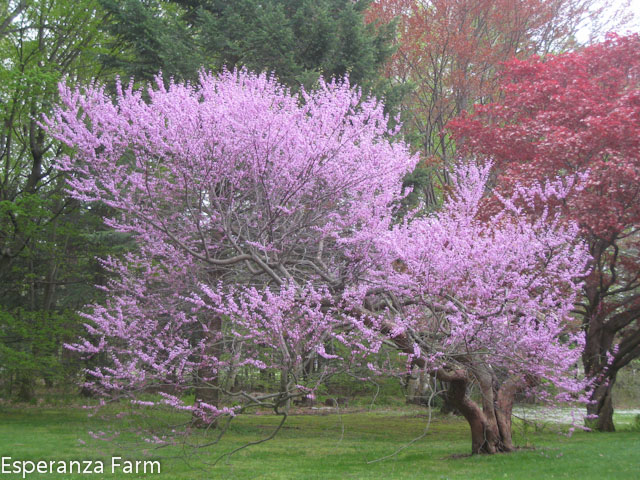
The Redbud from the other side.  This photo was taken a few years ago, there are now several props under it.  However, currently the porch furniture is all over the lawn due to the painting, so no current pictures.  Imagine that whole thing just humming with bees though!

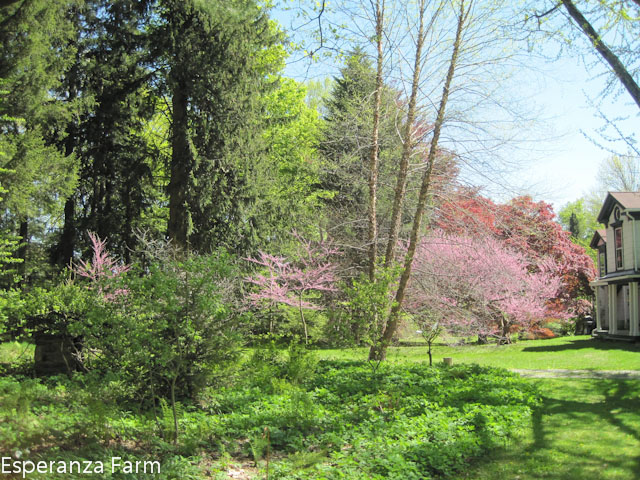
Showing all three of the east lawn redbuds, and the river birch; the very light green tree in the background is actually a sugar maple in full bloom.  This was taken last year, and all the sugar maples bloomed like mad.  The very tall, dark conifers are Norways, the one conifer you can see the top of is a forty year old Douglas Fir…

Paint! Thursday, Apr 19 2012 

The porches having been sanded, we have started on the process of repainting them.  They needed it, badly.  As always, chrome green to match the trim.  I got the east porch floor done today (though not around each of the pillars) and I think the paint will work quite well.  It is always a bit a gamble.  The only paint that truly lasted was the WWII surplus battleship grey, that lasted decades.  The previous job was incorrectly applied and lasted all of a year or two before it began to fail.  To be fair, antique wood over a dirt crawlspace….not the easiest sort of porch to paint.

We shall see, this is an acrylic (with lots of fancy gibberish concerning epoxy particles and such).  It went on easily, looks good, and seems to be drying well.

What is blooming? Tuesday, Apr 17 2012 

Finding it far too much work to actually write something, a list, not comprehensive of what is blooming right now, within 100 yards of the house:

Maples: Norway, Sugar, Red; the Red is almost done, Norway well along, the Sugars are just starting

River Birch

Spice Bush (Lindera Benzoin), nearly finished

Japanese Quince, nearly finished

Forsythia, nearly finished

Evergreen, small leafed azaleas, starting

Redbud, starting

Crabapples, starting

Apples, almost starting

Peach, finishing (oops!)

Wild and cultivated cherries, starting

Shadblows, full bloom

Blueberries, well along

Red Currants

Spice currants, also known as Yellow, buffalo, Ribes odoratum ‘Crandall’s’

Scarlet Elder, just starting

Daffodils, past the midpoint

Scilla, nearly done

Tulips, starting

Muscari, full bloom

Pulmonaria, full bloom

Spring trout lilies, also known as Dogtooth violets (all of one blossom, they take for ever to get to mature size)

Trilliums, red and white, just starting

Bloodroot

Five or more species of violet by the thousand

Pussytoes, a listed rare species here

Bluets, by the thousand

Various native sedge/rush types

Bleeding hearts, just starting

Greater Celandine

Creeping Phlox

Strawberries

Dandelions

Both types of Gill-over-the-ground

Sorrel

other, I am sure I am missing something….

Doggerel for the weather Monday, Apr 16 2012 

The sun has set

Behind knife edged blue hills

Where skeletal ashes vanish,

Consumed by the pitiless starfire.

August in April scorches

The river’s modest bed,

Laid bare for the passerby.

« Previous PageNext Page »