May 12th, 1879 Monday, May 14 2012 

An unusual letter, in terms of survival, from Fred Davis (husband of Lucy Smith, Julie’s youngest daughter) to William Webster Ellsworth (husband of Helen Yale Smith, Julie’s third daughter).  Fred was writing from New Orleans, where he worked in Morris’ firm as a junior partner.

“It is with feelings of awe and reverence that I, at last, take my pen in hand to address you in regard to the episode, as A. Ward humorously terms it, which has lately occurred in the house of Ellsworth.

Taking life as it exists, it really is not so incomprehensible after all, for such things are wont to happen in all well regulated families, but it causeth me to smile, at time when I am not awestruck to think that the boy I used to bull doze and champion by turns is really the father of a blushing daughter. Yet such I learn is the fact, and just here I doff my hat, and tender you my formal and most sincere congratulations….

….Mrss. Smith and Yale went up to the latters plantation last Saturday in company with a box of champagne and a hundred lbs of ice. As they did not return this morning I conclude the ice has not all melted yet.

I am glad to hear that Helen is getting along so nicely. When you go home, to Esperanza, give her my love, and if she allows you the honor, Kiss the baby for her uncle.”

The baby in question was Lucy Morris Ellsworth.

The camera doesn’t lie Friday, May 11 2012 

Well, yes and no.  It does as far as the human mind is concerned.  On days like this, when the wind carries the scent of honeysuckle, viburnum, lily of the valley, and a thousand thousand growing things; when the sun is warm but not yet hot; when the birds are singing hard; when the light has a vibrancy that makes every flower, every blade of grass, every leaf glow….then the camera lies.  For days of glory, there is no record but the soul.

127 years ago Wednesday, May 9 2012 

there was a boy…

Actually, there were any number of boys in 1885.  One knows that quite well.  Still, there is something almost tangible about looking at a pencil line recording that boy’s height on a convenient wall.  One of the more poignant touches in Esperanza is the growth chart on a corner post in one of the upstairs rooms.  It was used between c.1885-1950.  And somehow, people become so much more real when one can run a finger across a pencil line that marked their height when they were five or six or ten.  Most of the people on that chart are long, long gone (not all! :)).  Yet…they were young once; someone, perhaps a doting grandmother?, had them stand there, ‘Stand up straight now!’ and carefully drew a line in heavy pencil. And time bends into stillness.

On the mowing of lawns Tuesday, May 8 2012 

Lawns, and the mowing thereof, are a cherished American tradition.*  Esperanza has Lawn.  Lots of it.  It had more, but I am determinedly shrinking it.  However, Esperanza’s lawns would be a nightmare for any lawn care company or a dream come true for any chemical lawn care company.   Why?

Two reasons: first, at no point does the lawn conform to a nice steady mowing pattern.  It is composed of low-hanging trees, rising foundation walls and roots that can only be driven over in one direction, wildflowers to cut around, sections that are mowed on a different schedule, steep banks…

Second: only about 60% of the lawn is lawn.  The rest is: speedwells, creeping jennys, moss (oh the horror!), gill-over-the-ground, bluets, violets (at least five types), Indian paintbrush, daisies (English and Ox-eye), pussy-toes, native sedges, buttercups, dandelions, wild strawberry, cinquefoil, barren strawberry, plantains, sorrel, thyme, and those are just what I can identify (and remember).   Never mind the sections that have reverted to woods and are now dominated by wood asters, ferns, phlox, forget-me-not, etc.

Two large sections are only cut in late summer.  Right now they are a blaze of red/purple grass with touches of dusky lavender (early English daisies), white bluets, pussy-toes, and a floating crown of pure gold from the buttercups. 

What is interesting is that having these uncut sections actually makes the genuine lawn far more beautiful.  The pure green ‘pops’, to use designerese, far better when set against such a background.  Besides, we will have lightening bugs, phoebes, bluebirds, robins, swallows, bats…the list goes on.


*That lawns actually represent one of the biggest ecological disasters of our time is conveniently ignored.  A monoculture of an invasive species forming a close to impervious surface carefully tended by tons upon tons of insecticides, herbicides, and petroleum.

Spring 1901 Monday, May 7 2012 

Random entry in the guestbook:

An Esperanza Sonnet

While from the hills the shadows lift

And colors melt to gold

Across the sky the clouds adrift

The shapes of faces mold.


The calm and peace and full content

Our hearts at Anchor lie,

While love and life with Hope are blest

Beneath the close-hung sky.

Marie Stewart (sic?)

Claustrophobia by tree Saturday, May 5 2012 

When Spring finally occurs in New England, I always end up slightly claustrophobic.  The trees suddenly fill in, and because the young wood is extremely flexible and filled with moisture, branches are suddenly reaching down.  Yesterday, working around the biggest Japanese Maple and the Copper Beech was especially odd and it took awhile to understand why: not only had both trees fully expanded their leaves, they were also giving a red cast to the light.  By summer, one is accustomed to the red light beneath those trees, but in the spring, to go from no real canopy to a nearly solid red one is disconcerting.  It was, I think, especially noticeable because it was a cloudy day with diffuse light and no real shadows.

  The speed is the most remarkable aspect of the transformation.  For example, a young sugar maple by the barn has added four inches of height in about two days time.  That, when you think about it, is an impressive level of energy and cell division.

Given a chance, eastern North American forests regrow with astonishing speed.  The composition of early successional woodlands is, of course, radically different from climax forests.  However, in fifty years a Connecticut field can go from open meadow to a closed canopy of trees, many of which will be eight inches or more in diameter.  Nowadays, of course, it will also be an utterly impenetrable tangle of the big four invasives: barberry, winged euonymus, multi-flora rose, and Asian bittersweet.  Things grow, maybe not the things you want to have grow, but they do grow.

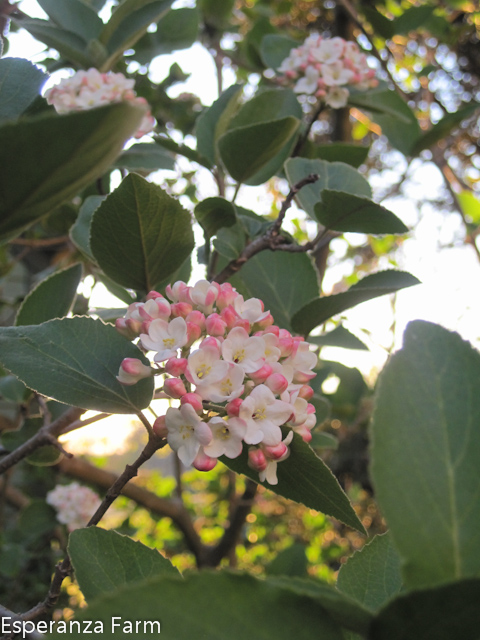
Carlesii viburnum flower Friday, May 4 2012 

Carlesii viburnum in bloom.  The shrub is full sized, at about fifteen feet in height; it is currently an arc of white blossoms against the moss-green of the cottage, Minnietrost, and in the evening (as in this photo) it is backlit by the sun slicing between the building and the big yew to the north.  But such lighting only occurs in May and again in late September, both are times when the viburnum is at its peak, either in flower or foliage.  A happy accident.

May 6, 1873 Thursday, May 3 2012 

Julie to Morris:

“Yesterday I drove out to Esperanza, both horses, taking Nell (Helen) and Lucy. It was a lovely day, and they had a thoroughly good time. It was curious to see their joy, and hear their reminiscences of their last year’s happiness…I only mention this to show you how every thing belonging to the place is dear and precious to them. Nell went all over the favorite spots bidding them adieu.”

While most of Julie’s letters are dominated by business (the rest of the letter is a very interesting discussion of the cows, poultry, orchards, and hired help); the letters also contain glimpses of the very real people and emotion.  And sometimes, as in this one, a hint of the constant strain that must have existed due to Morris’ yearly absences.  Esperanza was an escape from Hartford, which was ‘Julie without Morris’, and from New Orleans, which was ‘Morris without Julie’.  It was a new place, where they would all be together.  Interesting psychology at work.

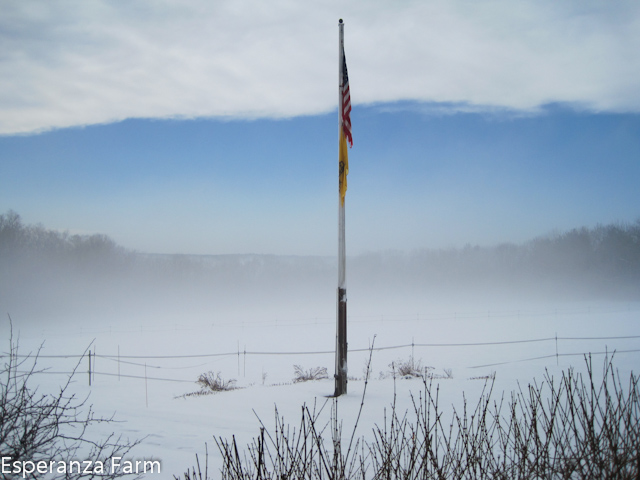
Weird Weather Tuesday, May 1 2012 

This picture was taken back in February: the tail end of a storm clearing out at speed.  A few minutes earlier it had been a solid fog bank, a few minutes later and it was clear blue sky.

Where else? Monday, Apr 30 2012 

Until after World War II, Esperanza was only a summer home; although, there is evidence that suggests that the farm cottage was being lived in year round as early as 1905 by Carlotta.  This leads to the obvious question…’what about the other six months?’

While Julie was alive, the winter home was Hartford.  However, from the earliest period the situation was somewhat more complex and speaking of a winter home is somewhat incorrect.  Julie lived in Hartford, but Morris was generally in New Orleans, while her daughters were spread out from upstate New York, to New York City, to New Orleans.  Right from the beginning then, Esperanza functioned as a gathering spot for a far flung family.

After Julie’s death the focus, now based on WWE and Helen in the next generation, shifted to New York City and, by the late 1890’s, to Yonkers.  Yonkers, or NYC’s environs, would remain the winter focus until the house became a year round place.  The NYC focus had a longer tradition for Julie and Morris had first met in New York.

Oddly, due to generational/cultural/social shifts no doubt, about the time the house became a year round place, the summer-time ‘gathering of the clan’ so to speak began to reduce.  A social/cultural shift, the white-collar professional/middle class ceased to take long multi-generational vacations, shorter vacations focused on the immediate nuclear family became more typical.

« Previous PageNext Page »