On investments Saturday, Sep 17 2011 

One might argue that an excellent training seminar for investment bankers would be studying trees.  I am currently, and have been for more than a decade, working on a sugar maple grove above Julie’s Pond.  When I started thinning saplings, they were so dense you could not have ridden a horse through the area and all were about an inch in diameter and fifteen to twenty feet in height.  Today, one section is almost thinned as far as I dare (considering the young trees stand beneath 100 foot giants that periodically fall in an uncontrolled fashion).  Those left measure 4-6 inches in diameter and are heading to forty and more feet.  No whippy saplings, but solid trees. 

This has been an exercise in close observation, which tree is growing well and why.  Sometimes, there are hard choices: two quality trees that are simply too close together, you flip a coin and hope.  It has also been a lesson on time and patience.  Had the thinning started twenty years earlier, they would be that much larger; had it not started, they would still be scrawny poles.  What takes a decade in nature, will take a decade.  To try to force the growth would result in poor quality, to have not done the work would also result in poor quality.  In a century, God willing, those skinny saplings will be the giants.

Cercis Canadensis Saturday, Aug 20 2011 

cercis canadensis

Cercis Canadensis is better known as the Eastern Redbud, also known as a Judas tree or Spice tree (more on that later).  It ranges naturally from New Jersey to central Florida, west to Michigan and eastern Nebraska.  A variant, the Mexican Redbud, ranges down across Texas and into Mexico.  This official range is somewhat inexact, I have seen it as far west as Wichita County Kansas, north through New York state, and of course, it grows quite happily here in Connecticut (hence this entry). 

It is perhaps most spectacular in the mid-range.  As a medium height, understory tree with a spreading and dramatic habit, it is spectacular in the spring in West Virginia and the Delaware Gap region; where it frames many roads, and in bloom is a vibrant pink spray of flowers against the rugged rocks and green river valleys, nicely complimented by the white dogwoods.

It is not a tree of great height, rarely forty feet. It is, however, very fast growing (see below picture).  But what it often does is branch near the ground creating a wide spreading tree with fantastic branches.  The wood is fibrous and hard, but weak.  The bark is an attractive red-brown.  It withstands rot and is not bothered by partially torn limbs, which is good for ice damage is common.

The pink flowers bud out along the branches in a unique fashion, before the leaves and last nearly a month.  These flowers are followed by seed pods that look exactly like snow peas.  Birds love them, especially chickadees and goldfinches.

The green twigs can be used for flavouring game, hence the Spice tree.  The flower buds can also be pickled for use as a condiment.  The other name, Judas tree, more properly belongs to its European cousin, Cercis siliquastrum.  This tree growing from the mountains of Israel up through Iran and Turkey, was historically known as the Judean tree.  The corruption of that name may account for the name Judas tree.  However, the more common legend is that Judas Iscariot hanged himself in a redbud.

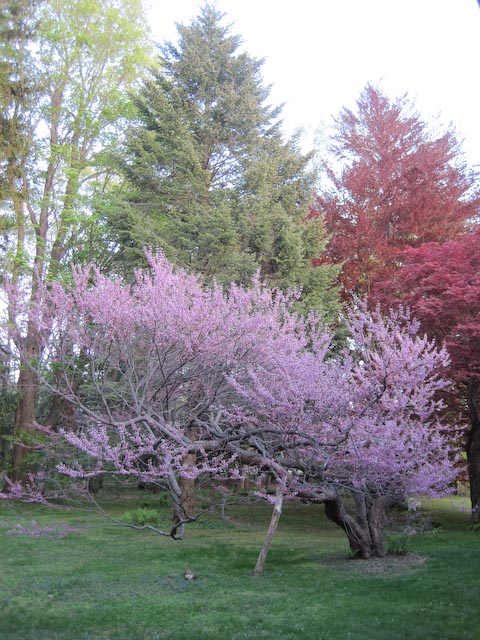
And so, Esperanza’s redbuds: the image at the top is the original one, planted c.1977.  It was planted by my grandfather, Newman, who remembered fondly those in the Shenandoah and Ohio River regions, where his family was from. It has a sheltered location east of the house, with plenty of water.  In recent years several young redbuds, volunteer offspring have been encouraged elsewhere.  However, they do not prosper in areas on the property that have high wind loads, suggestings that this is a northern end of their range. Notably, those in the mid-west also tended to be in locations with lower wind loads.
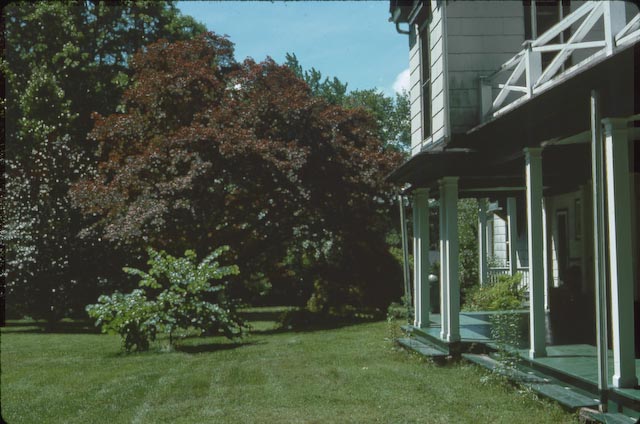
This picture, taken in 1978, shows it as a young tree. One of the benefits of the redbud is that it is a fast growing, disease resistant tree, that also happens to be extremely elegant.

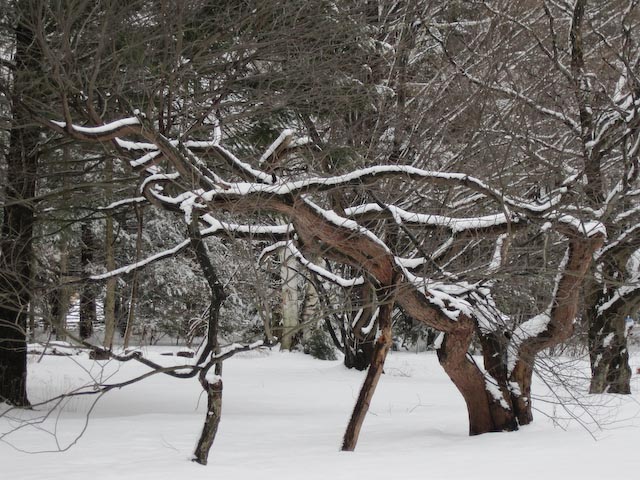
Taken last year, this shows its low branching and dramatic structure. Note the supports.

Japanese Maple just after dawn Wednesday, Aug 17 2011 

Cut leaf Japanese Maple

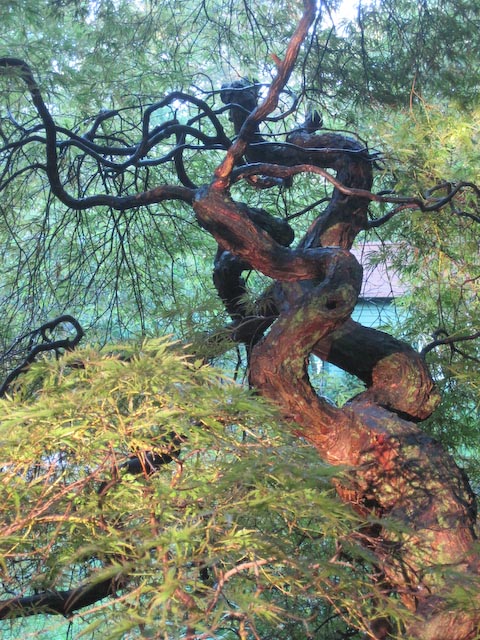
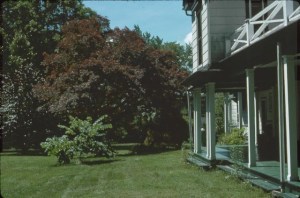
I clearly ought to get up early and wander around with the camera more often.  This is the smaller of the two original Japanese maples, a fine cut-leaf type.  I believe they were somewhat common in early twentieth century landscaping, I saw two specimens, not as big, on an estate in Norwalk.  Tends to be sort of life-size bonsai if that makes sense.  It has, for all intents and purposes, stopped growing; although it is clearly larger than it was in photos from the 1950’s, but the essential shape is unchanged.

The chipmunks and red squirrels love it.


Disease Control Wednesday, Aug 17 2011 

There is a guy wandering about in our woods right now spraying our hemlocks for adelgid and scale.  We use a lot of hemlocks here, mainly as screening from the road, but several are major specimen trees.  Wooly adelgid and scale have both turned into chronic issues in Connecticut, capable of knocking out even very large trees.  In areas along the coast the adelgid has killed almost all hemlocks. 

Now I have never pretended to be a devotee of the organic way, though it has its points; I like to use what works, if it is organic wonderful, if it isn’t also wonderful.  The little Pyrethin molecule (quite capable of killing just about anything) doesn’t know after all if it was distilled from a marigold or made in a lab.   The insecticide being used is somewhat close to black magic.  Highly water soluble, the stuff is sprayed on the trunk and is absorbed into the tree; if it rains and washes into the ground it is absorbed through the roots.  From there the only critters affected will be insects chewing on the needles. Upsides: reduces the potential drift problems (hence reducing the number of other insects that are unintentionally killed), works on our eighty foot monsters, reduces the amount needed; downsides: not cheap, and for God’s sake don’t dump it into any watercourse.   There is a place for correctly used, nasty tools.

Black Locust Sunday, Aug 7 2011 

Black Locust, north of Happy Thought, when it was measured it was the biggest in the state.

« Previous Page