Tall trees Tuesday, Feb 28 2012 

I mentioned, the other day, the raven sitting on the very top of the tallest Norway Spruce.  That is the tree in the very center of the photograph, beyond the house, looking quite thin.  To give one a sense of scale: the big chimney on the farthest left of the house is approximately 38 feet tall.  The trees beyond the house are roughly a hundred feet from it, while the photo is taken from about 800 feet away.  The house’s elevation is exactly 1000 feet when standing outside the center section on this side of the building.

Other interesting things with this photo: you can see that it was taken after the October snowstorm, which is why the gingko is the weird, light green tree beyond the house to the left.  You can also see leaves on the oaks and tulip poplar to the left of the house, and leaves on the apples in front of the house.  The tulip poplar is the faint, light gold, pyramidal tree on the left, directly above the ‘nz’ in the watermark.  The height of the cucumber magnolia, to the left of the house, is also apparent: the faint outline of a slightly pointed top (directly beyond a very vertical twig in the foreground, or above the ‘rm’ of the watermark), shows that it is closing in on a hundred feet in height and that it is clearly well above the oaks.  It is also interesting to the note that the hemlock, the very tall, pyramidal conifer to the right, is beginning to look balanced, as you can see its left side is thinner than the right: it was originally paired with another hemlock that stood about eight feet away, which succumbed to adelgid eight years ago.

The lack of snow on the left end of the roof is not a major heat leak, by the way, rather that is the effect of the wind.

Sentinel Raven Friday, Feb 24 2012 

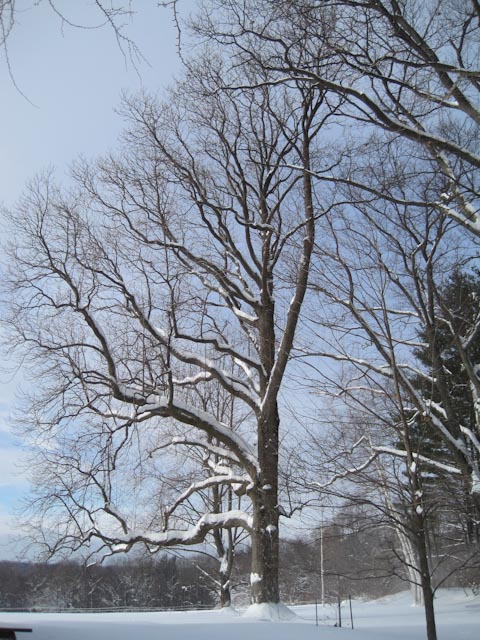
Yesterday, the raven watched the wind rise across the western hills.  The crows in their discontent circled below him, before leaving for the pines.  From where he sat, unrivalled, he could see east as far as Avon Mountain, some 15 miles; south as far as the horizon line would bend; north up the valley to Massachusetts; west to the slowly rising hills of the Berkshires, as far as Norfolk, another twenty miles.

He was, of course, sitting at the very top of the greatest of the Norway spruces, some 109-110 feet tall.  That the tree sways like a ship’s mast doesn’t seem to bother the birds.  It is a favored perch for the crows, but when the raven is there he is utterly unmistakable.  Much too big to be a crow, he (or she) is also a slightly different black, somehow deeper or richer in color.

Someday that tree will fail.  Repeatedly struck by lightning, it also bears the full brunt of the wind.  Its top thirty feet, where it is fully exposed above the other Norways, is thin and ragged, as would be expected in a tree of that age and height in that location.  But for the meantime, the birds will watch the sun.

Topiary Sunday, Jan 29 2012 

I have always thought that topiary animals are a bit bizarre, actually to be correct I think they are a bit creepy (especially giant rabbits for some reason)*  However, I can see how the challenge of creation would be rather appealing.  Trimming any tree or shrub is a very slow form of sculpture, what you do this year will affect the coming years and every single cut eliminates certain growth patterns permanently.  You can’t glue the branch back on.  Now in trimming an apple tree (today’s pastime) such a mistake is less a mistake and more a choice, since hopefully one is choosing the healthiest branch or simply choosing between two fairly equal branches.  The goal is less about aesthetics and more about the overall health of the tree; though I am as concerned about aesthetics as I am with the apples from this set of trees, which is part of why it takes me forever to trim them.  However, imagine making a mistake about a prospective topiary giraffe, how frustrating it would be to end up having to decapitate it a decade into the project because you choose the wrong branches for the neck!  Though I suppose you could create an okapi out of it…

*weird recollections of Monty Python perhaps, though that rabbit was normal sized?

Reactionary Behaviors in a Magnolia acuminata Wednesday, Jan 25 2012 

I have previously commented on trees as living records, generally a tree’s growth is mildly affected by its surroundings; sometimes, however, it can be quite dramatic.  The biggest of the cucumber magnolias is such a dramatic actor.  In the woods cucumber magnolia (magnolia acuminata) tends to be a very straight tree, with few small branches low down and a high canopy crown.  In an open area, the tree can be spreading and irregular, generally producing a broad rounded crown.  Think large here, this species routinely hits 80-100 feet in height and in an open area can spread 40-60 feet without trouble.

Our big tree has always had full western exposure, but it has always had trees to the north and east of it.  Currently there are two black oaks, but there have also been a succession of red maples.  Now the tree probably has had some of its eastern branches trimmed off, but it has primarily developed on one side as an open-grown tree, on the other as a tree with competition (if in a generous space).  It has also reacted to the house, which is south and east of it. 

This picture taken this last October’s freak storm clearly shows the magnolia from the southwest.  Here you can see the magnolia’s rounded growth pattern (it has no leaves, the oaks behind it are still in full leaf).  This is the open growth side: spreading branches that reach from nearly the ground (the lowest branch reaches down to within four feet) to the crown, currently at about 85 feet and nearly as broad.

This picture is taken from the east (last winter) and shows the open crown side, but also the tree’s reaction to competition on the north and east: fewer branches and one major eastern branch that did not waste time going out toward the big oak, but rather aimed for the thinnest piece of canopy between the magnolia and the oak.  This branch has since created a topknot effect, punching through the canopy, and reaching about ten feet above both the main trunk’s crown and the oak.

This photo from the northwest also shows the ‘up’ versus ‘out’ behaviour of the two sides of the tree.  Observe the different growth pattern of the main eastern branch and its western counterpart at the same height.

Finally the last picture shows a remarkable growth pattern that has only become evident in the last few years.  The tree has never been trimmed in order to keep it out of the drive, but because of the wind and the shadow of the house you can see how the lower twenty feet are not growing out as fast as the section which is above the house’s roofline.  The tree is now expanding south as much as it is west, but is doing so starting above the house’s roof, since those branches are not being shaded.

Ghosts Thursday, Jan 5 2012 

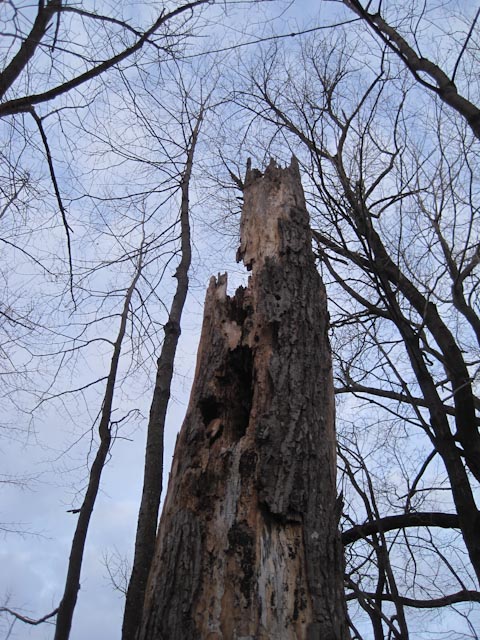
Does a tree make a sound when it falls and no one is there to hear?  As for the metaphysics of that question, I don’t know.  The science says ‘yes’ by the way.  But in any case, a tree does leave an afterimage.  This tree fell many, many years ago and the picture was not intended to show its afterimage, the angle is all wrong.  Yet nevertheless, even decades later, the space where that tree once was remains.  Branches have begun to fill in, but the trees around it were already grown when it fell, and no saplings have filled the hole, and so the image remains.  Consider the tree just to the left of center and the one in the top-right corner and their complete lack of branches on the side of their trunks facing the camera, and facing the old tree.

Fire on the Mountain Monday, Dec 5 2011 

Or the difference between a skidder scar and a fire scar on a tree.  Most people are aware of the science of dendrochronology: the interpretation of past events through the reading of tree rings; but we tend to associate this with long-past history.  We tend to forget that a living stand of trees can actually tell us as much, or much more, about the past century or so. 

The woods on Yellow Mountain are deceptive, the lack of invasive species tends to imply an undisturbed area.  And indeed, the numerous small woodland plants, such as the club mosses of all types, sheep laurel, the wintergreen family, etc., all are good evidence that the ground has not been compacted or disturbed in the last century or so.  But the preponderance of beech and the lack of fully mature oaks, or declining oaks, or other hardwoods in any quantity indicates logging in the last half century, and is correct to do so.  While the mountain has always been dominated by beech, hence its name; they oughtn’t be quite so dominate.  That oak is found on the hard to reach ridges but not on the flatter (within the meaning of the word) is also evidence for this disturbance.  The clincher is the occasional cleanly cut stump.

So, to skidder scars.  Three things leave similar marks on trees: deer, skidders and fires.  The deer scrapes are usually only on trees under about four inches in diameter, usually between six inches to four-five feet off the ground.  Deer scrapes are somewhat irregular in shape and not infrequently wrap more than 90 degrees around the trunk.  Skidders are at the same height, but they are sharp, they don’t wrap around the tree and are not oval.  Which makes sense if you consider how a heavy piece of machinery might be pulled past a tree.  Fires burn to the ground or below, leaving a rounded top and often wrapping around the trunk, they are highest and deepest on the uphill sides of trees, where forest litter has piled.  Skidders and fires tend to scar trees over five inches in diameter, under that the tree probably will not have survived, especially with skidders.

The mountain can seem like a place far from the crowded Connecticut landscape, an oasis.  Yet, it is also a testament for the ability of the forest to grow and change.  And in this growth, paradoxical as it might seem, trees remember.  They record everything that has happened to them.  A fully mature tree, standing above all others, will still indicate on which side the heavier tree cover was when it began growing, it will indicate prevailing winds, it will record all damaging storms.  A tree is a witness, an incorruptable witness, and this may well explain part of the reverence some cultures hold for them.  For this record, this decipherable record, is created apart from man but is readable and changable by him.

Lost Arts Sunday, Nov 27 2011 

Much to my satisfaction, I turned that ash tree mentioned in yesterday’s post into genuine split rail fencing.  Not the greatest job, and it took me a fair bit of time, but I did succeed in splitting several 11 foot sections into four rails a piece.  I have sinced learned a trick regarding the starting wedge placement that should aid future attempts.  You apparently start a wedge in the cut end (just as one would for firewood) and then leapfrog your wedges down the section, this first wedge controls the split better. I hadn’t done that and had problems controlling the angle. You do need at least four good big wedges and having a chainsaw or axe to hand to deal with incompletely split fibers helps.  Have at least one extra wedge hanging about, when the things get stuck…they get stuck.  It also helps if the ground is flat and hard since if the log shifts or bounces you lose much of the maul’s force.

It is also d—ed good exercise!

One Man’s Vision Saturday, Nov 26 2011 

or why we spent the day dropping a sixty foot ash into the pond and then hauling it back out, a task made somewhat fraught by its attempt to swing over into a key laurel bush, jam on the bank, and otherwise hang up.

Why did we take the ash out?  Well, for one it was rooted in the stone wall of the bank; two that it was shading a perfectly lovely black oak; and three…it looked bad.  While the two, much larger, trees (a black cherry and a maple) stood back from the curve of the bank; and the black birch leans far out over the water in a graceful manner; the ash was a perfectly straight pole that broke the curve and stood too close to the cherry disrupting the picture.  It also had a bad top and was thoroughly surplus.  That the long term aim is also for the area to be oak/hickory with a laurel/ilex understory also factored in happily.

Some landscapes aren’t managed by man, parts of the North American north for example, though there a sense of pathos is often created in a piece of artwork (as opposed to the actual experience of being there, when it tends to be an unwanted intrusion) by the careful placement of a man-made structure in the foreground.  Connecticut, however, is much like Europe or Great Britain…man shapes and reshapes the landscape.  Current thought is that even before the colonists, the Native Americans extensively managed the area through the use of fire and hunting patterns. 

Landscape design often deliberately attempts to create something that looks natural, even when it isn’t.  Or that emphasizes certain natural elements and uses man-made elements to draw the eye.  To do this well is fiendishly difficult.  The pond on a lesser scale reflects the same sort of picturesque, shaped landscape that was a signature feature of the movement in the nineteenth century that was best realized in North America under Olmsted’s creations of Central Park, the Boston Fens, Mont-Royal in Montreal and other places.  That it happens that such places can be ecologically as well as aesthetically pleasing makes it even better.  The pond has played host to several groups of migrating wood ducks, teals and mallards, as well as the ever present wood-peckers, the innumberable amphibians, turkeys, deer and many others.  It has healthy , if small, populations of partridge berry, pippiwessa, ilex, laurel, highbush blueberry, three or four fern types, and hopefully will have trilliums, Indian cucumber, native sweet flag and cardinal flower.  By taking the ash out, the dominate feature of that bank (oak/hickory) will hopefully be given emphasis…it is what would primarily occur there anyway, but without any distractions.  The trick is figuring out what counts as a distraction and what is integral, either ecologically or aesthetically.

Amusing interludes Tuesday, Oct 11 2011 

I was happily working away when I heard the doorbell ring (note to self, what do you know, it actually  still works…nobody uses it, they just pound on the door).  An enthusiastic individual who was a volunteer for Connecticut’s notable tree list appeared on the other side.  He wanted pictures of the black locust, which he thought might well have moved up in rank, as it was last measured in 1994. 

He also waxed enthusiastic about the Cucumber Magnolia and the redbud.  So presumably in a few days’ time there will be some photos of them, with me as scale, on the website  http://oak.conncoll.edu:8080/notabletrees/index.jsp


Fall color Monday, Oct 10 2011 

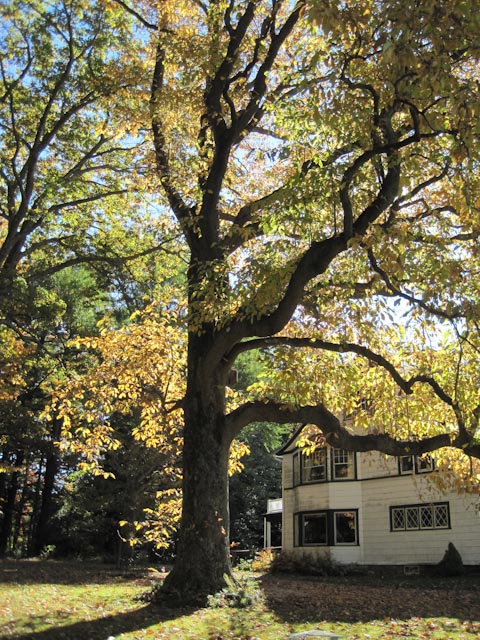
Not much this year, highly dependent on the weather patterns, the combination of a warm wet September followed by a hot, dry start to October has resulted in both the ashes and maples simply dropping their leaves.  Rather reminiscent of the UK, actually.  Fall color depends on a set of factors: first the changing daylight, a wonderfully consistent factor, then temperature.  An early freeze means the leaves simply drop, but no frost at all (as in this year) reduces color.  Then there are the individual factors, the type of species (obviously), soil type, location (including zone, exposure, elevation), stresses on the individual tree, and finally the specimen’s genetic make-up (a factor in some but not all species, red maples are highly variable but striped maple isn’t at all).

« Previous PageNext Page »