On Fences Sunday, Nov 20 2011 

Until recently fences were emphatically local in style and type.  Immigrants may have brought house styles with them, but a fence was made of the local materials at hand and for local purposes.  You might dream of the fences in a country you loved, but you built yours with what was there before you.  Before the tumultuous advent of wire, fences were built of two materials: wood, living and dead, and stone.  Yet the variety is endless: stone might be the end-set Caithness sandstone slabs in Orkney, eerie echoes of the great standing stones in the mundane world of the sheep farm; mortared ashlar walls of England; the dry laid walls of New England some of which were linear rock piles and some four feet wide and five tall built of boulders with footing deep beneath the frost line. Wood is even wider ranging: the living walls of beech, hawthorn, acacia, rose, osage orange; any species that will grow quickly, some which must be annually sculpted, some which can simply be a hedge.  Then the wood: the wood/stone zig-zags of Ontario and sometimes New England, the cedar/juniper stockades of the western states, the five or six rail split hickory fences of the mid-South, the early stockades built from up-ended tree root balls, both formidable defense and formidable amounts of work.

Until recently wood and stone fences were local creations, you used what there was a lot of on hand.  Picket fences were an extra expense: planed lumber rather than simply cut or split  Importing lumber was an unheard idea. Iron was used in gates, but rarely elsewhere.

I have continued the tradition of the locally sourced fence, sort of…I confess the metal t-posts and the wire come from God knows where.  But the poles are primarily sugar (rock) maple, which isn’t good fence material since it doesn’t last more than a decade or so, unlike hickory, chestnut or locust; but I have a lot of it following the thinning of the south wall of the meadow.  So, the fence at the corner of the highway is getting extended and will run around the corner from the end of the stone wall into the brush pile fence.  Building fences takes, like all else, practice, and learning by trial and error means I already want to go back and redo the sections I did sometime ago.  Thank goodness it isn’t stone!

Sightlines Tuesday, Nov 15 2011 

A house is, ideally, placed in its landscape.  There are a number of aspects to this which can go beyond the straightforward engineering to conform with zoning or health regulations.  For most of us a landscape may be more properly considered as a streetscape where the house’s position is dominated by its relationship to the neighboring structures.  This is can call for some remarkably innovative ideas: creating a cell tower that appears to be a church steeple in an historic district or an ultra modern building in a 17th century street which utilizes elements from the 17th century designs but is emphatically modern.  In the streetscape the lot is generally ornamentation, functioning like the paint and trim to express both individuality and the house’s relationship, or lack of relationship, with its neighbours.  It is absolutely critical to the house; but it is part of the house and is best described as an outside room.   

However, if the lot size is large enough the focus is shifted towards the landscape as an entity.  (It should also occur with the creation of subdivisions, though these are rarely done with an eye to design.)  While it is a rare property that does not pay some attention to its neighbors, either in the form of completely blocking the view or by using them as part of the view, a large landscape is more than an outside ‘room’.  Rather it is character and structure equal to the house in complexity and importance. 

Landscape design is a formidable topic, but one goal of the designer is to balance stopping the eye and encouraging the idea that there is something beyond that would be interesting.  Over time, because landscapes are comprised of things that grow, these views can be obscured.

This change in the landscape can be quite profound, I mentioned in the post on WWE washing windows that the far hills were fields in that photograph.  Today they are trees with a sprinkling of houses, most only visible at night.  The immediate landscape has also changed, the property’s own fields have grown into woods, and in particular, the clear definition of hedgerows, stone walls, and the promise of something beyond the next field has been obscured.  We are slowly working on restoring the hedgerows.   There are two reasons for this work: the first is aesthetic, restoring the concept of a larger visual space that ties the house not only to the far view from the top of the hill, but also to the more intimate view of the pond, stone walls, fields and woods.  The second is environmental: the removal of invasive species and the encouragement of quality young maple, oak, hickory as hedgerow trees and native shrubs, mostly apple, vibrunum, dogwood, sassafras, etc.

It is slow going, mostly done by hand since stonewalls and stock wire do evil things to chainsaws, but we will get there!

Knock Knock Thursday, Oct 13 2011 

The west porch pillars are hollow, with ventilation holes cut about halfway up.  For the last few days, a Downy woodpecker has been happily working on the inside of the pillar directly outside my window.  He or she seems to be intent on enlarging the hole, as it is currently a bit of squeeze to get in.  It seems to be their mid-morning job, for an hour or two.  It just might drive me nuts.

On historical importance Thursday, Oct 6 2011 

One of the peculiar aspects of this house’s history is its disconnectedness.  If you go down to the local historical society or even farther afield, you will not find anything of real substance.  There are a few copies of Lucy’s book floating about, a few newspaper clippings related to the National Register Nomination…and nothing else.  That, of course, is much much more than most houses have, but in relation to the length of time it as existed as an entity and the amount of history in the house it is jarring.  Or perhaps usefully humbling, or reminder that one’s center of the universe isn’t, in fact, any one else’s.  (and how awful, in the old sense of the word, to be at the centre!)  History is often said to be written by the victors, perhaps more correctly it is written by those who write it.  Rather a tautology that.  But the thing is that ‘famous’ is really a synonym for ‘well known’ when it comes to history and the general public; there is a critical mass aspect: a person is written about or leaves a coherent body of work behind them, so they are easier to study, so they are written about some more, so they are…and pretty soon the individual becomes an important figure in that time period…or more correctly, an important figure in our preception of that time period.  One of the jobs of the historian is to explore the lesser known areas to find the unknown but historically significant people or events that explain history. 

In an example of the above, I have volunteered myself to give a short presentation on Julie sometime this winter, as part of a lecture series on the famous women of New Hartford.  Is Julie famous? No, she wasn’t on the original list drawn up by the society; but is she historically important as an example of women’s history and history in general? Yes, if you happen to have chanced across the information.

Cleaning the barn Friday, Aug 19 2011 

One of the double edged gift swords of this place is that it has never been moved out of; generation after generation has left their traces, some faint and some not.   The positive is that truly accurate impressions can be gathered, as opposed to the prettified and censored concepts of the past that are more common.  But it also means there is a lot of stuff and some is junk; that the last two generations have refused to tender their oblations to the god of consumerism means there is less than there might be.  But there is a lot.

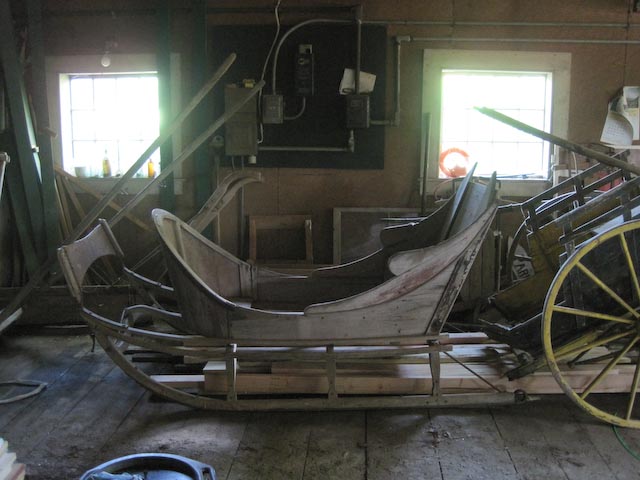
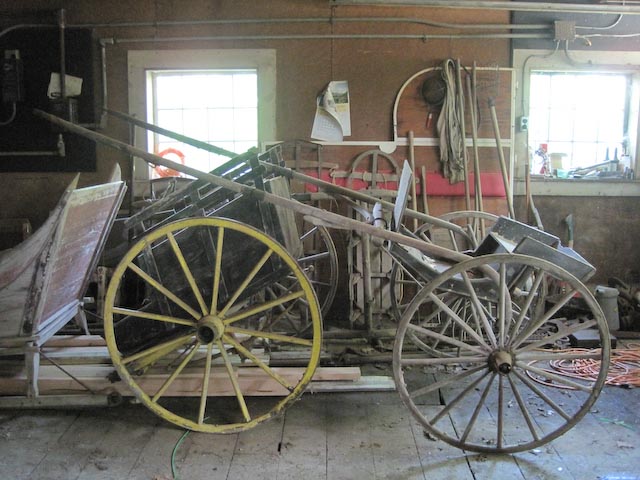
In any event, clearing space in the barn for the recently reacquired gigs and sleighs means an opportunity for reorganization, re-evalution and reflection.  One truck load has already gone to the dump, another is organized for it.  But what is the value of can of pre-war (WWII) Lincoln car wax?  It evokes a car only seen in a few pictures, a different world of manufacturing (everything in the depths of the barn is either UK or American manufacture, even car wax), a different aesthetic.  But is its value as an historical artifact transient? Does it have meaning to me only because my father could tell me about the car, because I recognize fondly the remnants of a bygone era (warts and all)?  Would someone else have even looked/ Should they have even looked?  Would it have meaning tomorrow? 

Difficult questions, and the car wax was the least; there were and are lots more questions.  Benign neglect has a value when it runs for generations; but at some point it has to stop…and apparently it is starting to apply the brake.

Crocus! Friday, Aug 12 2011 

It being a gorgeous August day when the wind is from the North Land…I am contemplating spring flowers.  Landscapes are good for long term planning.  Anyway, I just ordered some 1200 crocus, intended for the West Meadow fence line.  I hope they will tolerate being interplanted with the daylilies.  So blue, purple, white and gold in the spring and orange in the summer.  Sounds good!

Eeny Meeny Miny Moe Thursday, Aug 11 2011 

Finally settled on creeping red fescue (festuca rubra) for the top of the repaired dam on Julie’s Pond.  Whether or not it is the same grass that is still found in the Spring Lot is unknown; identifying grass seems to be something that I have neither the talent nor the patience for.  It is native here, tolerant of dry shade, grows to the correct height, tolerant of foot traffic and is affordable…so.

The pond is definitely one of  ‘those’ projects: a great opportunity both for recreating an historic landscape and in creating a native habitat, but also a great deal of work.  Still, we are getting there! It actually has water again, furthermore water that isn’t growing algae and duckweed and is growing frogs by the thousands.  A far cry from last year at this time.

The carts and sleigh today Tuesday, Aug 9 2011 

The sleigh is of an unknown age, the only known reference to a sleigh is by Julie in the 1870’s.  It was originally red and black and is missing upholstery, a seat and the top of the back (should be a complete arch). The sleigh is also a rather unusual type, and I have yet to pin it down; although references to a ‘slipper-bath’ style do pop up in literature concerning the mid 1800s in rural New York state and in Quebec. 

The two carts, skeleton gig types.  The yellow and black one does have its shafts as well.  The other was originally red and black.  Both use iron leaf springs and have iron rimmed wheels.

« Previous Page