Gripes about weather Tuesday, Jan 17 2012 

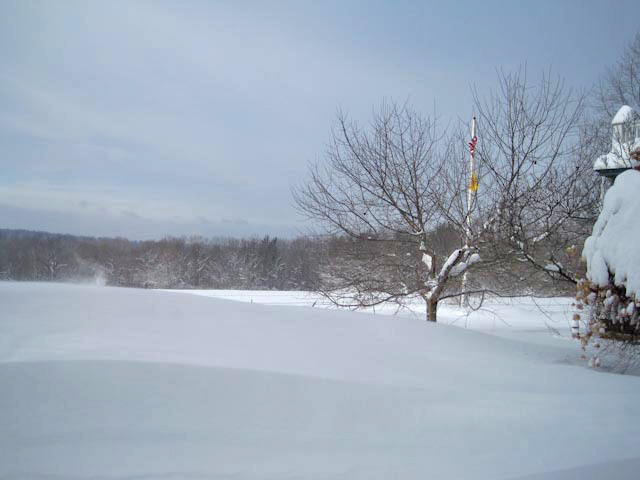
There is perhaps, if I am generous, two inches of snow on the ground right now…in comparison consider this picture taken January 15, 2011…


That is a drift, something over four feet tall, you are looking at.  The lawn is actually sloping down, and the picture is taken looking straight out from a porch which is about two feet above ground level.  Overall, non-drifted snow was about two feet.  It isn’t much snow in comparison to some areas of the country, but a fair bit for here.

Climate change science may have its complications; but, whatever it is doing, extreme weather patterns seem to be part of life.


Christmas Cactus Friday, Dec 30 2011 

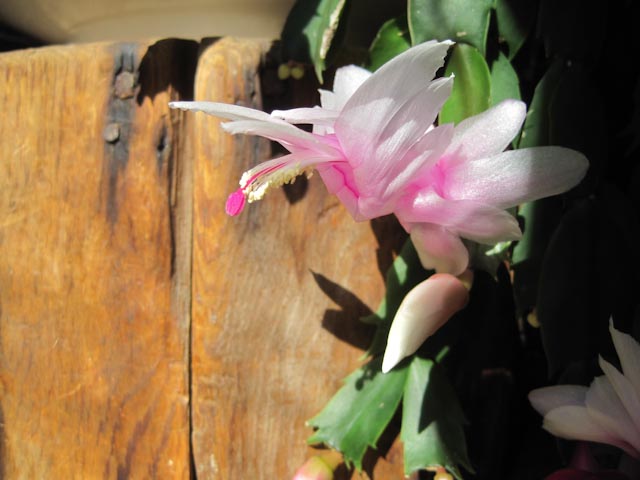
Actually, this one is technically a Thanksgiving Cactus of the Schlumbergera truncata group, as opposed to the S. buckleyi group as shown by the pollen colour, leaf shape, and flower position.  See: http://en.wikipedia.org/wiki/Schlumbergera

We have a very large Christmas Cactus as well, my grandmother had it for years and it now has branches several feet long.  They are ideal house plants, not minding partial darkness, occasionally forgetful watering, and so forth.

Indoor plants are remarkably useful in a house, they add a living touch as well as potentially ornamental/sculptural effects.  They are also an innovation of the mid nineteenth century for the majority of the population, a combination of central heating and the colonization of the neo-tropical regions from which most houseplants hail, including the Christmas cactus group which comes from the coastal mountains of southeastern Brazil.  While the use of southern exposure and walled gardens to extend the growing season and to fiddle the garden’s zone one or two levels dates back to the Classical World, the idea of a Glass enclosed, heated environment wasn’t possible until the modern era.  That a house could have enough light and heat to grow plants which needed longer days and temperatures staying above fifty must have been a revelation for the frustrated gardener.

Your random picture of the day Friday, Dec 30 2011 

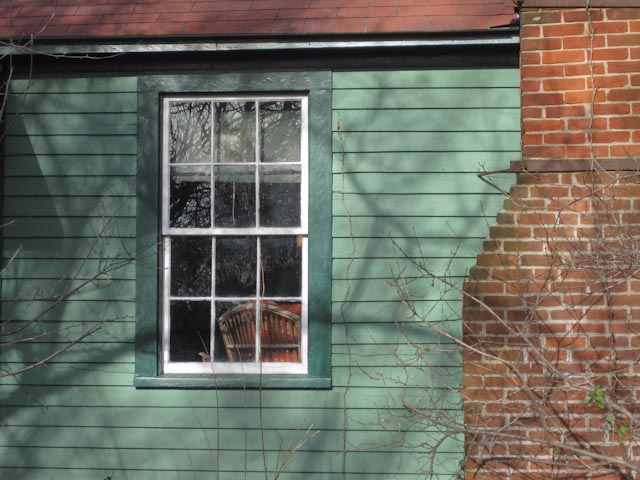
The side of Minnietrost, one of the summer cottages, in winter sunlight.  It was quite a struggle to decide on the color when they were repainted a few years ago.  Appropriately, for the genealogists amongst us, it is Webster Green, a nice subtle grey/green.  Winter light always has a sharper air to it, as if looking through glass rather than water.

(yes that is an iron strap holding the chimney in place…no it is definitely not usable at the moment! someday?)

Mouse Ice Tuesday, Dec 13 2011 

Ice on one of the little ponds.

Ice on the main pond, the spring is in the center right of the photo and is not yet collecting ice.  Not that the ice is exactly thick! Hence the name, though that may also come from the way the ice forms whiskers and patterns. I don’t know if one could ever skate on the pond, it only appears to have the one spring in the corner; however, it wouldn’t be much fun to go through the ice: three feet is quite deep enough. The animals are willing to walk across it in the winter, but a fox is lighter than a man…

November Roads Tuesday, Dec 6 2011 

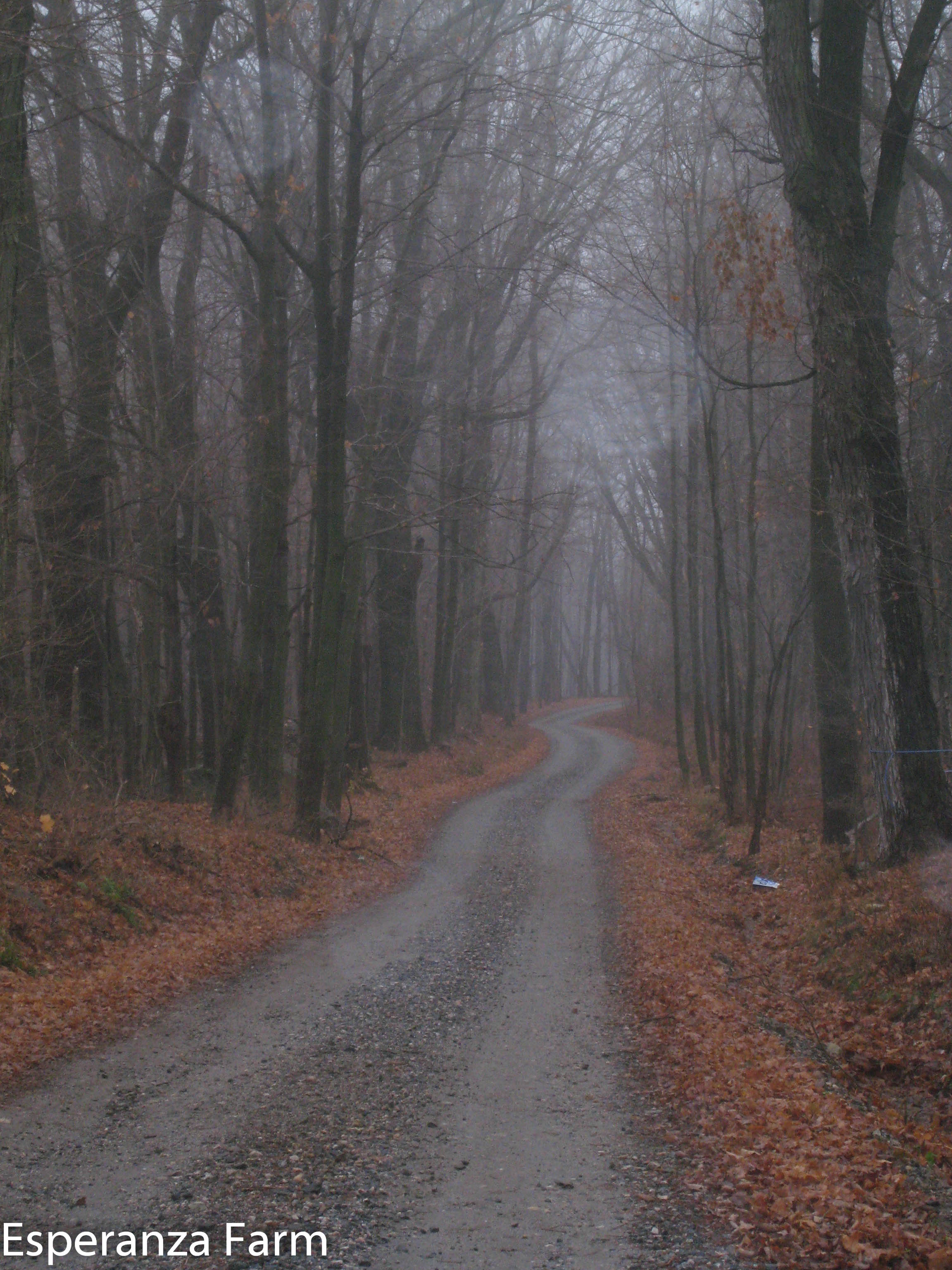
The lane winding down into the woods.  Actually taken last year, it looks a little raw this year, what with being rebuilt following the hurricane.  Julie’s Pond is off to the left of the curve at the bottom of the picture.

The woods of November Thursday, Dec 1 2011 

Most people equate fall in New England with vibrant colours; but I tend to prefer November, when the stormy weather is somehow wilder than any other time of year.  Not in the strict factual sense but in its darkness, the trees are bigger, starker, and the earth and the sky closer and more alive.  Maybe too many Victorian gothic illustrations in my youth?

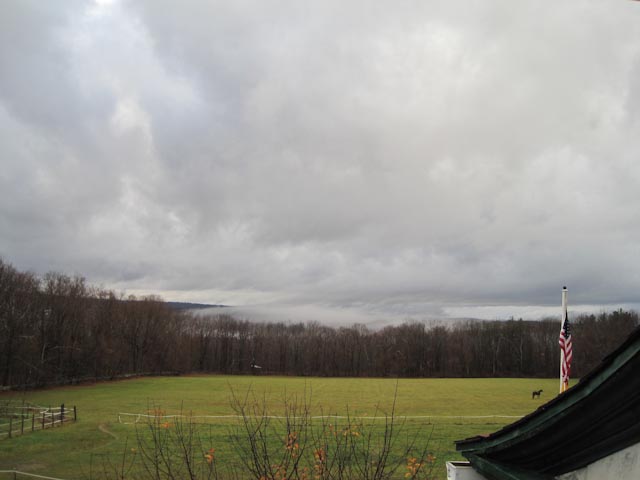
Anyway, a view of the field and forest just after November rain:

On the water’s edge Saturday, Nov 12 2011 

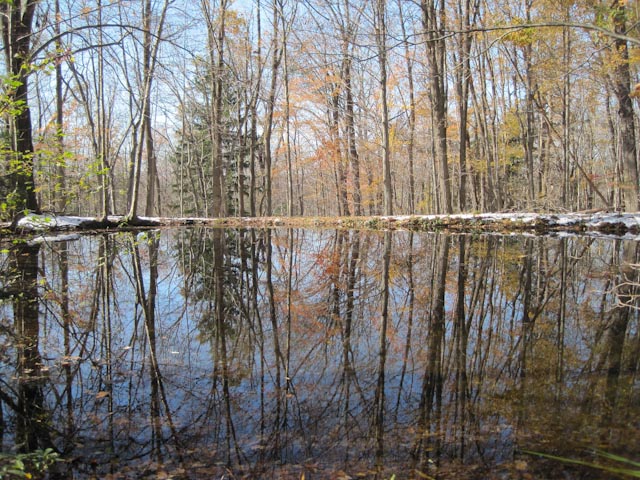
Julie’s pond a few days ago.  Bit of a difference from exactly a year ago!  The repaired dam is that far edge. 

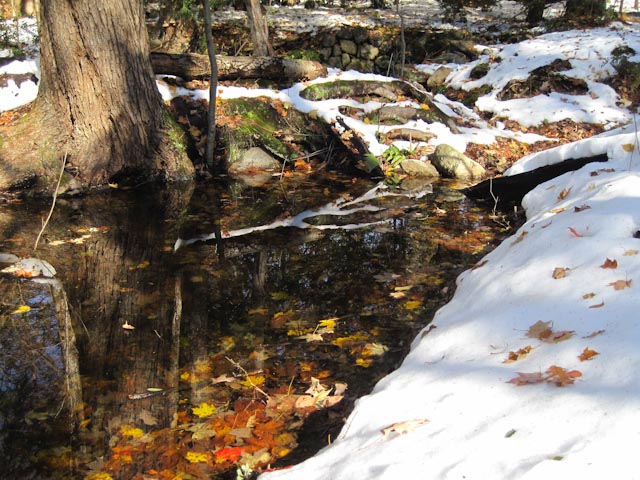
One of the smaller ponds.

walking down to the pond, the bridge over the outlet is just ahead of the person on the path.

Seasonal jewels Wednesday, Nov 9 2011 

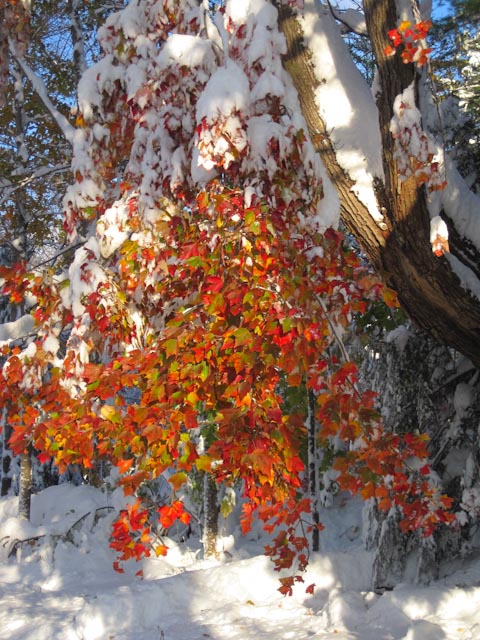
A Red Maple branch after last week’s storm

The old shed Friday, Oct 28 2011 

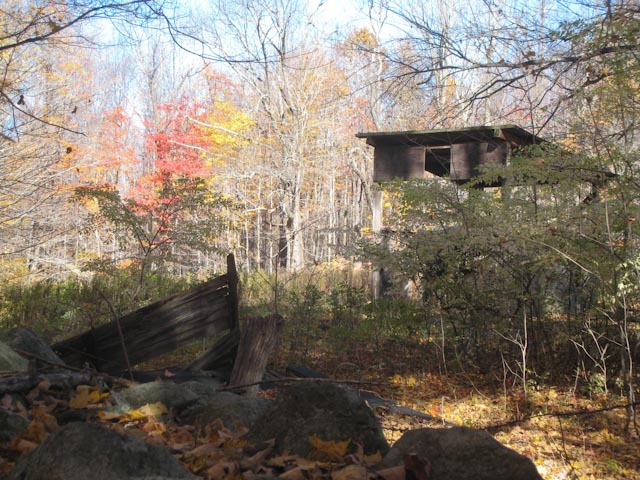
Two old sheds actually, the collapsed structure is the old calf shed, last used in the 1950’s, the other was built for the horses in the early ’80s.

Asters Friday, Sep 16 2011 

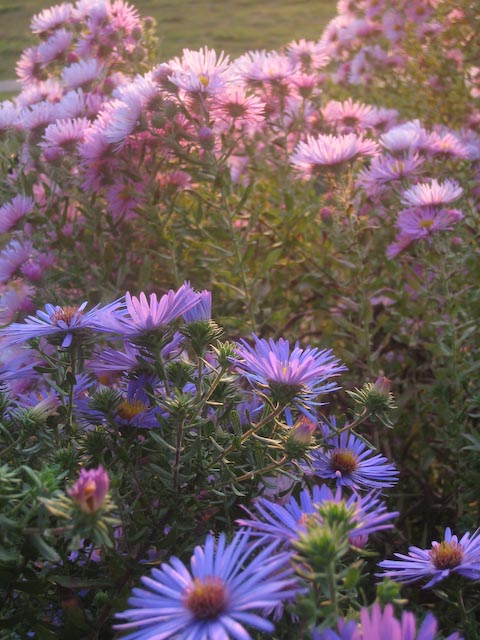
Asters (a huge and confusing family, that according to the molecular botanists should be split apart) are one of the stars of fall.  The blues, pinks, wine-reds, and whites are all dusky.  They are antique colors, not the saturated hues of summer.  And even the modern hybrid crosses stubbornly refuse to be excessively extravagant and exotic looking. 

The ones in this picture are descendants of the novi-belgii and novae-angliae group, the New York and New England native asters.  Some of the other modern garden types are descedants of the Michaelmas Daisy (A. amellus), the European aster family.  The North American group  includes the prolific white wood aster, blue wood aster, heath aster, stiff aster and a myriad of others.   All plants that go from dull green foliage to a profusion of white or blue flowers in September, usually without any care or feeding.  Indeed, the white wood aster is more than capable of taking over any area.  The New York and New England asters will grow in nearly any soil, from boggy to dry, though they don’t tolerate salt.  They need some sun; ideally full sun, but are more than happy to grow on forest edge.

The aster is one of the plants where the North American species has as much, if not more, to recommend it when compared to its European cousin.  It is a whole set of posts to ponder why the long preference for European or Asian flowers in North American gardens, and why in recent years that has changed. 

The aster family is an excellent example of how modern science continues to debate and refine our understanding of the natural world: what was one genus has now been split into many, thanks to genetic studies.  It is also a flower whose name evokes history.  Aster is, of course, from the Greek.  Michealmas recalls the old English calendars and hooks to whole symbology, from the naming of school terms to astronomy to Christianity, that lies behind that single word.  Novi-belgii and novae-angliae serve as reminders of the complexity of the European settlement in North America, for the New York aster’s Latin name stakes the flag of Belgium.

« Previous PageNext Page »