On Galanthus and Leucojum Monday, Mar 12 2012 

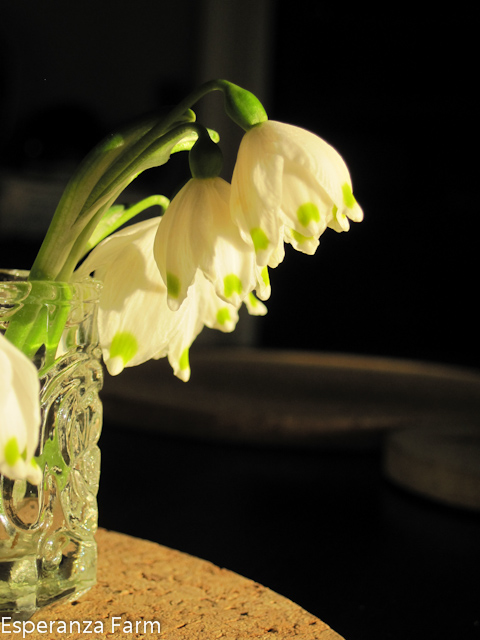
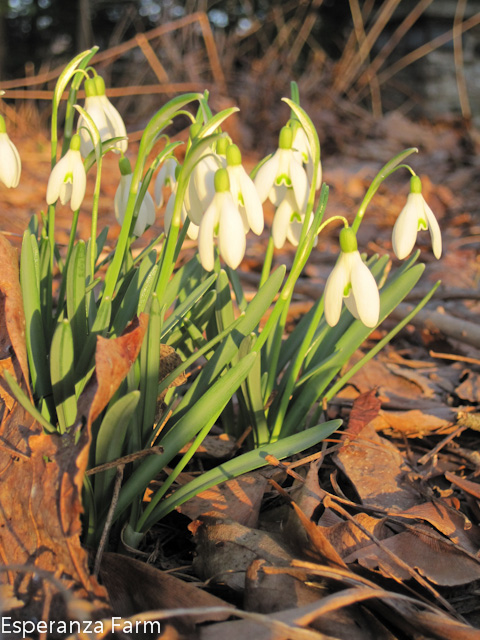
Or snowdrops and snowflakes.  As I mentioned the other day, we have both here.  As always, in a slightly perverse fashion, we have more Leucojum (snowflakes) which are the larger, bell shaped type.  They occupy about 30 square feet of ground beneath a hemlock, pine, oak area, which has western exposure.  Over the years we have gradually helped the patch’s expansion, though it mostly expands by virtue of its own seeds and divisions.  The Leucojum doesn’t seem to mind the intermittent streamlet in the area (winter flooding can sometimes dislodge the bulbs).  Nor does it mind the heavy oak leaf cover.  It is this latter issue that appears to be the downfall of the Galanthus, which generally are said to be the hardier type.  The Galanthus simply does not have stems sturdy enough to get through the leaves.  Possibly, I haven’t experimented.

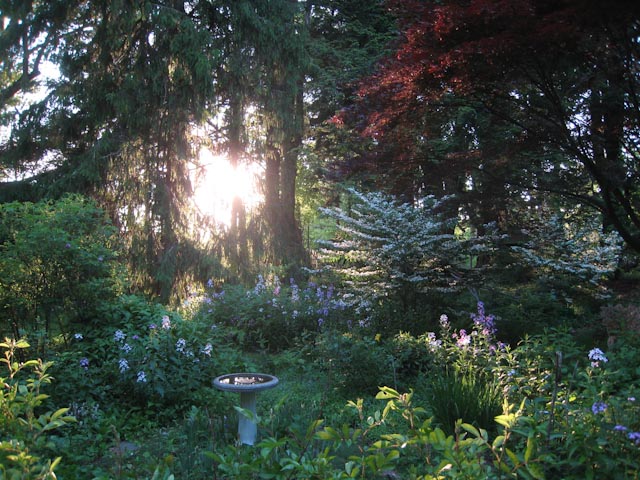
In any event, they make a lovely white carpet beneath the hemlock, just as if they were a remnant snowdrift, only shining in the sun.  The leaves will stay as a good green groundcover well into summer, an added benefit.

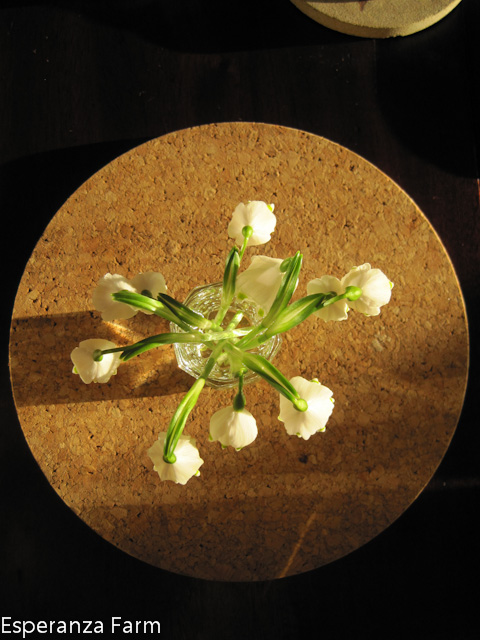
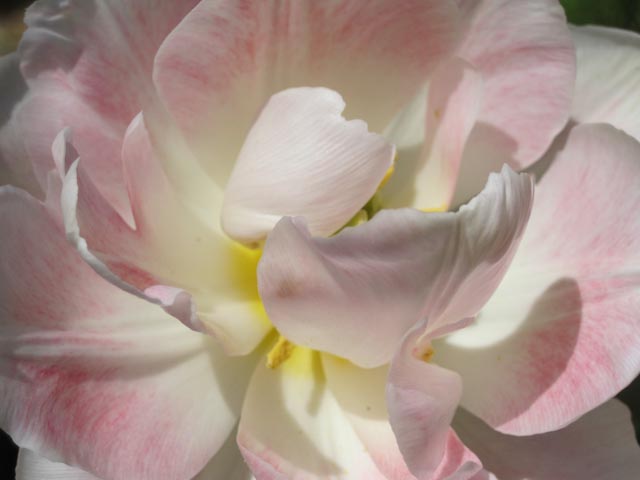
Leucojum, on the table.


Galanthus, outside.

Camouflage Tuesday, Mar 6 2012 

One of the largest landscaping headaches at Esperanza is the presence of a state highway running across the front of the lot.  Although this road was moved about fifty feet away from the house in the 1930’s, the massive increase in traffic makes it a constant presence in the landscape.  One of the goals, therefore, in the landscaping is to build a barrier between the house and the road.  Now, you might ask: why not build a fence?  Two reasons: number one, a truly effective sound/light barrier is costly.  Number two is that a fence which can’t be seen through is an attractive nuisance.  People decide that there must be something interesting behind it, something that makes trespassing inviting.

So trees it is.  Besides I prefer trees.  It is a Slow process, but if you drive past at 60 and are not actively looking, you probably won’t see the house.  We still hear and see the traffic, but there is an illusion of distance.  I count as a success the bicyclists, who I recognized as having gone past all summer, suddenly yelling “there is a house back there’ one day in the fall.  I also count as a success the state highway truck that refused to believe the drive was a drive.  I say nothing about the individuals’ situational awareness.  In general, one can safely assume that people don’t see things.  But there is a trick to this, the trees can’t look ‘planted’; they have to read as a forest, which means it has to be a forest.  In this case, it appears to be a mature mixed hardwood forest with a strong evergreen component.  Furthermore, because we want to keep the concept of distance, the dense planting must be close to the road, with a mixture of trees, understory, and strategic but visually pleasing clusters closer to the house.* 

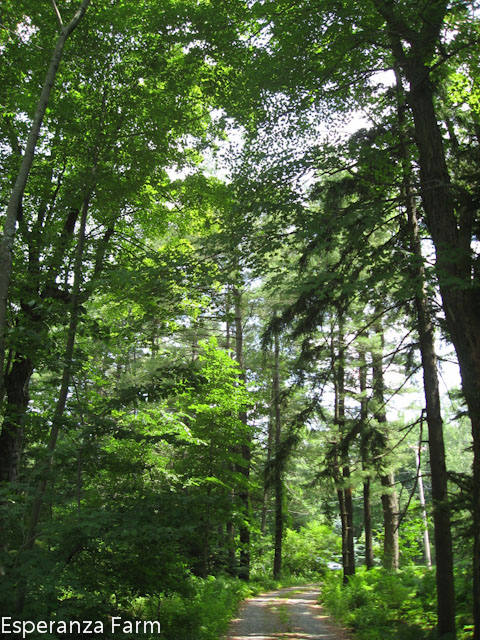
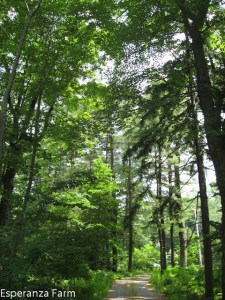
It is very complex section of the property, the description of which I won’t bore you with, but an idea is given by these photos which were all taken on the drive.  We obviously have the advantage of a century here for the large trees, but the strategic understory is a creation of the last decade. 

In the summer, the view from the drive entrance:
In the winter, looking out the drive from the pillars, at just about the farthest point of the drive in the summer picture. Here you can see how the barrier is still quite thin, the loss of one hemlock created that hole just to the right of the plow truck, the trees you see beyond are actually on the other side of the road:

And a view from in the woods, looking at the road but in fog, showing rather well the varied ages and spacing, much of which comes from nature being allowed to run its course:
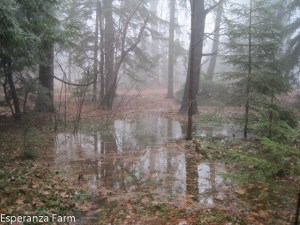
 

*Mercifully, trees want to do this, forest edges form dense thickets, while areas under closed forest canopies tend to be open.  Transitioning the edge from ineffective, ugly and invasive Norway saplings to native, or non-invasive species, is a bit harder though.

A view from a window Sunday, Mar 4 2012 

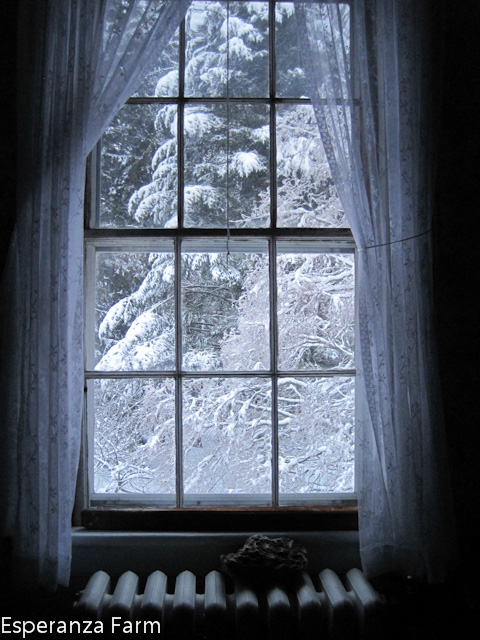
There is a strong tendency to look west out of the house, looking across the hayfield the view opens out towards the low hills that begin the Berkshires.  The view to the east is quite different… Here is a second story view during a recent snowstorm.*   If, of course, this was a hundred and fifty years ago, this would also be a spectacular view, but trees grow.  Personally, I rather like it, the trees have a great deal of character and the sense of enclosure helps to balance the western space.  Early morning light filtered through trees has a gentler, more subtle, feel to it, as well; partially, I imagine because we tend to sit and watch sunsets as opposed to sunrises.

*Please excuse the problems with horizonitis…in addition to my usually skewed view, I was dodging a very perturbed cat who thought I ought to be paying attention to him.

Happy 140th Birthday! Thursday, Mar 1 2012 

“hundreds of nights on the white road have I passed it by, in my lonely walk, and stopped and listened to it, standing there in its lights, like a kind of low singing in the trees; and when I have come home later, on the white road, and the lights were all put out, I still feel it speaking there, faint against heaven, with all its sleep, its young and old sleep, its memories and hopes of birth and death, lifting itself in the night, a prayer of generations.”

Gerald Stanley Lee, writing of Esperanza in his book ‘The Lost Art of Reading’ published 1902.

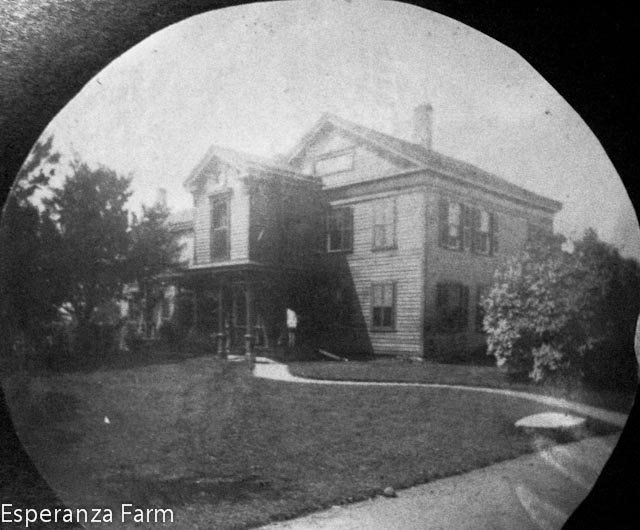
On March 1st, 1872, Julie took possession of the old Lyman house.  Morris had bought it over Christmas, 1871, as a replacement for the neighboring house, bought in 1871, which had burnt down in late November.   The Lyman house was not available until March, 1872 because it was being rented.

In January, 1872, Julie wrote to a friend, “Satis Bene lies in ruins, but I have become the happy possessor of the Lyman place, to which Morris and I have given the name, Esperanza-Anchor of Hope.”  Thus started the story.

Esperanza, circa 1875-1880, mid-summer.

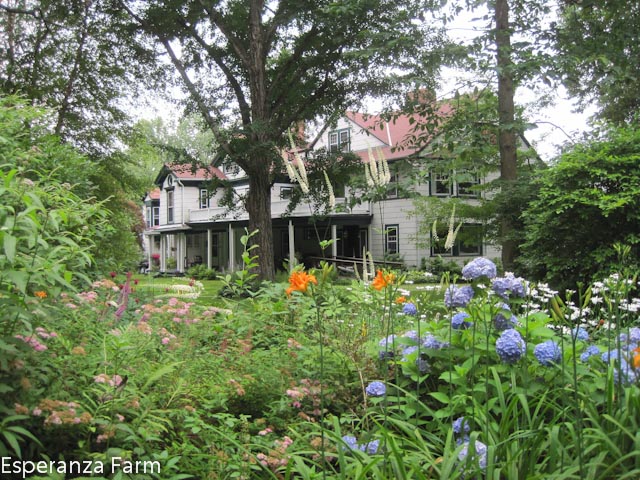
Esperanza, July 2011

May it continue!

Tall trees Tuesday, Feb 28 2012 

I mentioned, the other day, the raven sitting on the very top of the tallest Norway Spruce.  That is the tree in the very center of the photograph, beyond the house, looking quite thin.  To give one a sense of scale: the big chimney on the farthest left of the house is approximately 38 feet tall.  The trees beyond the house are roughly a hundred feet from it, while the photo is taken from about 800 feet away.  The house’s elevation is exactly 1000 feet when standing outside the center section on this side of the building.

Other interesting things with this photo: you can see that it was taken after the October snowstorm, which is why the gingko is the weird, light green tree beyond the house to the left.  You can also see leaves on the oaks and tulip poplar to the left of the house, and leaves on the apples in front of the house.  The tulip poplar is the faint, light gold, pyramidal tree on the left, directly above the ‘nz’ in the watermark.  The height of the cucumber magnolia, to the left of the house, is also apparent: the faint outline of a slightly pointed top (directly beyond a very vertical twig in the foreground, or above the ‘rm’ of the watermark), shows that it is closing in on a hundred feet in height and that it is clearly well above the oaks.  It is also interesting to the note that the hemlock, the very tall, pyramidal conifer to the right, is beginning to look balanced, as you can see its left side is thinner than the right: it was originally paired with another hemlock that stood about eight feet away, which succumbed to adelgid eight years ago.

The lack of snow on the left end of the roof is not a major heat leak, by the way, rather that is the effect of the wind.

A tulip photo Tuesday, Feb 14 2012 

In honor of a certain holiday, a nice spring flower from last year, a double, parrot tulip to be exact.

Waiting for a miracle Monday, Feb 13 2012 

It sometimes seems incredible that in three months time, images like this will be commonplace around here.  Especially this year, when everything is dry and brown.  Waiting, impatiently!

That picture is a corner of the north garden.


Views or what does northwest Connecticut look like? Friday, Feb 10 2012 

Connecticut is 68% forested; consequently finding a decent view of the countryside is complicated.  One can climb all the hills one wants…and not see anything aside from trees.  The exceptions come from either manmade clearings (roads, house lots, towers) or from the rare rock outcropping.  This is a view from the latter, looking north of east down the Farmington River valley as it winds through New Hartford.  Esperanza is off to the right of picture, outside of the frame, on the range of hills that forms the horizon line on that side.

Connecticut will never win any points in the ‘My home is more rugged than yours’ contest*; but this picture does give a good sense of what the landscape is like: not flat, if you are walking across it the constant small up/down, stream/rock/tree is surprisingly time consuming, and despite being the third most densely populated state, comprised almost entirely of small private landowners, astonishingly full of trees.  Those trees hide a great many sins of course, as they tend to obscure the amount and spread of development.  The picture also points out precisely why rivers are the main highways of early exploration.  The Farmington is not a big river, but for a guy with a canoe it would be much faster than the hill/swamp/tree/rock dance.

*One of the more fascinating, and irritating, characteristics of American culture is the macho point-scoring of the contest, ‘because I live in either a) a ‘harsh’ environment or b) city x I am a stronger/better person than those who have not had enlightenment, namely you.’  To be fair, it may be a colonist thing, I have known Canadians, Aussies, and Kiwis to indulge in it as well, but never quite so consistently and arrogantly.  Europeans take the tack of  ‘I am living in the place where the Enlightenment happened, therefore…’ so perhaps I ought to chalk it up to human nature.


Reactionary Behaviors in a Magnolia acuminata Wednesday, Jan 25 2012 

I have previously commented on trees as living records, generally a tree’s growth is mildly affected by its surroundings; sometimes, however, it can be quite dramatic.  The biggest of the cucumber magnolias is such a dramatic actor.  In the woods cucumber magnolia (magnolia acuminata) tends to be a very straight tree, with few small branches low down and a high canopy crown.  In an open area, the tree can be spreading and irregular, generally producing a broad rounded crown.  Think large here, this species routinely hits 80-100 feet in height and in an open area can spread 40-60 feet without trouble.

Our big tree has always had full western exposure, but it has always had trees to the north and east of it.  Currently there are two black oaks, but there have also been a succession of red maples.  Now the tree probably has had some of its eastern branches trimmed off, but it has primarily developed on one side as an open-grown tree, on the other as a tree with competition (if in a generous space).  It has also reacted to the house, which is south and east of it. 

This picture taken this last October’s freak storm clearly shows the magnolia from the southwest.  Here you can see the magnolia’s rounded growth pattern (it has no leaves, the oaks behind it are still in full leaf).  This is the open growth side: spreading branches that reach from nearly the ground (the lowest branch reaches down to within four feet) to the crown, currently at about 85 feet and nearly as broad.

This picture is taken from the east (last winter) and shows the open crown side, but also the tree’s reaction to competition on the north and east: fewer branches and one major eastern branch that did not waste time going out toward the big oak, but rather aimed for the thinnest piece of canopy between the magnolia and the oak.  This branch has since created a topknot effect, punching through the canopy, and reaching about ten feet above both the main trunk’s crown and the oak.

This photo from the northwest also shows the ‘up’ versus ‘out’ behaviour of the two sides of the tree.  Observe the different growth pattern of the main eastern branch and its western counterpart at the same height.

Finally the last picture shows a remarkable growth pattern that has only become evident in the last few years.  The tree has never been trimmed in order to keep it out of the drive, but because of the wind and the shadow of the house you can see how the lower twenty feet are not growing out as fast as the section which is above the house’s roofline.  The tree is now expanding south as much as it is west, but is doing so starting above the house’s roof, since those branches are not being shaded.

Random photo Thursday, Jan 19 2012 

Sunset at the pond.  One of the things that is so intriguing about the pond is how it is set: the drop to the south-west is so great that it almost hangs on the edge of the hill.  The location was chosen for the consistent spring, running at about 5-10 gallons a minute for at least the last 140 years; but the hill is also important, by building the dam up, so that the spring is at the highest original elevation and enters the pond at the original ground elevation, (the spring is in the far NE corner) rather than digging the pond down, you get a much greater sky/water effect with far less earth in the view.  Had they built the pond primarily east and south of the spring, the effect would have been lost because the hill’s slope would not have been turned into a vertical drop and so there would have been hill in the foreground.  This way there is water, a thin strip of land, then a distant hill and the sky.  It must have been quite startling before the forest returned.

« Previous PageNext Page »