On Reading Letters Thursday, Feb 28 2013 

Reading old letters is one of those guilty pleasures, we know we aren’t the intended audience.  It is, of course, that which makes the information in the letters both more useful and more misleading.  We don’t have the full story, but the story that is there isn’t written with an eye towards our reaction.  Our offense or our delight are not being deliberately provoked by the original author.

I tend to pay less attention to the snarls of the personal relationships in the older letters, though they intrigue me greatly.  My particular delight comes from the passages which more fully describe the time and setting.  Sometimes, these passages can capture a philosophy far better than a dry bit of argument.  Below is a piece written in 1873, by William Gillette (then in Houston, Texas) to Helen Ellsworth (then in Europe).  The confidence in the Manifest Destiny philosophy is clearly in full flower here:

“Texas is extraordinary. To say it is the best part of the great United States would hardly do, out of consideration to old New England. But Texas will sometime be a wonderful place. When the Mississippi is lined with great and handsome cities every few miles of its course, and the Territories are divided into innumerable states, and cultivated like gardens; when Chicago shall have outstripped in size and splendor London or Paris, and Boston become the literary center of the world, then Texas will be one of the wonders of this mundane sphere.”

Whatever one thinks of the philosophy, how well that seems to capture the youthful confidence and passion of the time!

Mardi Gras! Tuesday, Feb 12 2013 

It is easy to forget, it being several generations and a long distance, that at one time New Orleans was a major part of the Esperanza culture (so to speak).  This is hinted at in some of the art-work, a sketch of a New Orleans cafe, sketches of plantation life and workers from Louisiana, an oil painting of a bayou.  And mentions of invitations to various balls given by some of the old line krewes: Comus, Proteus, and Momus at the least.

We don’t really know what approach to religion that either Julie or her daughters took, except church-going (but what denomination?) and opinionated about all flavours equally.  However, living in New Orleans in the winter, Julie’s daughters, especially Carlotta, seem to have enjoyed Mardi Gras.  (which even then had remarkably little to do with religion!) Julie herself went to balls only a few times, mostly to get material for writing; Morris was actually asked to help organize a Krewe one year but declined due to health, he had been involved at some level even before the Civil War; Carlotta who wintered in New Orleans on and off from the late 1870’s through to about 1900 seems to have enjoyed it the most. 

It must have been a very colorful world, far away from Hartford’s winters.

Plus ca change Monday, Feb 4 2013 

Hartford, Jan 30, 1871; Julie to Morris:

“I have had Such a time with the gas and water, no light for three evenings, and finally found that the pipe was frozen up in the front hall. The waste pipe got stopped up in Mrs. Johnson’s room, and I had just got that cleaned out when the boiler sprang a leak in the kitchen…

The plumber came up and he showed me how to take up the chamber floor and thaw out the gas with boiling water, so that if we have another freeze, I shall be mistress of the situation.”

Gas lighting was by, all accounts, temperamental and apparently prone to freezing.  The current headaches don’t involve gas, but they do still involve water and oil.  It would be an interesting exercise to see if how fast the pipes can be drained, the one great problem with this house is that if, as happened yesterday, it runs out of oil the temperature is going to drop.  While it could be made livable using the fireplaces, one couldn’t keep the plumbing from freezing.  Therefore, if the oil runs out the clock starts.  Thankfully, our oil company is a good one, even if dispatch did screw up.

Not quite on the anniversary Thursday, Jan 24 2013 

A letter written by Julie to her friend Mattie Yale on January 21, 1872:

“Satis Bene lies in ruins, but I have become the happy possesor of the Lyman place, to which Morris and I have given the name ‘Esperanza’ -‘Anchor of Hope’.

So you see, my dear, we are to be neighbours after all. I could not consent to see all our fine plans blown away like the mountain mist before a north wind.”

A bit of background.  Satis Bene had been bought by Julie and Morris in late 1870, a former farm with about 65 acres.  Following the summer of 1871, work was being done on it in November, 1871 when a fire started, burning it to the ground.  Julie then bought the neighbouring Lyman farm on the other side of the road, with another 18 acres.  This became Esperanza.  Satis Bene was rebuilt as a farm house; in the 1960’s Satis Bene and ten acres of the original purchase was sold off.  It is now a winery.

Mattie Yale lived in the house next to the Esperanza lot.  She had been instrumental in causing Julie to fall in love with the idea of creating a summer home in New Hartford, having invited Julie and family out several times.  If one is facing the houses: L to R is Satis Bene, a dirt road, Esperanza, and then the Yale house (then known as the Parsonage or Eaglesnest).

It says nothing good about the state of farming in the area that it was cheaper to buy up another farm rather than rebuild…  By that time the top of the hill, once a bustling town center, was virtually abandoned.

Proper Ladies Thursday, Jan 10 2013 

For certain readers from certain areas that may or may not start with ‘C’ this may or may not offend.

IMG_9469

Julie was nothing if not independent; making her own way as an author, she was nonetheless highly aware of the correct societal norms, especially as they concerned her daughters. She insisted that they learn the proper skills and manners to succeed in society; her letters are full of remarks and corrections, even when her daughters were adults, and give us a great deal of insight. One of the more disconcerting aspects of examining the upper middle-class, well-educated, women of the late nineteenth century is just how accomplished, independent, and frankly formidable so many of them were…several generations before women’s lib (but I won’t go there). They may not have occupied the upper echelons of business and they may not have been able to vote, but they were neither dim nor silent.*

Some attributes of a proper lady, judging by what Julie encouraged in her daughters: they were comfortable travelling alone throughout the US and with appropriate escorts in Europe, they were well-read, multilingual (Latin, French, and German at least), they could manage the household, ride a horse, drive a horse, make clothing, do fine embroidery, read music, hold up their end of a conversation, garden, could draw passibly and had elegant handwriting, and could shoot.

It is that last thing, of course, that in the current climate will no doubt appall some of my readers. Yet, Helen carried a handgun much of the time and needed it once to fend off a robbery on the road to Hartford, Lucy in the next generation generally had a handgun in her purse, and if I recall correctly Helen Adelaide once backed her husband up with rifle in hand in the tense hours of negotiating a potential agricultural strike.

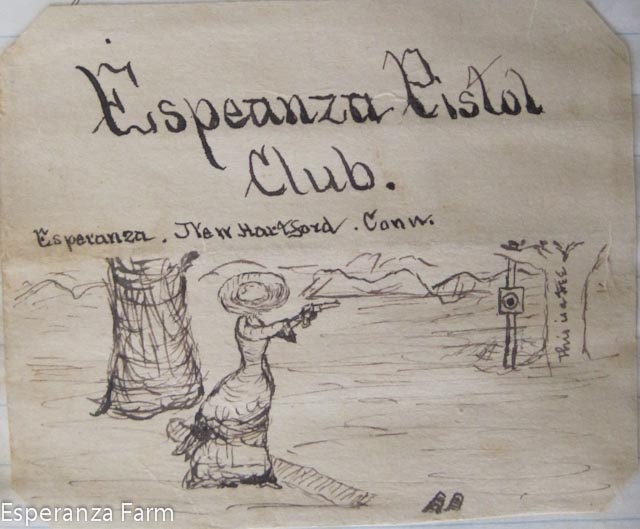
Aside from being used on a farm as varmint control and for hunting (the former generally only the men, the latter sometimes by women as well), guns were regarded as potentially useful tools that a proper young lady should know how to use if needed. They were tools that ensured their independence and relative safety and were absolutely nothing unusual that merited concern. They were also fun tools, as the sketch from the guest book from the summer of 1877 shows. The woman in question was Helen Yale Smith Ellsworth.

We know that the guns owned were designed to be carried in a purse or pocket. Given that, given the independent nature of the people in question, and given that there was no particular desire to collect guns; the only reasonable inference that I can draw is that the women of that generation felt that having the ability to carry gave them a level of defense that their mothers and grandmothers lacked. It wasn’t paranoia or politics, I very much doubt either Helen or Lucy were given to such; it was simply part of being a capable woman. Despite its enduring popularity in the novels of that day and today, ‘damsel in distress’ was not approved practice.

I’m happy to report that the ability to use tools continues today.

*Obviously, there were some dim bulbs, there always are.
*By well read think Memorizing the English Canon from Shakespeare on.

Book Reviews Saturday, Jan 5 2013 

Though Julie Palmer Smith was the first author to live at Esperanza, her son-in-law, William Webster Ellsworth, was a well respected author, his career at the Century Company, from its beginning’s as an offshoot of Scribner and ending as Secretary (think CEO), meant that he had a formidable network of connections.

A review of his book ‘A Golden Age of Authors’ published in 1919 by Houghton Mifflin* hints at this network; the review was by Albert Bigelow Paine*: “When the MS. arrived and I saw the size of it, I said, ‘It looks formidable but I’ll read it. I’ll do it for Ellsworth, I’ll do anything for Ellsworth.’  Then after dinner I got my clothes off, got into bed, propped up, and began. I hadn’t read three pages before I realized a remarkable thing, viz: that it was not I doing it for Ellsworth, but Ellsworth doing it for me, by the Great Inventor of Letters, yes! I was simply eating it up. I was enthralled, enslaved. I couldn’t stop. I read till late, late (I am an early bird) and at five thirty the next morning I was at it again. It was not a big MS. any more, it was too little.’

A much more interesting, and honest, book review than many!

*He had parted ways with Century Company a few years earlier, following a rather nasty personality clash with the new editors brought in after Richard Gilder’s death.

*http://en.wikipedia.org/wiki/Albert_Paine

Letters: reflections on mortality Sunday, Dec 16 2012 

From Julie to Morris, 1846.  Morris had written that he had an attack of some sort of family illness (not clear from the writing) in his previous letter and the doctor gave him ten years (he was twenty at the time), he wrote that he would spend it wildly.

Julie’s reply:

“Dear Morris, I am alone and the fire burns cheerfully before me, and there is a basket of fine grapes on the table before me. The clock has told the hour for retiring, but I am wakeful. I choose to talk to thee. The truth is my Friend, you have lived Not wisely, since we parted. And now you are but reaping the fruits. Bitter! are they not? and hardly worth the pains and toils you have bestowed to garner them up. We need to live two lives to learn how to live well. So; you tell yourself you will be satisfied with ten little portions of time, and do you think when those years have all flown, when the last sand has run you will be ready, to try what the next life will bring of pleasure or pain? Can you lay down your burdens and say to yourself that you have fulfilled all your tasks? You have lived out the precepts which your Father taught you? And heeded carefully all the warnings which your Mother breathed softly in your ear, ‘before your heart had grown familiar with the paths of sin,” and which now steal upon your memory? In the silence of midnight when you are alone save the prayers which that Mother whom you love, which float about you, like guardian spirits and hallow the place and hour? This letter will reach them.”

Julie was not one to go for sweet nothings…

Things in desks Wednesday, Dec 12 2012 

Cleaning out/rearranging things always leads to discoveries here.  Amongst the inventories in the desk was Eileen Creevey Hall’s* diary from her trip to Italy and France in 1927 when she would have been 17.   Unlike those of us with excellent intentions and poor follow-through, she kept the diary the entire trip with a fair bit of detail throughout.

I have yet to do more than thumb through it, but I think it shall bear further investigation.

*In the cast of characters: Eileen Creevey Hall, daughter of Lucy Ellsworth Creevey and George Creevey, great-granddaughter of Julie P. Smith.

letter excerpts Wednesday, Dec 5 2012 

Before magazines were common and well before the internet was even a fictional fantasy, letters were the form of communication.  We’d often like these to discuss the ‘great’ events of the day, those important to history.  The people writing them, however, were as human as we….  Fashion, weather, jobs, conversations, chance meetings, the little important events of lives.

Here Julie writing to her mother in 1845 gives her some information on NYC fashions:

“Dresses stand out as much as ever, stiff skirts are worn and very full indeed. Don’t have your silk made, wait till next year and then come down to New York, and we will go together to Connecticut.* Tight sleeves seem to be the reigning mode with all sorts of caps set into the armhole. Black straw hats are a good deal, trimmed with velvet scarves, mostly crimson. All sorts of fanciful head dresses, made of ribbon, lace, feathers, flowers, and everything else put in all imaginable forms. Hair is worn low and high and between. I have seen all this at the concerts and so on where I have been.”

*Hartford, Ct actually was a fairly important town at the time.  They could probably get clothes cut there in fashions close to that of NYC, but more reasonably priced.

Some chronology Monday, Dec 3 2012 

Always useful…early chronology of Esperanza, before it was Esperanza.

c.1795-1800: the first property deed to mention a house on the site of Esperanza.  The first deed is 1800, but the interior evidence in the house suggests it was built in preceding decade….or the lumber was cut then….

1802-1832: the house (then just the center section built in a typical New England vernacular style) is owned by the Reverend Amasa Jerome, pastor of the Town Hill Church.

1832-1849: owned by Rev. Jerome’s widow, it may have been rented out as a farm during this time.

1849-1859: owned by Rufus Rood, during this time there is mention of a fire causing severe damage and then immediate rebuilding.  It was probably at this time that the core of the southern extension was added.  Remains in use as a farm.

1859-1872: owned by Frederick Lyman.  Continues to be used as a farm.  However, farming in New Hartford (at least on the hills) had collapsed completely by this time: the Town Hill Church and over a dozen houses on the hill were vacant or abandoned by 1870.

1872: bought by Julie Palmer Smith, who had purchased the adjacent property the year before.  The other property had, in her opinion, a better house…but it burnt to the ground in late 1871.  It was cheaper and easier to buy the Lyman property as it meant that they could, as planned, spend the summer of 1872 in New Hartford.

« Previous PageNext Page »