March 3, 1873 The Grand Tour, planning thereof. Saturday, Mar 3 2012 

From Julie in Hartford to Morris in New Orleans:

“I went to New Britain Monday. Mr. Kilbourn has got a list of sailing steamers. The Oceanic, which is a favorite of his, will sail on the 10th of May, and he intends to take passage in her for the girls. It is as yet uncertain whether he goes. If not, he will put them under the care of a friend and telegraph to Lizzie to meet them in Liverpool.

Mr. Kilbourn bought exchange on London, Julius Morgan, but he says he thinks it is cheaper to buy thalers, and Lizzie is banking now with Thode in Dresden. I don’t know if I have used the right words, ‘exchange, &c’ but if you will write to Mr. Joseph Kilbourn, New Britain, he will tell you all he knows. I told him to get the passage money from C.B. Smith and Co., New York, which I hope is right.  Nelly’s outfit I can furnish out of my own money, which makes me very happy. It will not cost you anything. Now I am sure you cannot say my books are no good anymore….

……Don’t borrow any trouble Darling about the European trip. I feel fully capable of everything and shall enjoy the details. Who would have thought that one of Julie Palmer’s children would go abroad. All that, and this, and everything, I owe to my Boy, with all love, and honour, and obedience…..

….Lunch is ready. Good bye sweet. Love me not as I deserve, but out of your plenteous goodness.  Your Julie.”

These excerpts from a longer letter are part of the planning for Helen’s trip to Europe, 1873-75.  Helen went with Mattie Kilbourn, a close friend.  European trips, the Grand Tour, were considered to be the ultimate ‘finishing school’.  But they were neither cheap nor easy to plan.  The slow nature of financial transactions is immediately obvious.  The Julius Morgan, referenced, may actually by Junius Morgan, father of the J.P. Morgan and the founder of the banking house, which would become JP Morgan.  The ship referenced, the Oceanic, was the first of the White Star Line’s ships built by Harland and Wolff and was, at the time, the pride of the fleet, being a major step forward towards the luxury liners.  http://www.titanic-titanic.com/oceanic.shtml

  I think one of the overlooked aspect of the Grand Tour was that of social networking.  For young women, in addition to a list of people to call on, there was the added complication of appropriate travelling companions, chaperones, and often teachers.   The introductory letter, now a completely extinct beast, was a critical part of any Grand Tour.  Tourism, as we understand it, was only in its infancy.  Instead of a network of anonymous businesses catering to the tourist trade, there was a network of expatriates, government, and business officials who would smooth the way for the tourist, if the tourist knew them, even in a distant fashion.  However, without access to that network, it would have been quite difficult.  In Helen’s case, the Kilbourns had familial connections in Europe, making Mattie Kilbourn an ideal companion for Helen.
Happy 140th Birthday! Thursday, Mar 1 2012 

“hundreds of nights on the white road have I passed it by, in my lonely walk, and stopped and listened to it, standing there in its lights, like a kind of low singing in the trees; and when I have come home later, on the white road, and the lights were all put out, I still feel it speaking there, faint against heaven, with all its sleep, its young and old sleep, its memories and hopes of birth and death, lifting itself in the night, a prayer of generations.”

Gerald Stanley Lee, writing of Esperanza in his book ‘The Lost Art of Reading’ published 1902.

On March 1st, 1872, Julie took possession of the old Lyman house.  Morris had bought it over Christmas, 1871, as a replacement for the neighboring house, bought in 1871, which had burnt down in late November.   The Lyman house was not available until March, 1872 because it was being rented.

In January, 1872, Julie wrote to a friend, “Satis Bene lies in ruins, but I have become the happy possessor of the Lyman place, to which Morris and I have given the name, Esperanza-Anchor of Hope.”  Thus started the story.

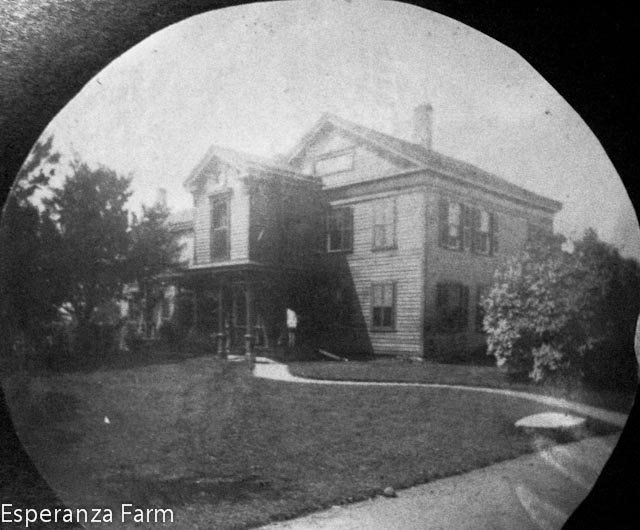
Esperanza, circa 1875-1880, mid-summer.

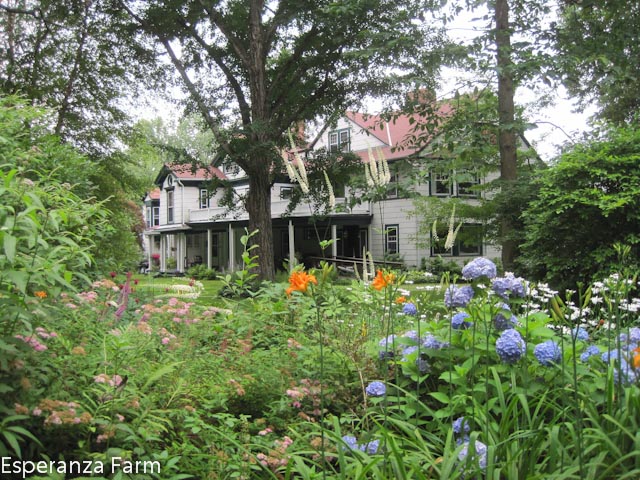
Esperanza, July 2011

May it continue!

Yale, Esperanza, and societal mores Thursday, Feb 23 2012 

“Young people liked to go to that house in Edwards Street (Hartford), and liked to be  invited to the family country home, known as Esperanza.  Yale boys were apt to spend a week or two there when college was out, the latter part of June, and there were always girls to go around. Picnics, rowing parties on West Hill Pond, straw rides with the oxen to draw us, private theatricals, charades, horseback rides, general good times kept us busy. All this was before what we know as weekends, and Mrs. Smith was criticized for inviting girls and boys together. Only the guest-house, Happy Thought, where the boys lived, saved the situation.”

That description comes from William Webster Ellsworth’s recollections of his first introduction to the family in the summer of 1876.  The gaiety of the college summer parties were a fairly short episode, really from 1873/4-1878.  Between 1879-1881, the summer parties still retained the core of the group drawn from (as WWE refers to them elsewhere) the ‘Yale boys’; but with Helen and WWE married, things naturally began to change.   Summer parties came to a near stop following Lucy’s* death in 1881 and then picked up again after Julie’s death in 1883. They were now organized by WWE and Helen, and were mainly friends from the publishing, theater and art worlds.  The range of activities remained the same, but with an ever greater emphasis on the performing arts, which seem to have been Helen’s passion.

This passage is also very interesting in regards to societal roles; and the more one considers it, the more complicated Julie’s position on the role of women apppears.  It is no wonder she didn’t get along with Hartford’s society.   However, one should not overstate the radicalism.  Julie was always at great pains to advise her daughters on proper behaviour, and dearly wanted all of them to marry; furthermore while she laughed at Morris’ concerns over proper dresses for the girls, she did not think he was wrong.

Of course, one also wonders what New Hartford thought of all this…

*Lucy Smith Davis; Julie’s youngest daughter, died in February 1881 following a long illness probably connected to childbirth complications.  Julie never recovered.

Feb. 19, 1879 Saturday, Feb 18 2012 

From Julie, in New Orleans, to Helen in New York:

….

“The Esperanza paper is lovely and is so nice of you and our son Will. We shall enjoy it exceedingly- we like the design- and it is so ‘very swell’ as Nelly Bunce would say.

Last week I chaperoned the girls to the Ball of the Lousiana Club. It was a magnificent affair, and as some man said of the party, “I have not seen such sights since I was weaned.” Morris plumed himself immensely upon his daughter’s dress, because they had waists and sleeves to them, you must get Lucy to show you what he said to her. He put his nose close to her neck and exclaimed, ‘my daughter I am glad you dont parade your charms.’  Next week we are going to the Rex Ball. I hope to gather items there for my book to be laid out here and apropos, I shall not touch the story we talked of till I can talk with you….”

I would dearly like to know which wallpaper they were talking about.  It is remotely possible that it is the wallpaper still in Opposite-To-It: a completely faded white with a floral border of yellow roses.  That would fit the time period, but it could easily have been one of the other rooms that was modified in 1893, possibly the Little Parlour or the room that was completely redone as the Main Hall.

The balls Julie is talking about are, of course, some of the balls leading up to Mardi Gras in New Orleans.  The Rex Crewe was founded in 1872 and is still active.  We know that they also attended, or at least were invited to, balls held by the other old line krewes (Knights of Momus, the Mystick Krewe of Comus, and the Knights of Proteus) throughout their time in New Orleans, in the 1870’s-1890’s period.  Julie, however, was clearly more interested in people-watching for her next book rather than partying, which is not surprising!

Love Letters, Feb. 1878 Sunday, Feb 5 2012 

The vast majority of the correspondence over the years between Julie and Morris tended to be primarily concerned with necessary information, how the children, the business, the finances were doing, or the day to day activities.  Very few letters are strictly emotional, though many will have one or two flying sentences.  Only rarely is the entire letter devoted to it.

In the winter of 1878 business was not especially profitable and Julie was still living in Hartford, liking it less than ever, but busy planning Helen’s wedding.  It may have been this that spurred a set of letters reflecting the strength of Morris and Julie’s, often long-distance, marriage.

An excerpt from Morris:

“I don’t believe that you will be satisfied till you see me, that I still love you, that the charm you bound about me years ago still holds. Wait a few short months and you shall judge. Perhaps it may do some service to say that I love you more than ever, which is the case, for I have not a thought or plan in which you are not dominant……

(description of the practical and the loving sides of their marriage)

….Have we not been through all the changes, from poor to rich and now again to poor and all with increasing fondness. Brockport to New York, Hartford to New Orleans, Chestnut Street to Carriage and Horses, and now to Esperanza with its quiet, its trees and sunny hillsides and one day we will sleep together in its quiet church yard, away from all the turmoil and strife of the world, you and I together. Lately I have often thought of this and Dear Julie, my wife, my love, my trust, I have no other wish but to be with you to the very last. I love to see you, hear you, to be sensible that you are by. Good night darling, you have my never dying love.”

Morris.

Concerning the title ‘Farm’ Tuesday, Jan 31 2012 

Historically, the house has sometimes been known as ‘Esperanza Farm’.  Today this title is not used, as the hayfield (as decent a crop as it is by Connecticut hay standards) is hardly a central point and certainly not an economic one, though its existence does save us around a thousand dollars annually. 

However, time that was…  During the late nineteenth century and through WWI, the farm made a decent income for itself.  Morris states in an 1874 letter that he has just instructed Mr Beaney, then the winter caretaker, to sell the potatoes…all hundred odd bushels of them.  While again, not much by modern standards, a hundred bushels is a respectable amount to have produced on a hilltop farm.  Unfortunately, he doesn’t record the price.  But it is safe to say that a fair number of people in New Hartford ate potatoes from Esperanza Farm.  Potatoes are mentioned other years, as are the sales of pigeons, vegetables, and later dairy products.* 

Esperanza Farm fit into a class of farm to which modern agriculture owes a certain debt.  These were farms run by people whose wealth came from other areas, but who had a deep interest in farming.  Today we tend to call them ‘hobby farms’, but in this turn of the century era, that title is incorrect.  For one thing, they added substantially to the local food chain and made actual money doing so.   More importantly, in the overall scheme, they could afford to take risks and to experiment.  They were interested in the science of it.  It was this type of farm that supported, especially politically, the rise of science in agriculture.  The nineteenth century subsistence farmer, amongst whom I include those whose entire capital got sown annually, could not risk an entirely new concept nor did he have the time, money and stock to selectively breed for improvement.  In many cases he wanted to, but could not afford to until the risk of the unproven had dropped.

Esperanza Farm was not, as far as I currently know, ever closely connected to any of the cutting edge developments; but it was definitely a part of that movement.  Were such farms those of hobbyists, dilettantes, dedicated amateurs, foolish risk takers, capitalist innovators? Depends…

*Project: dig through the odd ledgers hanging about for more info…

Trace sign Tuesday, Jan 24 2012 

While working on a lecture concerning conservation for a garden club, I had occasion to consider soil types.  For many people in suburbia, the history of the ground has little reason to intrude upon their conscious.  The North American appetite for the bulldozer means that most house lots created after 1950 have been regraded with topsoil taken away and/or added.*  This tends to create a uniform surface, the whole lot is one type of soil.**

However, Esperanza has generally lacked in the bulldozer department and it also happens to have a rather large lot and a fairly complex history.  This history is recorded in the soil and does not vanish.  The soil is predominantely a heavy clay till with a good scattering of rocks.  However, there are other pockets. The old abandoned road-bed is a compacted sand/gravel mix, well draining and low in organic material, despite the surrounding area growing up to trees this road-bed remains open. On the other hand the two old tennis court areas demonstrate very different tendencies. The most recent one is a fast draining sand/clay mound created artificially and abandoned circa 1930, that has happily regrown as pine trees.  But the early one was a packed clay court, probably created simply by rolling the native clay, and it reverted to Norway maples and multiflora rose, both invasive species capable of dealing with that type of compacted clay.  It continues to be a difficult area to grow plants on, despite over a century of organic material having been laid down.  Elsewhere, the less disturbed soils tend to revert to oak and birch, with cherry, red maple, and cucumber magnolia also appearing.

And then in the hayfield…the two ploughed sections, the horse’s paths, they will probably continue to show up on Google Earth’s imagery for decades.


*yes, I actually saw one house lot where the builders took away the soil, and the house-owner later (no doubt at great cost) re-imported soil.  Someone’s genuis at work there.

**For those of us with a bent towards archeology, it is also somewhat worrisome: one bulldozer can, in a matter of minutes, remove thousands of years of stratigraphy, leaving one with a blank slate, no doubt appropriate for today’s culture.

Jan 23, 1854 Monday, Jan 23 2012 

From Julie to Morris; Julie was at Red Cottage in Brockport, NY, Morris was in New Orleans; taken from a letter that was some forty handwritten pages long (surely some sort of record) though some pages have gone missing.

“It is a very cold evening, no soft southern breezes fan our cheeks with perfumed breath, no flower odors greet us, no rich green leaves wave and whisper and nestle; but the fierce wind rages and roars and sweeps along with majest. It is very cold. Courageous is the soul that ventures abroad this day. I shall sit by my ain fireside, that is to say my own stove (what a miserable substitution as far as poetry is concerned) and sew, ‘stitch-stitch-stitch-gusset and band and seam’.

Lottie is in her waggon playing with divers and sundry odds and ends such as half an apple core, a bit of shingle, a tin cup and such like. They are just as pleasant to her as if they were worth solid gold. She is in a very conversable humor and says constantly, ‘Ajax-see there!’  These two words being her stock and trade in the conversation line.  Where she made the acquaintance of the said Ajax it is impossible for me to determine. I suspect however he must have been an adorer of her’s in some former life away back in olden times when the world was young. Perhaps she helped him ‘some rocks vast weight to throw’. Perhaps she walked and talked in the sweet moonlight with Clytemnestra, before she did the fatal deed which wrote her murderess. I often think there is a deep spirit in her dark eyes, which we cannot fathom.”

Mid Jan. 1877 Saturday, Jan 14 2012 

From a letter by Julie to Lucy, Julie was in Hartford but it isn’t clear where Lucy was.

“We have all finished Mark Twain’s new book- it is very entertaining- but not very high toned- not such a book as I should think he would want his little girls to read.

…Carlotta is reading Dickens. Mattie Kilbourne is coming here this afternoon. I do not like Mattie Kilbourne very much. I can’t go out driving this afternoon because- the snow has melted so as to let the horses’ legs down through and I am afraid they would break off and leave me nothing but two bodies on top and I don’t much like bodies.  Now here comes a dun. I have paid the bill, it was not an honest bill but I paid it and I hope the money will bring Mr. Linus Fern into trouble as I have no doubt it will.”

This is a rather interesting letter on several accounts.  It comes from a group where money, 1876-77 was overall a bad economy, was a constant concern and colored the correspondence.  What is particularly interesting is the overall tone of the letter, despite being about two pages long (handwritten), the letter has a stream-of-conscious style which is very revealing of Julie’s mood throughout the day she was writing it.  Her ‘voice’ is very clear.  Unable to get anything written but letters, she was also feeling trapped by Hartford’s society demands and, physically, by not being able to get out thanks to the weather.  A whole paragraph states how she would prefer to be at Esperanza.  Lucy was essentially a confidant for Julie for more personal matters than the letters to Helen or to Morris; Lucy was in frequent correspondence with her mother and the first section is social advice from Julie on how Lucy might select a proper gift for Mrs. Davis (Lucy’s future mother-in-law). 

This sort of letter has almost entirely vanished from the current record, the phone has replaced the ‘sounding board’ aspect, email the social advice aspect.

It also neatly summarizes Julie’s attitude towards literature.  I do wonder what she would have thought of the modern television show….

Jan. 7, 1910 Saturday, Jan 7 2012 

From the local news column of the New Hartford Tribune, the source of perfectly delightful gossip.

“Miss Smith, manager of Esperanza Farm met with an accident Tuesday morning while delivering milk to her neighbors. The sleigh turned over near Miss Kate F. Holcomb’s throwing out the contents. The horse continued on its way to G.C. Kellogg’s where it was caught and placed in the stables. The damages were slight. The cold and high winds were severe with zero weather.”

Miss Smith was Fannie, (Julie’s daughter).  What is interesting about this comment is that it conclusively shows that Fannie at least was living here year-round.  She lived in the cottage across the lane.  This parcel, since sold, was the site of successful, model dairy farm run by Fannie.  She was very interested in the science of improving dairy farming and held a voluminous correspondence on the subject with the various state agricultural stations, Cornell University and other institutions.  It must, however, have been something of a change from her earlier career with Steinway (pianos).

« Previous PageNext Page »