Pergolas Tuesday, Jan 3 2012 

And the building thereof.  There was a pergola at Esperanza at the turn of the last century.  It had square white pillars, echoing the porches, and appears to have had few vines.  It had as a south focal point the bust of the faun; as such it was more of a structural ornament as opposed to a structure built for the vines first.  It didn’t last long, it was probably built around 1900 and seems to have vanished by 1930.  One of its main uses was in the enactment of tableaux scenes generally of a vaguely classical theme.*

We are contemplating a new pergola on the same location. However, this one is going to be dual purpose: both growing grapes and creating a structural element.  Figuring out how to make it visually work from all angles: the south lawn, the driveway entrance, the house, and built so that it can take the vines is a bit of project.  Part of the difficulty is the house’s outward looking architecture: as mentioned previously the house looks to its surroundings, its rooms are designed to immediately connect to the outdoors and the porches blend into the lawn.  This means that structural elements outside have to work with the house even when they are not physically connected to the house.  Their style must compliment the house’s style.  Sketches have ensued, as has a small forest of poles to determine which edge lines up with which other edge.  I think Photoshop may become involved…

In addition to space for grapes, the pergola will also add an edge to the south lawn, so that beyond it the lawn can gracefully transition to the woods through a bit of meadow grass.  The area has a tendency towards some of the wild flowers already: paintbrush, pussytoes, violets, bluets, blue-eyed grass, wild dianthus, wild geranium, wood sedge, etc. are all present.  But most of the south lawn is formal and structured and simply stopping regular mowing at an arbitrary line looks peculiar.  Yes, shrinking the lawn is a goal too!  Along with the pergola, a replacement for the pear tree will also be planted. 

Assuming we make the transition from planning to reality…always the hard part!

*It is interesting to note that the word ‘pergola’ doesn’t enter the English language until the 17th century.  It is slightly different from the word ‘arbor’ from Middle English.  They essentially mean the same thing; but arbor’s etymological roots give greater weight to the vines or trees whereas pergola, coming from the Italian word for a projecting roof, gives greater emphasis to the structure.  You can create an arbor out of trained living vegetation, you can’t create a pergola.  So, if the vines become more important than the structure (which they will) it should be an arbor, unlike the c.1900 one which was always a pergola. 

*I could write quite the post on the tableaux, a form of entertainment that has vanished quite completely from today’s culture.
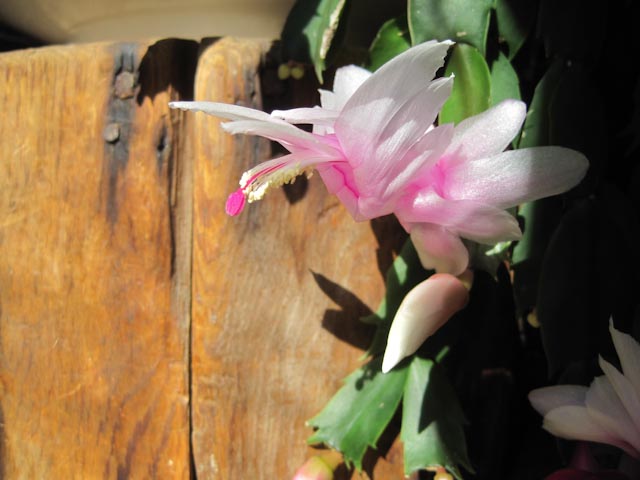
Christmas Cactus Friday, Dec 30 2011 

Actually, this one is technically a Thanksgiving Cactus of the Schlumbergera truncata group, as opposed to the S. buckleyi group as shown by the pollen colour, leaf shape, and flower position.  See: http://en.wikipedia.org/wiki/Schlumbergera

We have a very large Christmas Cactus as well, my grandmother had it for years and it now has branches several feet long.  They are ideal house plants, not minding partial darkness, occasionally forgetful watering, and so forth.

Indoor plants are remarkably useful in a house, they add a living touch as well as potentially ornamental/sculptural effects.  They are also an innovation of the mid nineteenth century for the majority of the population, a combination of central heating and the colonization of the neo-tropical regions from which most houseplants hail, including the Christmas cactus group which comes from the coastal mountains of southeastern Brazil.  While the use of southern exposure and walled gardens to extend the growing season and to fiddle the garden’s zone one or two levels dates back to the Classical World, the idea of a Glass enclosed, heated environment wasn’t possible until the modern era.  That a house could have enough light and heat to grow plants which needed longer days and temperatures staying above fifty must have been a revelation for the frustrated gardener.

Windfalls Saturday, Dec 17 2011 

One of the unseen benefits of gardening on a large property is that you can gather many materials that you would otherwise have to buy.  A gardener working on a small urban property can, with care, make excellent compost and a fair bit of mulch; however, other types of material are generally not possible.  Although, I suspect that with a bit more space materials for woven fencing, either from willows or pollarded trees, would be possible.  Pollarding trees is, however, a decidedly labour intensive task. 

That being so, I am rather appreciative of the fact that pretty much every year I can count on a literal windfall: enough pine or other evergreen boughs to cover the garden areas and shrubs most sensitive to winter wind and sun burn.  It does require time, of course, but not much else.  Sometimes it is a tree that had to be cut down, a blue spruce the other year, this year it was pine boughs broken in the big October snow storm, another year it was a thoroughly unexpected pine that snapped in the woods.  It is a very satisfactory feeling to collect from the land what you need, one is perhaps even more blessed if one is in the position to do so, but not in the position to Have to do so…

…now if only I could get the pine sap out of my jacket….

Crocus (croci or crocuses?) Tuesday, Oct 18 2011 

1200 of them to be precise, actually to be very precise 1101, as Mom planted 75 in another garden and I have reserved 24 for forcing in pots.  In theory the West Meadow fence line will shift from pale violet in late March, through cream yellow and blue to true yellow, pure white, and blue in early April.  In July it is orange from the daylilies I planted this spring, which are very happy.  My right wrist is, I believe , mildly sprained.

I think I have mentioned that gardening is an act of faith.  I have had bulbs fail completely due, probably, to problems in shipping.  I rather hope that these work, but I won’t know for another five to six months.  And assuming the thousand pound rabbit keeps his feet off of them…

Falling ahead Sunday, Oct 2 2011 

We often see fall as an ending, a death.  In a very real sense this is the case, many plants and animals will die in the winter.  Yet, it is also a time of opportunity.  Fall is a great time for planting certain things.  Spring bulbs (daffodils, tulips, etc) are all planted at this time, if possible after the squirrels and other rodents have stockpiled their food for the winter but before the ground has frost in it, anytime between early October and December depending on the zone.  After deciduous trees have gone dormant (October to Novermber) they can also be planted.  This allows them to establish their roots without having to support leaves, excellent for those of us carrying water buckets as it reduces our work. 

Fall clean up of gardens reduces next spring’s work, it sets the stage.  Cleaning the garden reduces overwintering pests, reduces the potential for rot and is an excellent time to weed, ensuring that only the plants you want are there.  Of all the seasons fall looks farthest into the future.

Asters Friday, Sep 16 2011 

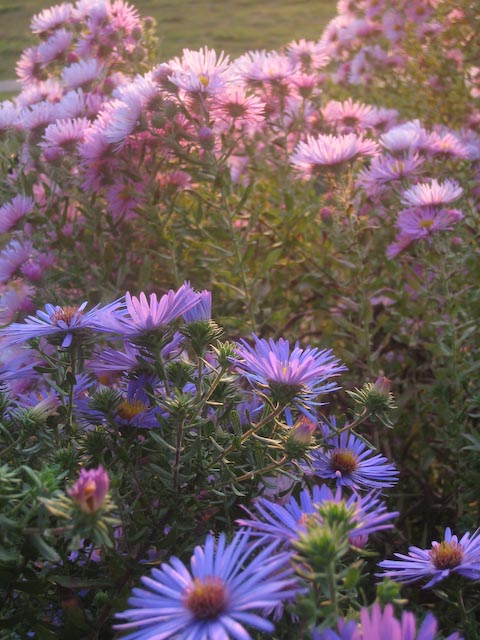
Asters (a huge and confusing family, that according to the molecular botanists should be split apart) are one of the stars of fall.  The blues, pinks, wine-reds, and whites are all dusky.  They are antique colors, not the saturated hues of summer.  And even the modern hybrid crosses stubbornly refuse to be excessively extravagant and exotic looking. 

The ones in this picture are descendants of the novi-belgii and novae-angliae group, the New York and New England native asters.  Some of the other modern garden types are descedants of the Michaelmas Daisy (A. amellus), the European aster family.  The North American group  includes the prolific white wood aster, blue wood aster, heath aster, stiff aster and a myriad of others.   All plants that go from dull green foliage to a profusion of white or blue flowers in September, usually without any care or feeding.  Indeed, the white wood aster is more than capable of taking over any area.  The New York and New England asters will grow in nearly any soil, from boggy to dry, though they don’t tolerate salt.  They need some sun; ideally full sun, but are more than happy to grow on forest edge.

The aster is one of the plants where the North American species has as much, if not more, to recommend it when compared to its European cousin.  It is a whole set of posts to ponder why the long preference for European or Asian flowers in North American gardens, and why in recent years that has changed. 

The aster family is an excellent example of how modern science continues to debate and refine our understanding of the natural world: what was one genus has now been split into many, thanks to genetic studies.  It is also a flower whose name evokes history.  Aster is, of course, from the Greek.  Michealmas recalls the old English calendars and hooks to whole symbology, from the naming of school terms to astronomy to Christianity, that lies behind that single word.  Novi-belgii and novae-angliae serve as reminders of the complexity of the European settlement in North America, for the New York aster’s Latin name stakes the flag of Belgium.

The coming Fall Wednesday, Sep 7 2011 

We tend to think of Fall as the end of the growing season.  Yet, in New England or farther south, it can also be a last flourish and a promise to the coming year.  In more southern areas, late fall (November) is a time to plant many seeds that need a bit of extra time in the spring.  The frost cracks in the soil work the seed downwards.  Here in Connecticut, late fall is a time to plant dormant trees.  From October through November, planting trees at this time allows them to establish roots without having to support their leaves.  For the planter it means far fewer trips with the water bucket.  Early fall is a last flourish.  The lawn, which has sulked through the summer heat, suddenly starts growing again; the asters, goldenrod, chrysantheums all put on a spectacular show; the garden can produce another round of lettuce and spinach, while things like kale grow much larger.

Early fall is definitely here, the ashes have begun to turn and some of the early birches.  A few of the shadblows have started to turn, jewels of gold, amber and crimson floating in the dark green understory.  The horse has shed his summer coat and now grows fuzzier and glossier, darker.  It seems, always, to happen overnight.

Gardening in time Saturday, Sep 3 2011 

Gardens are generally classified by types of formality (cottage vs parterres), cultural (French, Italian, English), use (vegetable, perennial, cutting) and so forth.  Yet, gardening (as opposed to gardens) divides itself by time.  There is, of course, the relentless seasonal clock.  This yearly cycle’s implacability is both a frustration and comfort.  The seasonal change is often a relief for the garden.  Winter, at least in New England, cleans the garden; fall and spring clean-up is as vital to its health as division, planting or trimming.  It means that the evil looking squash bed will soon be swept away, and maybe next year will be better.  The seasons guarantee a constantly changing landscape, always something new to look at.

But time is also a much larger construct in gardening.  A garden can be a seasonal, decadal or generational construct.  A vegetable garden or cutting garden can be created for a season, from bare earth to bare earth in less than a year.   It doesn’t have to, of course; it can have a permanence in the use of borders or perennial herbs, horseradish, rhubarb, wormwood, thyme, tarragon…so forth.  A perennial garden needs a decade at least, it changes yearly as plants expand or die, but the best results are about five years in on a plan.  The master gardener is one who can continue to plan within the existing garden, they don’t need to start fresh every few years.  But then there is the landscape gardener.  They work with, and must have the patience and vision for, shrubs and trees.  The results of what they plan will usually  not be seen by them, but they know it any way.  Here the master is one who not only can work in the existing structure, but whose plan is pleasing at all stages of its growth.  While a perennial bed can look odd in its spring that lasts but a few weeks, a landscape’s spring lasts for decades, it must always work, even if its ultimate triumph is a century in formation.  Ideally, all gardens (landscapes) should incorporate the three senses of time, from the vivid flash of the impatiens to the oak’s centuries. 

If only!

« Previous Page