Year Round Gardening Sunday, Mar 11 2012 

Theoretically, in mild years such as this one, you can probably find something that is in bloom throughout the year at Esperanza.  It does take a little bit of work, and a few non-natives: the Chinese Witch-hazels have a longer blooming period than either of the two native American ones, which tend to avoid January.  Heather, if correctly located, will also bloom throughout the winter, as will some of the Hellebores (which we have not as yet had much luck with). 

However, these are definitely oddities.  Spring here starts with the with the two snowdrops: the large Leucojum and the smaller Galanthus.  These like the wet, partially shaded woodland edges and have been in full bloom these last few days.  Also starting up are some of the species crocus planted against a south facing foundation wall.  From now through the end of October something will be blooming here.  Rather nice, that.

Camouflage Tuesday, Mar 6 2012 

One of the largest landscaping headaches at Esperanza is the presence of a state highway running across the front of the lot.  Although this road was moved about fifty feet away from the house in the 1930’s, the massive increase in traffic makes it a constant presence in the landscape.  One of the goals, therefore, in the landscaping is to build a barrier between the house and the road.  Now, you might ask: why not build a fence?  Two reasons: number one, a truly effective sound/light barrier is costly.  Number two is that a fence which can’t be seen through is an attractive nuisance.  People decide that there must be something interesting behind it, something that makes trespassing inviting.

So trees it is.  Besides I prefer trees.  It is a Slow process, but if you drive past at 60 and are not actively looking, you probably won’t see the house.  We still hear and see the traffic, but there is an illusion of distance.  I count as a success the bicyclists, who I recognized as having gone past all summer, suddenly yelling “there is a house back there’ one day in the fall.  I also count as a success the state highway truck that refused to believe the drive was a drive.  I say nothing about the individuals’ situational awareness.  In general, one can safely assume that people don’t see things.  But there is a trick to this, the trees can’t look ‘planted’; they have to read as a forest, which means it has to be a forest.  In this case, it appears to be a mature mixed hardwood forest with a strong evergreen component.  Furthermore, because we want to keep the concept of distance, the dense planting must be close to the road, with a mixture of trees, understory, and strategic but visually pleasing clusters closer to the house.* 

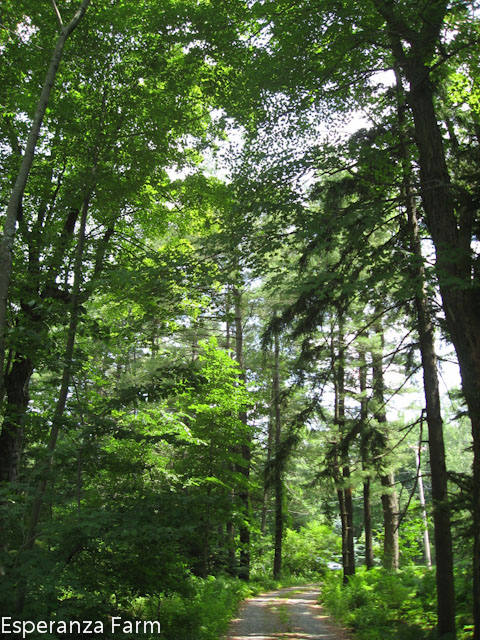
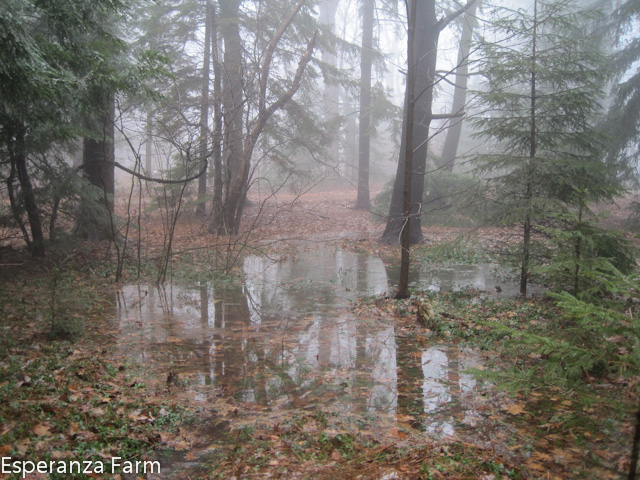
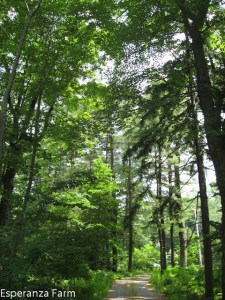
It is very complex section of the property, the description of which I won’t bore you with, but an idea is given by these photos which were all taken on the drive.  We obviously have the advantage of a century here for the large trees, but the strategic understory is a creation of the last decade. 

In the summer, the view from the drive entrance:
In the winter, looking out the drive from the pillars, at just about the farthest point of the drive in the summer picture. Here you can see how the barrier is still quite thin, the loss of one hemlock created that hole just to the right of the plow truck, the trees you see beyond are actually on the other side of the road:

And a view from in the woods, looking at the road but in fog, showing rather well the varied ages and spacing, much of which comes from nature being allowed to run its course:
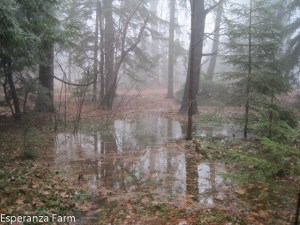
 

*Mercifully, trees want to do this, forest edges form dense thickets, while areas under closed forest canopies tend to be open.  Transitioning the edge from ineffective, ugly and invasive Norway saplings to native, or non-invasive species, is a bit harder though.

The Poor Man’s Fertilizer Saturday, Feb 25 2012 

We finally got a few inches of wet snow on unfrozen, bone dry earth and the temperatures have meant that much of that snow has soaked into the ground.  This is particularly evident in areas with leaf, grass, or other organic litter.  Field grass, which was desiccated, has been softened, its light gold color picking up some deeper brown and ochre shades.  The same effect has occurred in the woods: walking in the woods a few days ago was a noisy exercise, more reminiscent of mid-fall, today the rustle of leaves is muted and replaced with either the muted footfall or the crunch of ice. 

Late winter or early spring snows on partially thawed ground have long been called the poor man’s fertilizer.  It turns out that there may be some validity to this, as (if the conditions are precisely right) the moisture and possibly some of the nitrogen compounds carried in the snow may be leached into the ground in a slower and more effective fashion.  Certainly, several rounds of spring snow is better than solidly frozen ground, large amounts of snow, and then an abrupt, fast thaw.  But that may have more to do with the amount of water which is effectively absorbed into the ground rather than running off, and less to do with the chemical compounds in the water.  Still no matter the science, the ground today has a kinder feel.

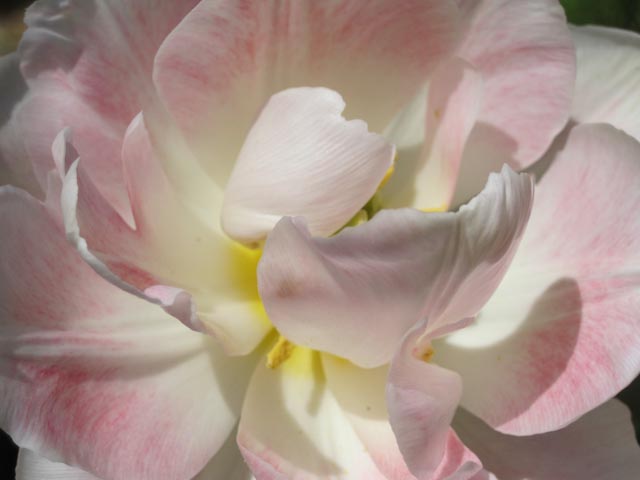
A tulip photo Tuesday, Feb 14 2012 

In honor of a certain holiday, a nice spring flower from last year, a double, parrot tulip to be exact.

Waiting for a miracle Monday, Feb 13 2012 

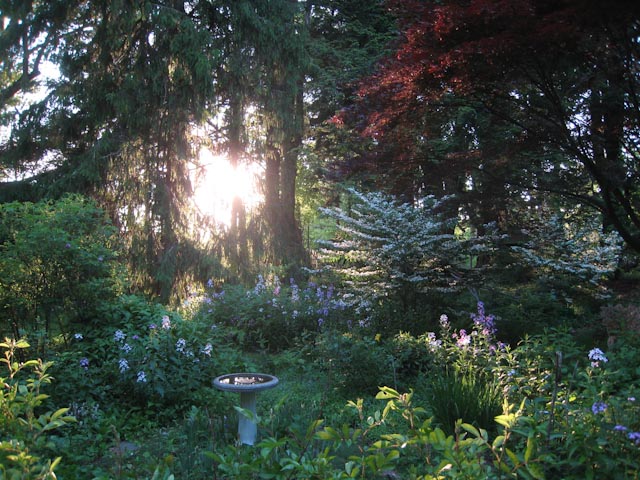
It sometimes seems incredible that in three months time, images like this will be commonplace around here.  Especially this year, when everything is dry and brown.  Waiting, impatiently!

That picture is a corner of the north garden.


Ease of Access Wednesday, Feb 1 2012 

Landscape design appears to revolve around the point of visual aesthetics.  However, as any good gardener, architect, stage designer, etc. can tell you function trumps beauty.  They can coexist, of course, as equals; but if it doesn’t work…you probably ought’nt build it.  

Well, ok, but what does that mean?  For landscape design around a house* it means several things: first, all sides of the house need to be accessible with a long-bed pickup truck: that means a path eight feet wide and at least eight (ideally ten) feet tall that is driveable.  No retaining walls, no low limbs, no shrubs.  The path can be meandering, but it needs to be there.  Why?  Because someday the roof will need to be redone and they will need to put scaffolding up.  You don’t need access to all of the side, but at least to a corner. 

Secondly, all garden beds need to be accessible with a small lawn tractor, they also need to be designed so that the radius of curves and the widths of the paths are at least the width of the lawn mower…not an inch less than the width.

Third, emergency vehicle access (also the same as UPS truck access).  Yes that may be a very pretty tree limb romantically stretched across the drive.  However, it will be a pain if UPS refuses to scratch up their paint job and drops the package on the roadside, it will be more than unfortunate if it blocks the fire engine.

There are other things of course…. 

But the above explains why I spent some time carefully trimming the River Birch, the climbing Euonymous, the Burning Bush, the Wayfaring tree, and the Cucumber Magnolia along the drive…in order that the UPS truck would cease its peregrinations upon the lawn…only to watch them stop by the road (at least they walked in with the package though).

* Please note, I am thinking a house of this size and complexity…a small bungalow or ranch may well be a different proposition.

The Winter of the Spring * Thursday, Jan 26 2012 

This year, when winter has been a fleetingly erratic guest, though there are still a few months to Spring proper, the signs of new growth have never been far.  I was very glad to see the other day that the crocus (croci?) that I planted last year are beginning to appear.  It was a bit nerve-wracking to plant some 1200 bulbs.  One can’t help but wonder if the shipment was good, since I have had an entire shipment get fried before, and, of course, one doesn’t know till after they are planted, long after.  But it looks like they will come up, probably even many of the ones that my horse stepped on.  (it is slightly ridiculous, I have resorted to spraying Deer-off along the fence, because out of 15 acres that is where he Must walk and eat)

And hopefully, they will look like they ought…though the mutant in the pot we forced has me worried; it is about five inches tall and is a set of white sheathed spears, unfortunate at best.

*Shamelessly stolen from John Greenleaf Whittier’s poem: ‘A Dream of Summer’

Trace sign Tuesday, Jan 24 2012 

While working on a lecture concerning conservation for a garden club, I had occasion to consider soil types.  For many people in suburbia, the history of the ground has little reason to intrude upon their conscious.  The North American appetite for the bulldozer means that most house lots created after 1950 have been regraded with topsoil taken away and/or added.*  This tends to create a uniform surface, the whole lot is one type of soil.**

However, Esperanza has generally lacked in the bulldozer department and it also happens to have a rather large lot and a fairly complex history.  This history is recorded in the soil and does not vanish.  The soil is predominantely a heavy clay till with a good scattering of rocks.  However, there are other pockets. The old abandoned road-bed is a compacted sand/gravel mix, well draining and low in organic material, despite the surrounding area growing up to trees this road-bed remains open. On the other hand the two old tennis court areas demonstrate very different tendencies. The most recent one is a fast draining sand/clay mound created artificially and abandoned circa 1930, that has happily regrown as pine trees.  But the early one was a packed clay court, probably created simply by rolling the native clay, and it reverted to Norway maples and multiflora rose, both invasive species capable of dealing with that type of compacted clay.  It continues to be a difficult area to grow plants on, despite over a century of organic material having been laid down.  Elsewhere, the less disturbed soils tend to revert to oak and birch, with cherry, red maple, and cucumber magnolia also appearing.

And then in the hayfield…the two ploughed sections, the horse’s paths, they will probably continue to show up on Google Earth’s imagery for decades.


*yes, I actually saw one house lot where the builders took away the soil, and the house-owner later (no doubt at great cost) re-imported soil.  Someone’s genuis at work there.

**For those of us with a bent towards archeology, it is also somewhat worrisome: one bulldozer can, in a matter of minutes, remove thousands of years of stratigraphy, leaving one with a blank slate, no doubt appropriate for today’s culture.

On Choosing a Plant Monday, Jan 16 2012 

It being January, I am naturally flipping through a stack (it really is a stack) of plant catalogues, with the added dimension of surfing a series of garden websites.  The number of plants I would like to plant is rather large, the bank account not so large, and so a selection process occurs.  In the process of that, I am also considering why I want this plant or that plant.  What is that attracts me to it?

Two things it seems.  The first is a strong desire to re-establish as many native species as I can.  This was an almost reasonable urge when I was eyeing trees save they take a great deal of space and take quite some time to grow, having gotten intrigued by the woodland herbaceous types….well.

The second is a more complicated one: that is the history of the plant in relation to man.  Names are the beginning of this: if a plant has succeeded in getting an intriguing common name it is of more interest to me than if it is still a straight botanical name.  In this I betray myself as a humanities scholar and not a botanist; this means that Trillium recurvatum, aka ‘Wood Lily’ or ‘Bloody Butcher’ is more interesting than Trillium pusillum, aka ‘Dwarf White Trillium’.  Both are equally elegant natives, therefore attractive on that alone, but the former’s common name suggests a longer human awareness of it.   Plants such as Goldenseal, Mayapple, Solomon’s Seal, Shooting Stars, the list is endless, are not simply beautiful natives; they are also living reminders of the rich relationship man has had with the natural world.

This interest in the human/plant relationship is not limited to names and botantical folklore.  Art enters into it: I am eyeing a perfectly lovely double columbine called ‘Ruby Port’.  Why? Because it is precisely the same flower as shown in an illuminated manuscript from the late 1400’s.  I have a thing for the medieval plants; but I also have an interest in the plants of the late Victorian period.  Why? Because they are, dare I say it, ‘period correct’ for the landscape….of course, it also is an excuse to sometimes go after the eye-catching Asian species!

So can one come up with a healthy, primarily native plant landscape with accent plants of medieval European and nineteenth century American garden heritage? Well yes, but knowing that doesn’t help me narrow the list down…grr.

Snow or lack thereof Tuesday, Jan 10 2012 

Having had Snowmageddon* back in October we now have no snow, on the other hand it isn’t cold.  This isn’t especially good for plants, though it would be much worse if it was very cold and there was no snow.  Yet, it is also an interesting reminder of how plants react to light as much as temperature.  Most trees for example are primarily attuned to daylight length, and will wait for spring regardless of the warmth.  Temperature does play a role, of course, especially in how sap is released; this year will be terrible for maple syrup.  Furthermore, early warm spring once the daylight hours have really begun to shift will cause them to break dormancy.  But fifty degree weather in January doesn’t flip the chemical switch.  Some perennials, however, are attuned to soil temperatures with little attention to light; these are a bit confused and are not quite dormant or are almost dormant.  The hollyhocks, parsley, kale are all sort of still trying to grow.  I haven’t a clue as to whether this is good or bad. 

May you live in interesting times, indeed!

« Previous PageNext Page »