Thou shalt not… Monday, Apr 23 2012 

poach wild plants.  A bit of gospel I generally agree with, the survival rate of such transplants is often poor and most could be cultivated.  Unfortunately, the nursery business has only gradually begun to expand into rare native plants.  Many are also hard or slow to propagate, pushing the price up; it is often easier and cheaper to knick the plant, so no surprise that people do.

There is one form of which I approve, well two: the first is, of course, shifting plants about on one’s own property.*  The second is the rescue.  This isn’t that common.  Generally, unless you know the bulldozers are coming as you dig (we got most of our double daffodils that way) it is not a rescue but is theft.*  However, I could not resist today.  Last year the town, following the hurricane, widened the dirt road by almost a foot in some areas and raised it by six inches, creating high gravel shoulders where there were once dirt banks.  Now, the town doesn’t give up road width once it has created it; so those graded, gravel shoulders are here to stay.  In the stretch by our hay meadow, some Christmas, Lady, Marginal Shield, Interrupted, and countless eastern-hay scented ferns, along with a bit of Solomon’s Seal, were trying valiantly to come up through the two-inch sized gravel.  Even if they could live in the gravel, the annual grading and the snow plow will doom them.  I rescued some of them (not all, I would be out there forever).  I have re-planted them along our drive and in the woods, hopefully in the correct conditions.   I may go back for more.

*Even from distant bits to other distant bits; following the rule of never taking the entire colony, however.  If only so that if you screw up the transplant, you haven’t lost all of them.

*Actually, legally this is still theft…(well unless you have permission!)

What is blooming? Tuesday, Apr 17 2012 

Finding it far too much work to actually write something, a list, not comprehensive of what is blooming right now, within 100 yards of the house:

Maples: Norway, Sugar, Red; the Red is almost done, Norway well along, the Sugars are just starting

River Birch

Spice Bush (Lindera Benzoin), nearly finished

Japanese Quince, nearly finished

Forsythia, nearly finished

Evergreen, small leafed azaleas, starting

Redbud, starting

Crabapples, starting

Apples, almost starting

Peach, finishing (oops!)

Wild and cultivated cherries, starting

Shadblows, full bloom

Blueberries, well along

Red Currants

Spice currants, also known as Yellow, buffalo, Ribes odoratum ‘Crandall’s’

Scarlet Elder, just starting

Daffodils, past the midpoint

Scilla, nearly done

Tulips, starting

Muscari, full bloom

Pulmonaria, full bloom

Spring trout lilies, also known as Dogtooth violets (all of one blossom, they take for ever to get to mature size)

Trilliums, red and white, just starting

Bloodroot

Five or more species of violet by the thousand

Pussytoes, a listed rare species here

Bluets, by the thousand

Various native sedge/rush types

Bleeding hearts, just starting

Greater Celandine

Creeping Phlox

Strawberries

Dandelions

Both types of Gill-over-the-ground

Sorrel

other, I am sure I am missing something….

Well, obviously Sunday, Apr 15 2012 

You know how one can look at something all the time (in this case all one’s life) and not see it?

The other day, contemplating the Norway Spruce out to the east of Happy Thought it finally dawned on me that it really was different from the others… shorter (all of 80 feet), a darker green colour, narrower cones, bright magenta young cone buds, and….long hanging branches….much longer and much more draping than the normal habit of a Norway Spruce.   Why! It is a weeping Norway Spruce.  A fully mature specimen and not so extreme as modern cultivars of ‘weeping’ trees; but nonetheless distinct.  I shall have to stop and look, halfway up the hill there is another tree that appears similar.

I feel very stupid.

(pictures at some point)

Planted! Thursday, Apr 5 2012 

Three grapevines and two kiwis (of the pink variegated leaf and fuzzless fruit variety…really!).  That doesn’t sound like much, except of course for the minor detail of creating a garden bed running that side of the pergola.  You know the old term, ‘sod-busting’?  It has fallen out of use these days, but when the lawn is healthy, undisturbed for several decades, and composed of numerous perennial ground-covers (thyme, grasses, mints, violets, etc.) cutting through it becomes hard work.  You can bounce a blade off of it, if the angle isn’t vertical and the force isn’t great enough.*

I do hope the plants by the pergola do as they ought.  It will eventually include a honeysuckle, a rose, several clematis and space for a swing and a bench, as well as areas for the scented geraniums and the other tender perennials to be set out in the summer (I believe there is a fuschia and a begonia that are supposed to hang from the beams).  Very classic, which is of course in keeping with the location.  Well, the kiwis aren’t classic, but why not experiment a bit?

*Taking five minutes out to recreate even the most cursory of edges on the cutter makes a real difference.

Daffodils II Tuesday, Apr 3 2012 

Although the weather has been odd for spring has come early, erratic and hurried, and some of the daffodils have not done well this year (overcrowding is the main culprit), we have still enjoyed them in the hundreds.*  That the forsythia, gold; the quince, crimson; the siberian squill; lapis blue, are also all blooming at the same time makes for a spectacular display.  Combine that with the spring green of the young leaves on some of the shrubs, the deep green of the fields, the wash of red in the maples, and the blue sky….not bad, not bad at all.  Soon the apples will be blooming, white and pink, and on the forest edges, the shadblow in clouds of ivory, the redbuds in all their brilliance, will appear.

A good day to spend planting two new pear trees and working on repairing an old, iron garden seat that needs work.

*Literally, at least a hundred have been picked for one thing or another, and easily three times that number are outside.

Ego Stroking Saturday, Mar 31 2012 

It is always nice to have a professional admire the place.  In this case our arborist, who really appreciates our trees; since he has also worked at some arboretums, he has a certain standard of comparison.*  In any event, incidental to getting a quote on some preventive maintenance pruning in the big oaks and the Japanese maples.  The trick is to balance aesthetics and health.  It is straightforward with the oaks, take out the dead branches, give the young red maple some space…well, except all the branches in question are fifty to eighty feet up.  The Japanese maples are more of a challenge.  Thinning the crown a bit to let the smaller one have more light and to remove unhealthy branches that use more energy than they bring in or removing vigourous but structurally weak branches.  Very logical: if this branch is cut then this branch will do this.  But it requires thought and more skill than I have, especially with old Japanese maples.  I’ll stick to the apple trees and various shrubs; not only because I can reach them, but because they are much more forgiving.

*Of course, it shouldn’t be my ego, I didn’t plant those trees!

Meditations on Climate Change Thursday, Mar 29 2012 

I am not a fan of the Global Warming School, mostly for the simple reason that I don’t care for deliberately perverting scientific theory in order to advance an ideology. 

That being said, I do recognize that the climate does appear to be somewhat erratic, for whatever reason, and that it may be more erratic than it has been in the last century (a blink of an eye for the climate time scale). The case in point: a dry, snowless winter, followed by zero rain in March, the watercourses look like it was August.  Additionally, the temperatures rose well above seventy for two weeks in a row.  Followed by an overnight drop to nearly eighteen.  The result is not unexpected.  We are now back in ‘normal’ March weather of forties, windy, and finally a small bit of rain.

Many of the New England native plants are hesitant, they respond to daylight length more than temperature, so if the dry spell has really ended and normal rainfall patterns occur they will be alright.  Their main growing period is April, the dry winter will stress them but not unduly.  But anything from farther south, or other continents, will start growing in March here, if the temperature is high enough; additionally such plants are utterly unable to deal with a hard freeze.  This includes: peaches, magnolias, forsythia and numerous garden plants.  Whether or not the peach’s blossoms have been killed by the freeze earlier this week is as yet unknown, one has to wait a week or two.  Most people’s magnolias, and some forsythia, have turned a rather unattractive brown, however.  Also stressed by the lack of March water and accelerated by the heat are the various bulbs: crocus, daffodils, tulips, snowdrops.  The hard freeze didn’t hurt them, but their bloom time has probably been halved.

So, I am complaining about flowers, nice to be me?  Well, yeah. I’m lucky, it could be a tornado or severe drought, I know that very well.  But, if the peach tree is frozen, that is about two hundred dollars of peaches and 24 pints of canned peaches that won’t happen.  It is a maple syrup run that was the same as last year, despite an extra 150 taps.  It is an unexpectedly frozen faucet and burst pipe, it is damage to plants that would otherwise not need replacing.  This is how the cost of climate change begins to add up, even amongst the Western world’s middle class.

Meditations on Garlic Mustard Thursday, Mar 22 2012 

Certain tasks, in their simple, semi-repetitive nature, let the mind wander.  Sufficient physical activity focuses or perhaps distracts the surface thoughts, allowing the inner mental activity more room.  A recent study on workplaces found that if workers got away from their desks and did some sort physical activity they were more creative.  Nothing new there, at least not for someone who developed pretty much all of her essays and theses will away from any sort of desk.

Why does this lead to Garlic Mustard?  Well, I spent the better part of the afternoon pulling the stuff, trying to eradicate from several areas.  It is an easy weed to pull, despite its long taproot, easy to identify; but the physical activity of paying sufficient attention to not pull everything else, to duck under tree branches, and so forth gave me plenty of time to think on other things. 

One of the lesser thoughts was why pull the Garlic Mustard?  What is the justification for pulling it and not the Greater Celandine or the Dame’s Rocket?  All three are considered weeds and, worse, the Dame’s Rocket and the Garlic Mustard are both banned in Connecticut. Does pulling one and not the other make me somewhat hypocritical? If not, why not?  Yes, I can have moral angst over a plant.

All three are historic plants, the Garlic Mustard actually is a vegetable garden escapee.  The primary answer was actually quite simple, relying on science rather than legal definitions.  Garlic Mustard is a whole different level of invasive plant from Dame’s Rocket.  While Rocket will spread and form large clumps, it doesn’t actually alter the surrounding ecosystem appreciably.  Garlic Mustard however, chemically suppresses the mycorrhizal fungi found in North American forests as well as putting out other chemical growth inhibitors.  This prevents other woodland species from growing, allowing the Garlic Mustard to become a monoculture and the dominant plant in the understory.  It also is unpalatable to our white-tail deer and is poisonous to several butterfly species, which mistake it for their host plants. A self-fertile, biennial, a single plant will produce several thousand seeds; additionally, its main growing season is fall and spring, giving it a serious edge in the woodland environment.  In other words, it is a perfect example of plant capable of not only out-competing, but of permanently altering an areas ecology. 

So, it gets pulled.  The Rocket, equally illegal, stays.

Croci revisited Monday, Mar 19 2012 

As some of you may recall, I planted about 1100 crocus beneath the West Meadow fence line last fall.  So far, it appears that the experiment is reasonably successful.  The color balance is a bit off; right now it is dominated by gold and white, rather than the purple and blue shades, which is a bit baffling as there are more of the latter.  However, they may be a touch later in flowering.  I have at least five different species out there, plus the much later crocus vernus (the big one), so the bloom time should run for over a month.*  Rodents haven’t been too much of a problem, though something went along and tasted every single one of the light cream/gold ones.  They didn’t eat them, mind you, just bit the top half of the flower off and spat it out…repeatedly.

It will be interesting to know how they work in the long term.  They are interplanted with daylilies, which I have never seen anyone else do.  However, because crocus form new corms from the top of the older corm, rather than the side/bottom like daffodils and lilies, they should remain up above the root mass of the daylilies.  And hopefully they will spread out into the lawn and meadow.

One definite conclusion of course…I could use more.

*the HOT, dry weather is screwing over bloom times.

On Galanthus and Leucojum Monday, Mar 12 2012 

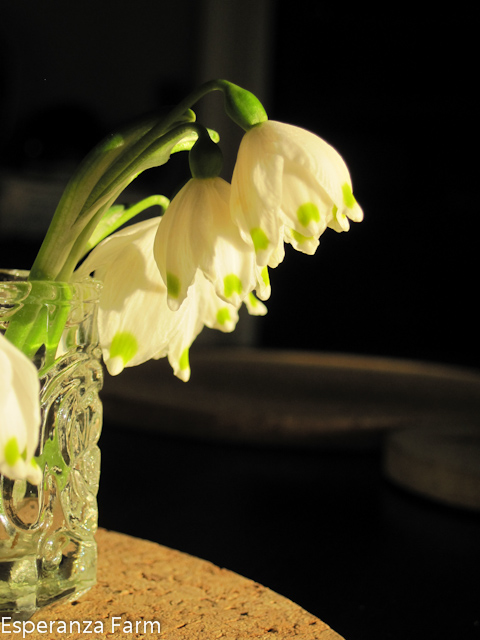
Or snowdrops and snowflakes.  As I mentioned the other day, we have both here.  As always, in a slightly perverse fashion, we have more Leucojum (snowflakes) which are the larger, bell shaped type.  They occupy about 30 square feet of ground beneath a hemlock, pine, oak area, which has western exposure.  Over the years we have gradually helped the patch’s expansion, though it mostly expands by virtue of its own seeds and divisions.  The Leucojum doesn’t seem to mind the intermittent streamlet in the area (winter flooding can sometimes dislodge the bulbs).  Nor does it mind the heavy oak leaf cover.  It is this latter issue that appears to be the downfall of the Galanthus, which generally are said to be the hardier type.  The Galanthus simply does not have stems sturdy enough to get through the leaves.  Possibly, I haven’t experimented.

In any event, they make a lovely white carpet beneath the hemlock, just as if they were a remnant snowdrift, only shining in the sun.  The leaves will stay as a good green groundcover well into summer, an added benefit.

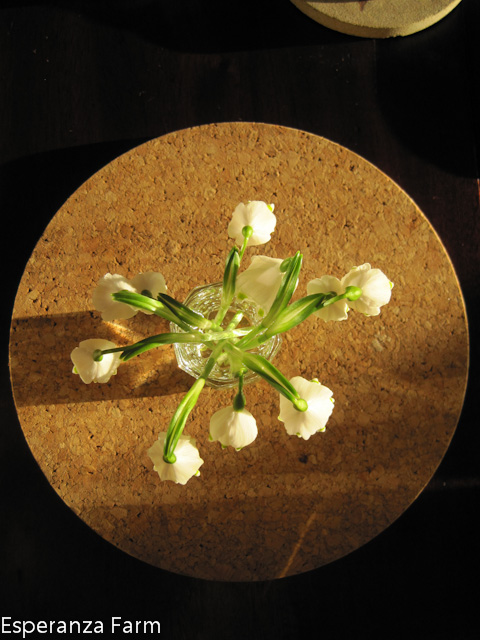
Leucojum, on the table.


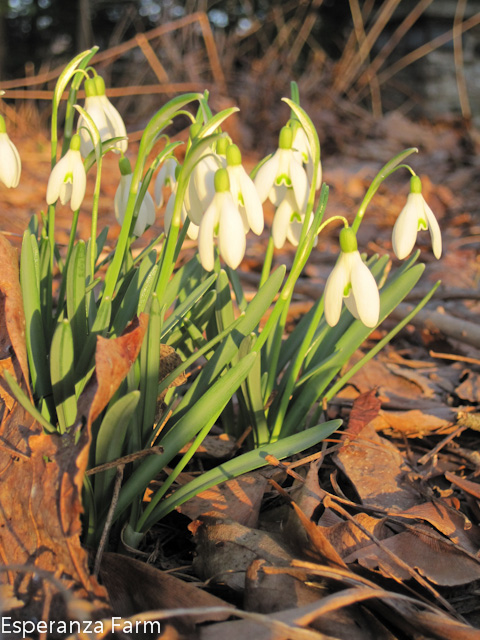
Galanthus, outside.

« Previous PageNext Page »