Electricity! Friday, Mar 30 2012 

Sometime between 1914 and 1920 electricity came to Esperanza, along with the plumbing and the telephone.  Lucy Creevey later wrote:

“suddenly we had bathrooms and washstands with hot and cold laid on all over the place. It has, of course, been an immense convenience; and one wonders how we ever got along without it, but we did, and happily, too.  Never a gadget to get out of order.  Now when things go wrong, I am told the fixture is “obs’lete.”  

We had a telephone too, and soon after this Esperanza blossomed out with innumerable electric lights.  Just in time to save ‘Daddy Will’ (WWE) from nervous prostration: he had the household job of keeping about thirty kerosene lamps going, a grim job.”

Somebody thought ahead when they put most of the wiring in; running in the walls and ceilings, almost all of it is sheathed in metal.  This reduces the rodent problem and the fire-hazard.  The safety concerns are further addressed by the continued use of protected glass fuses instead of circuit breakers.  This gave us a headache with the insurance companies (until we found the right one) as dingbats apparently use pennies to replace blown fuses or use unprotected fuses which allow for too high an amperage.  Circuit breakers are theoretically harder to tamper with, but you can continue to flip the breaker and continue to send current down a problem wire.*  With the fuses, if it blows, you have to fix the problem.

This leaves fixtures.  My faithful handyman (Jamie) was fixing one the other day, it having correctly blown the fuse.  That prompted me to look at the styles of wall fixtures.  I somehow hadn’t realized that there are at least five different styles. The Dining Room has its unique style, two slightly different styles in the stairs/halls; a very distinctive tulip style in two of the bedrooms; and then miscellaneous one-offs. What you don’t pay attention to!

*I’ve done this.  I had a flat where a certain light-bulb lasted about two weeks on average, every time it went the breaker would trip off, the routine was to replace the bulb, turn the light on and then reset the breaker.  If you left the light off while resetting the breaker, it would trip the next time you turned it on and blow the light.  What the short was exactly and how that worked, I don’t know; but I do know it probably wasn’t smart.  God loves fools.

On sentiment and value Wednesday, Mar 21 2012 

I spent an amusing afternoon this last weekend helping to host an antique appraisal fair (think Antique Roadshow).  As expected, the mix of items was dominated by three sorts of objects: collectibles, old but inexpensive, and sentimental.  Also as expected, there were mild protestations and disappointment when an object, perceived by the owner to have monetary value (but it was Grandma’s, but it is pretty!) turned out to have little financial worth.

Objects can be classified as belonging to several categories at such an event: the genuine antique, the oddities, the collectible, the tag-sale item, and junk.  These five categories* are then modified by what one might consider the sentiment variable.  The genuine antique is the rarest category as it generally requires a substantial hand-crafted element, demonstrate a high level of quality for its type, and (despite the legal definition) to be over the century mark.  Oddities tends to cover the interesting tools, trade paraphernalia, and easily shades into the collectible and the antique.  Collectibles have imposed value: the object itself may not be worth much, but because a sufficiently large number of people have decided to amass groups of like items, monetary value is created.  If they stop being collected, their value drops.  The tag-sale item is just that, as is junk.

What about sentiment?  Sentiment is a modifier.  Object x would be classified by the disinterested party as a common, tag-sale item.  But, the invested party grew up with it and remembers Grandma was very proud of it.  Grandma was important, therefore object x is important, therefore its value ought to be commensurate.  We all do this; it is a form of attempted affirmation of our own social value.  Unfortunately, as any honest historian will grudgingly admit, most individuals aren’t that important to society.  Very few people are so important that their ownership or presence adds monetary value.

Where does that leave Esperanza?  Well, its items represent all of those categories, probably with a fairly even distribution.  Sentiment, plays a huge role, as do two other modifiers: context and provenance.  Objects in Esperanza have both context and provenance.  Background and stories add social value to an object.   The more detailed and rigorous the background, the more value.  Provenance travels with an object, as long as there is a paper trail.  Context does not.  Like sentiment, these modifiers, will generally not add financial value.  In rare cases provenance can, but like sentiment it requires really interesting people or events. 

And so forth.

*Take as read that the categories are fluid and not exclusive.

Squirrels, phone lines and nonsense Monday, Mar 5 2012 

Like all old New England houses, the center of the house is a post and beam construction on a dry/minimal mortar field-stone foundation.  The southern section is even less airtight, as it rests on stone piers and has no foundation.  It also isn’t actually connected in any structural way to the rest of the house.  Consequently, Esperanza houses quite a few more inhabitants than the homo sapiens and felix domesticus.  All of the small furry kind.  The walls can be quite noisy at night.  However, the cats catch those that get above the basement, the electrics are all metal sheathed, and they don’t chew through plaster, so it falls under the incurable, endurable category.   Though the red squirrels have gotten to be a bit much, seeing as two of them were arguing with such vigour over the seed packets (that had been left vulnerable for about an hour) in the basement that they didn’t pay attention to the appearance of a person.  They also fight, roll acorns around in the ceiling, and are generally loud. They may, like the over-population of chipmunks last year, be reduced in number.

All of which is why, when the phones went out a few days ago we naturally assumed that it was probably a problem in the house, and probably a problem caused by a rodent.  The electrical lines may be sheathed in metal, the phone and cable lines are not.  It was rather nice to discover that while the problem was caused by a rodent…it wasn’t one of ours.  Rather, it was a nest in the switch box, several miles away, and one of the lines that was actually chewed through was ours.  Fun and games.

Happy 140th Birthday! Thursday, Mar 1 2012 

“hundreds of nights on the white road have I passed it by, in my lonely walk, and stopped and listened to it, standing there in its lights, like a kind of low singing in the trees; and when I have come home later, on the white road, and the lights were all put out, I still feel it speaking there, faint against heaven, with all its sleep, its young and old sleep, its memories and hopes of birth and death, lifting itself in the night, a prayer of generations.”

Gerald Stanley Lee, writing of Esperanza in his book ‘The Lost Art of Reading’ published 1902.

On March 1st, 1872, Julie took possession of the old Lyman house.  Morris had bought it over Christmas, 1871, as a replacement for the neighboring house, bought in 1871, which had burnt down in late November.   The Lyman house was not available until March, 1872 because it was being rented.

In January, 1872, Julie wrote to a friend, “Satis Bene lies in ruins, but I have become the happy possessor of the Lyman place, to which Morris and I have given the name, Esperanza-Anchor of Hope.”  Thus started the story.

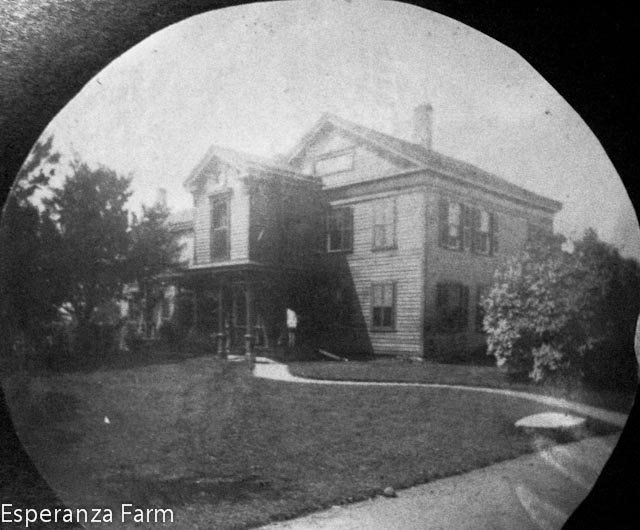
Esperanza, circa 1875-1880, mid-summer.

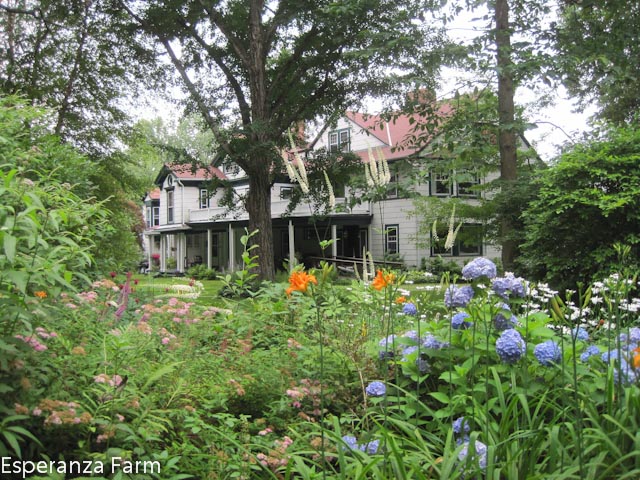
Esperanza, July 2011

May it continue!

Yale, Esperanza, and societal mores Thursday, Feb 23 2012 

“Young people liked to go to that house in Edwards Street (Hartford), and liked to be  invited to the family country home, known as Esperanza.  Yale boys were apt to spend a week or two there when college was out, the latter part of June, and there were always girls to go around. Picnics, rowing parties on West Hill Pond, straw rides with the oxen to draw us, private theatricals, charades, horseback rides, general good times kept us busy. All this was before what we know as weekends, and Mrs. Smith was criticized for inviting girls and boys together. Only the guest-house, Happy Thought, where the boys lived, saved the situation.”

That description comes from William Webster Ellsworth’s recollections of his first introduction to the family in the summer of 1876.  The gaiety of the college summer parties were a fairly short episode, really from 1873/4-1878.  Between 1879-1881, the summer parties still retained the core of the group drawn from (as WWE refers to them elsewhere) the ‘Yale boys’; but with Helen and WWE married, things naturally began to change.   Summer parties came to a near stop following Lucy’s* death in 1881 and then picked up again after Julie’s death in 1883. They were now organized by WWE and Helen, and were mainly friends from the publishing, theater and art worlds.  The range of activities remained the same, but with an ever greater emphasis on the performing arts, which seem to have been Helen’s passion.

This passage is also very interesting in regards to societal roles; and the more one considers it, the more complicated Julie’s position on the role of women apppears.  It is no wonder she didn’t get along with Hartford’s society.   However, one should not overstate the radicalism.  Julie was always at great pains to advise her daughters on proper behaviour, and dearly wanted all of them to marry; furthermore while she laughed at Morris’ concerns over proper dresses for the girls, she did not think he was wrong.

Of course, one also wonders what New Hartford thought of all this…

*Lucy Smith Davis; Julie’s youngest daughter, died in February 1881 following a long illness probably connected to childbirth complications.  Julie never recovered.

Record Keeping Monday, Feb 20 2012 

Esperanza has a large (very) book collection; it also has a large collection of artwork.  Every reasonably available bit of wall space is used, and the amount in storage is close to double that.  The multi-generational, eclectic nature of the artwork makes it very hard to categorize.  Consequently, every bit of information helps.  One of the issues with an historical collection is judging the significance of a piece.  Unlike an art gallery, where the primary significance is based on the piece’s own quality and its relationship to other artwork, that is: art history and art criticism, art in an historical setting may be judged on a different set of priorities.  Questions such as when it was bought and by whom, where has it been hung or not hung become more important: that is, the relationship between the art and the response of people to it.

Important pieces of information, therefore, can be found in old inventories, photographs and other written documents such as wills or letters.  Some historic collections are relatively static, in that the collection fits the space and was modified only by one person.  The idea of ‘it has always hung there’ can sometimes be literally true.  I know of one house (Hill-stead Museum) where only one painting in the collection can fit above the dining room mantel and the room’s colours are designed to compliment that painting.   On the other hand it is more likely that pieces move around quite frequently, as has been the case in other rooms at Hill-stead and is definitely the case at Esperanza.  Knowing where they were and when therefore becomes a potential source of information for how people reacted to the piece.

The fun thing about all that is, of course, that there is no law…don’t like the painting? Swap it for another. Just record what was swapped, where, and when!

‘I was here first!’* Friday, Feb 17 2012 

In a certain sense one can regard Esperanza, as deeply uncomfortable as it is, as a forerunner of the McMansions.  It was built as a second home, on a hilltop, with a commanding view, and is large…  The differences, of course, are a) it wasn’t built on an ingenious scheme of credits and mortgages but on hard cash; b) it was architecturally designed for its location; and c) the size comes from being designed to house a multi-generational family as opposed to DINKs (lovely acronym that).  It has also stayed in the same family for 140 years, rather than being abandoned after a decade for sunny Arizona/Florida.  Age creates respectability.  Or something.

Still, it was a little shocking today to realize that the people on the next hill over have cut down quite a number of trees, thus giving them and us entirely uninterrupted views of each other.  The property in question is a hay-field currently (it looks like they took out a hedgerow), but it could easily sprout a house or five.  This would be exceedingly unfortunate from our point of view, but my selfish side must wage war against my philosophical side: it is their property, and their right after all.   That I think it would be criminal to turn a ridgeline hayfield, a rarity these days, into houses is my opinion only.  (I’ll still whine) 

Might consider some strategic white pines…

* Or not, several generations of settlers, and several Thousand years of Native American settlement demolish that conceit.

Value Judgements Wednesday, Feb 8 2012 

The valuation of antique furniture these days tends to focus on original condition, thanks, mostly, to the rise of shows such as Antique Roadshow and to the rise of investment collections, that is antiques bought and sold because of their value rather than their personal appeal.  If it isn’t ‘original’ and/or in ‘like new’ condition, a piece of furniture is substantially devalued.  I could discuss the rather interesting psychological and economic drivers behind this preference for original purity, but I think it better to leave the philosophy aside.  Suffice it to say that it seems to be driven more by status concerns and less by personal preference.*

In any event, it was rather nice to be at a well-known house museum (Hill-stead) the other day, where I am training to be a docent, and to have a sane discussion of the history of furniture.  The furniture there is primarily in the Colonial or Colonial Revival styles, a fair amount of Sheraton and Chippendale influences; most of the furniture is from the nineteenth century but there are some fine 18th century French and late 17th century English as well.  What is strikingly different from today’s antique collectors is that the Pope family was quite happy to buy a late nineteenth century reproduction to match an original couch or chair of the style they wanted, to buy pieces that had been modified with added carvings and embellishments, to re-upholster pieces, and so forth.  In other words, while correct style and quality of workmanship were of paramount importance, ‘original’ was not important.   There is more than one piece of furniture there that has been modified, sometimes heavily, over the centuries, according to taste, needs of repair, or changing function.  This is to be expected when the items are, for lack of a better term, working items.  Today, of course, because the house is a museum the emphasis is now on preserving what the pieces looked like when the Pope family lived in the house.

The incredible mish-mash of furniture in Esperanza also reflects the concept of working furniture versus collected furniture; though, it lacks the same coherency of vision, since it was not put together by one person and only used for fifty years.  Much of the furniture in Esperanza, as in Hill-stead, has little value in and of itself, if valued on the antique investment market.  However, the pieces and the collection have great value as a descriptive picture of historical styles, tastes, and uses of furniture.  Unlike Hill-stead, they remain in use.  This tends to appall both the investment type and the museum curator type, as for both antique furniture is too precious to use.  It would however, make a great deal of sense to the majority of people before the late twentieth century.**   Does it mean that the monetary value of the furniture is reduced? Yes.  Does it mean the furniture is more fully appreciated and understood? Yes. 

*I might also suggest strains of idol worship, ancestor worship, poor self-esteem, and elitism; in a more charitable mood I might suggest a strict adherence to the rational definitions of historical accuracy.

*Of course, one does have to have a little bit of common sense: throwing oneself into a chair, eating on a couch, or putting shoes up on a piece of furniture is verboten, as is picking a piece up the wrong way and so forth.

East Lawn circa 1935 Friday, Feb 3 2012 

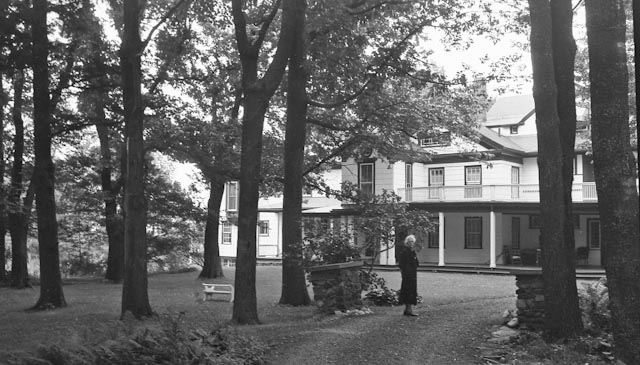
(no I don’t know why the picture is that small, probably the negative scan)  In any event, a view of the east lawn circa 1935, possibly a bit later.  It has to be after the mid-1930s because the house is sporting its white, asbestos shingles which it still has but perhaps not so Brightly white.  The pines just to the right of the right pillar are still standing, as is the big Norway spruce (the tree second from left); they are a bit fatter today.  All the other trees are gone, replaced with others.  However, the stump remnants of several can still be found (the stump/hole of the one by the left pillar is forever tripping me)  The fringe tree, the shrub in front of the left pillar, is still extant.  As is the bench.  The pillars, leaning rather alarmingly in this photo, were rebuilt in the 1950’s.  The woman is Helen Yale Ellsworth, then in her 70’s or so.

It is interesting to note how the landscaping has changed, at that time the lawn was very, for lack of better terminology, much a lawn, kept short and coming farther out under the trees.  Today, there has been a revision to a wilder look.  This was partly due at first to the simple fact that if you stop cutting the forest down here…it grows back; today, however, it is a stylistic choice.  While I appreciate the aesthetics of the lawn, the fact that a lawn is a monoculture of an invasive species just puts me off.  I like my violets, my Indian paintbrush, mosses, ferns, ad infinitum, much more interesting.

Set-piece or collection? Saturday, Jan 21 2012 

Having spent the morning in a lovely Arts and Crafts home, in which most of the furnishings match the style, I got to thinking (again) about one of the oddities of this place.  There is a strong sense of continuity on one hand: that of ownership, so the house has a closely linked textual and visual history and context.  On the other hand, the house is a evolved structure.  It was not built of a piece: there are four distinct expansions and modifications, none of which completely erase the previous layer.  The one possible exception is that the exterior, true Queen Anne Victorian facade was removed and replaced with an early Shingle style, but the interior Queen Anne style is still findable.  The furnishings are equally layered.  They all belong to the same family, but the range spans almost two centuries, multiple styles and at least three very different regions.  The house is not in the style of x, nor furnished in the style of x. 

This may be part of why the immediate reaction of the visitor is that it has a museum-like quality.  Museum furniture collections tend to show a wide range of style, taste and time period.  They are not of a piece in the way that historic houses tend to be. 

This gives a wider opportunity to tell a multitude of diverse stories.  Each piece of furniture is a hook to a person or a place in a different time period.  It does mean that telling a single story is harder, unless that story’s line is dominanted by change over time.

« Previous PageNext Page »