Jewelry Sunday, May 5 2013 

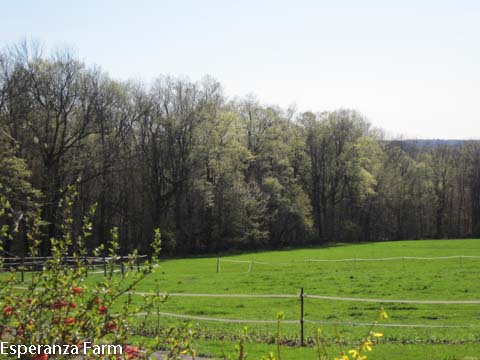
People tend to make a huge fuss over New England’s fall foliage; but I tend to think that there are a fleeting few days in spring that are just as spectacular. For perhaps 48 hours, every spring, the sugar maples’ flowers are out, ahead of all the leaves on the other mature trees. Looking at a hillside one will see each sugar maple picked out, as if with a very fine, dry watercolor brush in shimmering chartreuse on a backdrop of an infinite grey/brown/red. The chartreuse is almost see through, so the big limbs, the trunks, the trees beyond are all still visible; but each bud has broken forth with these long dangling flowers, several inches in length. The effect vanishes as other buds open, but just for those hours it is an amazing spectacle.
This shot of the meadow, taken a few years back, gives a hint.
IMG_4957

Cleaning Old Glass Thursday, Mar 14 2013 

Cleaning a few kitchen doors today; both are multi-paned with exterior storm doors.  It struck me that the old glass was more interesting to look at for any length of time.  The small lights are much, much harder to clean, as they have four times the number of edges.  The big outer panels are just flat pieces of glass.  They are entirely forgettable.  We generally assume that glass is supposed to be see-through, the modern triumph is invisible walls.  And yet….they are most assuredly walls.   I have to admit, I have always found the massive panels of perfect glass with minimal framing to be jaw-dropping, no doubt, but clinically cold. 

I was admiring one of the door’s lights, about the size of a shoe-box.  This small piece of glass had so much life in it.  The bubbles, the ripples, the multitude of imperfections, every single one of them caught the light.  At exactly the right angle and level a rainbow flashed and vanished.  This wasn’t a see-through wall; this was an (admittedly inadvertent) celebration of the sun.  

Now, I am sure that the people who built the house would spring for the modern, perfect glass; they went for modern whenever they could afford it after all.  But, studying the old glass ignites the artistic sensibilities.  Stained glass, painted glass, rippled, spun, blown, fractured; the possibilities are endless.  It is a pity we believe that flat, flawless, colourless, and large is perfection.

Where’d it go? Tuesday, Mar 5 2013 

The house has four chimneys, several with multiple flues; two of these chimneys have ingenious caps that effectively seal the chimney when the fireplaces are not in use.*  A spring loaded cable opens them from the bottom. 

We have had, and will no longer have, the bad habit of leaving the parlor chimney’s cap open.  The glass doors on the fireplace are an effective draught stopper, and the cable on that one is a bit of bore to operate being extremely tight.  So, laziness. This is a bad habit.  I had looked up on my way in last night to notice that the cap wasn’t up, but didn’t think anything of it.  But then, because the doors aren’t That good at draught-stopping, someone went to close the cap…..  No cable….Lots of down-draft….something’s not right.

It Has been windy here.  The cap was found halfway down the roof this morning, the cable forlornly dangling.  Mercifully, the mechanism and cap is undamaged.  It was mortared to the chimney top and over time the wind cracked the mortar.  Oops.

*Of the other two, one has the furnace and one is unusable so we might as well leave it for the birds.  For years it had chimney swifts in it.

Accurate dates or miscellany Monday, Mar 4 2013 

Letters are so useful!

Julie’s pond was definitely dug in the summer of 1874.  The pond today, taken on the winter solstice at sunset.  A few more trees, but a good job on the dam.  It has had to be repaired, but only the once back in 2011.  And considering the size of the embankment, that is no mean feat.  The drop on the far side of the bank in this view is about 12 feet.

IMG_6536


Octopi Friday, Mar 1 2013 

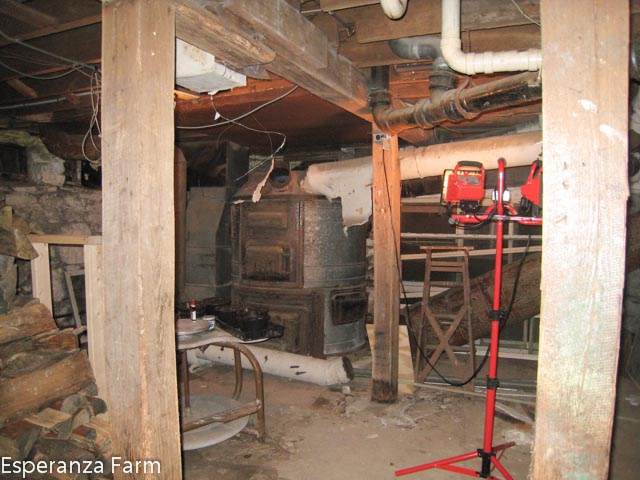
People sometimes wonder how Esperanza is heated: today an oil furnace and steam heat.  However, there was a gravity feed hot air system in the north end of the house from its construction in 1893 to the 1960’s; in addition to the steam heat system in most of the rest of the house*.  The air was heated by a coal fired furnace in the basement; the duct work ran (and still does) throughout the upper two floors.   The furnace still occupies a large portion of a basement room, being about 7 feet tall and four feet wide.  Originally, there were eleven ducts coming either into or out of the furnace, and some ran at about six feet off the floor.  Wrapped in white insulation*, which over the years had sagged, snaking off into crawl-spaces, and being in a very dark space, it is not entirely surprising that it earned the term the Octopus.  A few years ago, one of the cats ended up in the ducts (he fell through a hole in a main duct) and several of the lowest arms ended up being removed in the process of attempting to get him out.  That, combined with corralling the insulation, has made it much less spooky.  Some times people argue that we ought to take it out, as it is utterly unusable*.  But, I have to admit that I have grown to like it down there.  Not simply as a personality, but because it adds ‘character’.  I kind of like spooky houses.  Besides, why take it out if it doesn’t bother one? 

IMG_3140

two of the ducts are already off in this photo.

IMG_3165

looking across the top at the ducts heading into crawl-spaces, the hole on the bottom left is a removed duct.

*There is no heat in some of the house.

*Yes, it is asbestos; yes, its fuzzy; no, I am not dead; yes, this tends to make me somewhat sceptical about certain ‘green’ screeds.

*The bottom of the fire-pit no longer exists….in the spring there is a nice bit of groundwater there….

From the Guestbook Tuesday, Feb 19 2013 

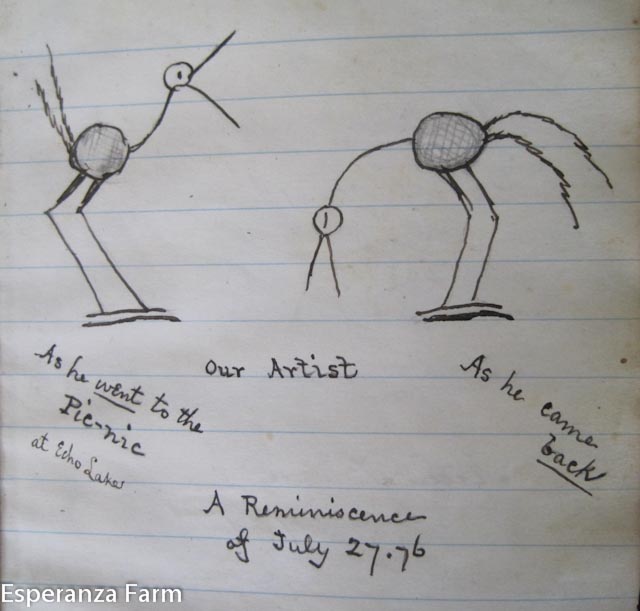
The earliest guestbook, which covers the 1870’s, has a number of truly delightful sketches in it.  This one, of the author, is a very simple one.  ‘The author’ by the way remains unidentified, we simply can’t figure out who signs with a little bird as his signature, except that he (presumably he, based on this sketch) is responsible for many of the amusing caricatures.  The initials appear to be ‘del’ but that doesn’t match either.  I am sure, by process of elimination I will figure it out, when I get around to it.

IMG_9448


Architectural chronology Saturday, Jan 26 2013 

One of the interesting aspects of the house is its growth over time.  This is fairly common with New England houses; the classic farmhouse that keeps getting lengthened.  It is not common with the surviving summer houses/estates built in the post Civil-War era.  This is a permanent tension in the house’s history, generated primarily by finances, no doubt its level of charm depends on the bank book.  The questions of identity so beloved of curators spring immediately to mind.

But a bit more on simple (ha!) dates:

c.1790-1810 for the center section, your classic post and beam cube.  Two and a half stories with a full height basement.*  Ceilings are sevenish feet.

c.1830-40 for the first dining room/southern extension.  At this time the facade is changed.  The house now appears as a Georgian farmhouse with a small southern kitchen ell, which is as long as but only half as wide as the cube.  This extension has a full-height basement, but is not as tall as the cube, being only one and a half stories above-ground.   The basement is now daylighted at its south end.

1874: the dining room is expanded on both sides; the two rooms above are created by popping the roof.  The height of the extension now matches the cube.   The dining room is painted PINK.  The length of the house does not change.  The southern extension is now about two-thirds the width of the cube. 

1875?: the extension to the west of Opposite-To-It, one of the rooms in the original box, its west wall is popped out by about four feet, creating a lovely, sunny bay…unfortunately it leaks cold air like a proverbial sieve.  The west and south sides of the cube are now obscured.

1878: the South End is added.  What was a three-story barn originally is refinished inside and tacked on to the south wall of the kitchen/dining room.   The bottom two stories are post and beam, presumably the third is as well.  It is the same width and height as the southern extension.  Three sides of the basement actually open at ground level.

1893: the North End is added, along with the porches.  It adds another quarter in length and is the width of the cube plus a bit.  It is a true three and a half stories in height, putting it a story taller than the cube and southern sections.  This massive section gives the house its distinctive appearance as an apparent early Shingle-style building instead of the rambling Georgian/Federal farmhouse with a few Queen Anne flourishes.  This section is not post and beam, rather it is balloon-framed and consequently a very different building to work with.  This building buries the original cube almost completely, it is now only visible on the east facade.

1890s-1960’s: the three-story porch on the west wall of the South End is gradually enclosed, making it wider than the dining room section.

?? Now, those of you that know the house, should spot a missing bit: ‘Hole In the Wall’ the distinctive feature built out over the east porch with the round red window.  There is a problem.  Lucy Creevey puts it down to 1881.  The photographs and oral history have it placed around 1873-75. ..this requires some research.  And is what I get for trying to run the dates off the top of my head???

However, having happily confused all of you who don’t know the house!

*what’s the ‘and a half’ story? Attic crawlspaces, really simply the roof structure above the ceiling of the rooms below.  Unfinished and uninsulated.


Not quite on the anniversary Thursday, Jan 24 2013 

A letter written by Julie to her friend Mattie Yale on January 21, 1872:

“Satis Bene lies in ruins, but I have become the happy possesor of the Lyman place, to which Morris and I have given the name ‘Esperanza’ -‘Anchor of Hope’.

So you see, my dear, we are to be neighbours after all. I could not consent to see all our fine plans blown away like the mountain mist before a north wind.”

A bit of background.  Satis Bene had been bought by Julie and Morris in late 1870, a former farm with about 65 acres.  Following the summer of 1871, work was being done on it in November, 1871 when a fire started, burning it to the ground.  Julie then bought the neighbouring Lyman farm on the other side of the road, with another 18 acres.  This became Esperanza.  Satis Bene was rebuilt as a farm house; in the 1960’s Satis Bene and ten acres of the original purchase was sold off.  It is now a winery.

Mattie Yale lived in the house next to the Esperanza lot.  She had been instrumental in causing Julie to fall in love with the idea of creating a summer home in New Hartford, having invited Julie and family out several times.  If one is facing the houses: L to R is Satis Bene, a dirt road, Esperanza, and then the Yale house (then known as the Parsonage or Eaglesnest).

It says nothing good about the state of farming in the area that it was cheaper to buy up another farm rather than rebuild…  By that time the top of the hill, once a bustling town center, was virtually abandoned.

Old Mirrors Tuesday, Dec 18 2012 

Lighting houses before electricity often made use of mirrors to double the amount of apparent light in a room.  A mirror behind a candle or kerosene lamp reflected the light outwards, a mirror on a dark wall brightened the space.  Cut glass also added to this effect.  Prisms on candle-sticks or chandeliers seem somewhat ostentatious in today’s brightly lit world, over-the-top; but before electricity, while still indicating wealth, they were far more understated: simply a glimpse of focused light in an otherwise dark corner, a true accent.

Esperanza has some old mirrors.  In many cases the silvering (mercury or sliver nitrate) has begun to fail.  Usually, the droplets condense on the bottom of the mirror, a subtle silver fog rising up over decades.  Such old mirrors can sometimes seem a little spooky.  There is a true reflection but it is obscured, shadowed…combine it with low light levels, ornate carving (all too often rising above the mirror like dark wings) and, voila, your talking mirror of legend.

Inventories Saturday, Dec 8 2012 

While rearranging my desk the other day, I came across two inventories for the house dating from the 1950’s and the 1960’s.  Neither are especially complete nor are they especially trustworthy, with several egregious errors on the first page alone of the professionally (?) done one from the 1960’s.  Deciphering them is made more difficult by the slow movement of objects so that none of the rooms match the descriptions of the inventories.

Inventories tend to go almost immediately out of date if they are organized by the object’s location, unless it is a static house museum.  But even there, every object has been given its own tracking number if the museum is serious about its work.  Ideally, every object gets its own card with a description and picture.  Every object.  Not sets.  This used to be a formidably expensive undertaking in paper and ink; the digital age has helped with that, though arguably it has meant an over-abundance of information without selection.

Still, both are very useful.  Most useful is the personal one compiled by Lucy Creevey in the 1950’s.  Uninterested in price, her inventory frequently gives the history of the object.  Unfortunately, figuring out which object she was discussing can be difficult.  The other one is mostly concerned about the price of the object and has those aforementioned errors; but still is interesting.

I suppose after 50 years…what an appallingly large project.*

*yes I know, First get the book/art one finished and off the non-working computer.  Pitfalls of digitized information….I can read the 1954 inventory, I can’t read the 2010 one because of the computer it is on…and yes I should have backed it up.

« Previous PageNext Page »