One of the largest landscaping headaches at Esperanza is the presence of a state highway running across the front of the lot. Although this road was moved about fifty feet away from the house in the 1930’s, the massive increase in traffic makes it a constant presence in the landscape. One of the goals, therefore, in the landscaping is to build a barrier between the house and the road. Now, you might ask: why not build a fence? Two reasons: number one, a truly effective sound/light barrier is costly. Number two is that a fence which can’t be seen through is an attractive nuisance. People decide that there must be something interesting behind it, something that makes trespassing inviting.
So trees it is. Besides I prefer trees. It is a Slow process, but if you drive past at 60 and are not actively looking, you probably won’t see the house. We still hear and see the traffic, but there is an illusion of distance. I count as a success the bicyclists, who I recognized as having gone past all summer, suddenly yelling “there is a house back there’ one day in the fall. I also count as a success the state highway truck that refused to believe the drive was a drive. I say nothing about the individuals’ situational awareness. In general, one can safely assume that people don’t see things. But there is a trick to this, the trees can’t look ‘planted’; they have to read as a forest, which means it has to be a forest. In this case, it appears to be a mature mixed hardwood forest with a strong evergreen component. Furthermore, because we want to keep the concept of distance, the dense planting must be close to the road, with a mixture of trees, understory, and strategic but visually pleasing clusters closer to the house.*
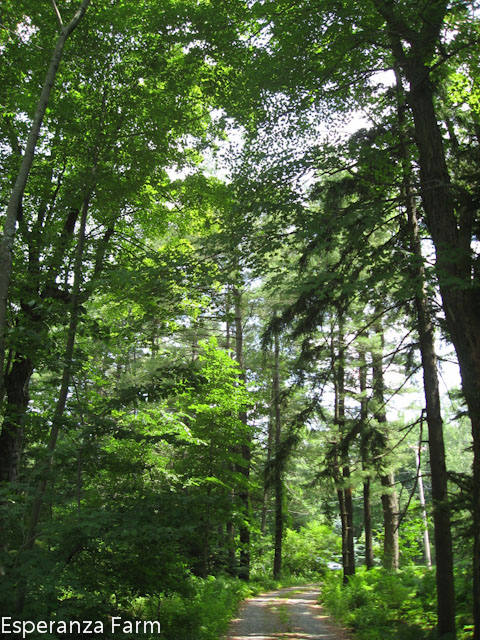
It is very complex section of the property, the description of which I won’t bore you with, but an idea is given by these photos which were all taken on the drive. We obviously have the advantage of a century here for the large trees, but the strategic understory is a creation of the last decade.
In the summer, the view from the drive entrance:
In the winter, looking out the drive from the pillars, at just about the farthest point of the drive in the summer picture. Here you can see how the barrier is still quite thin, the loss of one hemlock created that hole just to the right of the plow truck, the trees you see beyond are actually on the other side of the road:

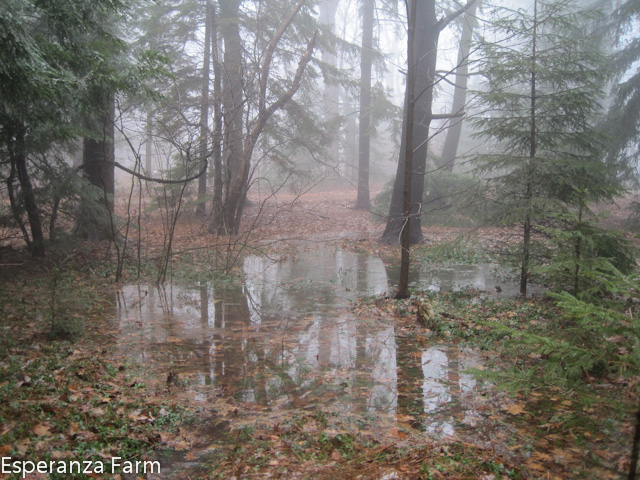
And a view from in the woods, looking at the road but in fog, showing rather well the varied ages and spacing, much of which comes from nature being allowed to run its course:
*Mercifully, trees want to do this, forest edges form dense thickets, while areas under closed forest canopies tend to be open. Transitioning the edge from ineffective, ugly and invasive Norway saplings to native, or non-invasive species, is a bit harder though.
 Acair Fearann