“hundreds of nights on the white road have I passed it by, in my lonely walk, and stopped and listened to it, standing there in its lights, like a kind of low singing in the trees; and when I have come home later, on the white road, and the lights were all put out, I still feel it speaking there, faint against heaven, with all its sleep, its young and old sleep, its memories and hopes of birth and death, lifting itself in the night, a prayer of generations.”
Gerald Stanley Lee, writing of Esperanza in his book ‘The Lost Art of Reading’ published 1902.
On March 1st, 1872, Julie took possession of the old Lyman house. Morris had bought it over Christmas, 1871, as a replacement for the neighboring house, bought in 1871, which had burnt down in late November. The Lyman house was not available until March, 1872 because it was being rented.
In January, 1872, Julie wrote to a friend, “Satis Bene lies in ruins, but I have become the happy possessor of the Lyman place, to which Morris and I have given the name, Esperanza-Anchor of Hope.” Thus started the story.
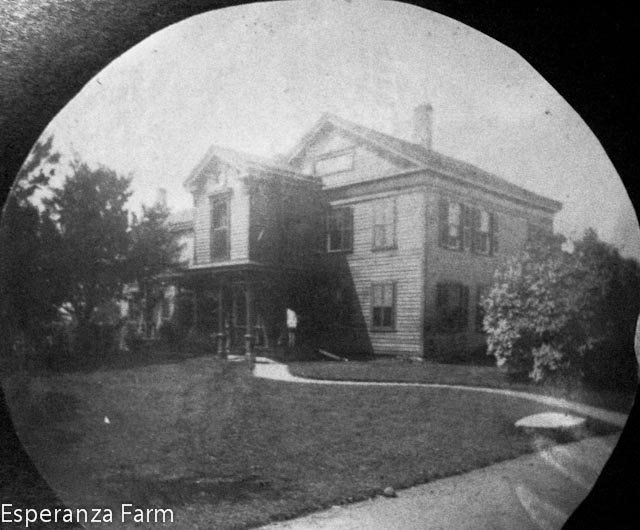
Esperanza, circa 1875-1880, mid-summer.
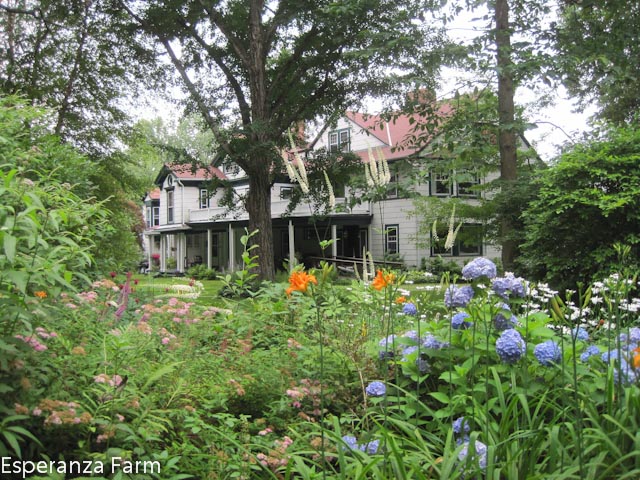
Esperanza, July 2011
May it continue!
 Acair Fearann
That passage by Lee was, as we know, put at the end of Lucy’s book on Esperanza. Being familiar with it, I quoted it in an essay I wrote in about 8th grade, including his comment about the house “growing”. I was emphatically told by my English teacher that houses, being inanimate and constructed, couldn’t possibly “grow” (never mind remember or breathe or such-like) and that I should learn to use words properly and not imaginatively. So much for a poetic approach to the house; alternatively, so much for English teachers. (Still one of my favorite descriptions of Esperanza!)