I have previously commented on trees as living records, generally a tree’s growth is mildly affected by its surroundings; sometimes, however, it can be quite dramatic. The biggest of the cucumber magnolias is such a dramatic actor. In the woods cucumber magnolia (magnolia acuminata) tends to be a very straight tree, with few small branches low down and a high canopy crown. In an open area, the tree can be spreading and irregular, generally producing a broad rounded crown. Think large here, this species routinely hits 80-100 feet in height and in an open area can spread 40-60 feet without trouble.
Our big tree has always had full western exposure, but it has always had trees to the north and east of it. Currently there are two black oaks, but there have also been a succession of red maples. Now the tree probably has had some of its eastern branches trimmed off, but it has primarily developed on one side as an open-grown tree, on the other as a tree with competition (if in a generous space). It has also reacted to the house, which is south and east of it.

This picture taken this last October’s freak storm clearly shows the magnolia from the southwest. Here you can see the magnolia’s rounded growth pattern (it has no leaves, the oaks behind it are still in full leaf). This is the open growth side: spreading branches that reach from nearly the ground (the lowest branch reaches down to within four feet) to the crown, currently at about 85 feet and nearly as broad.
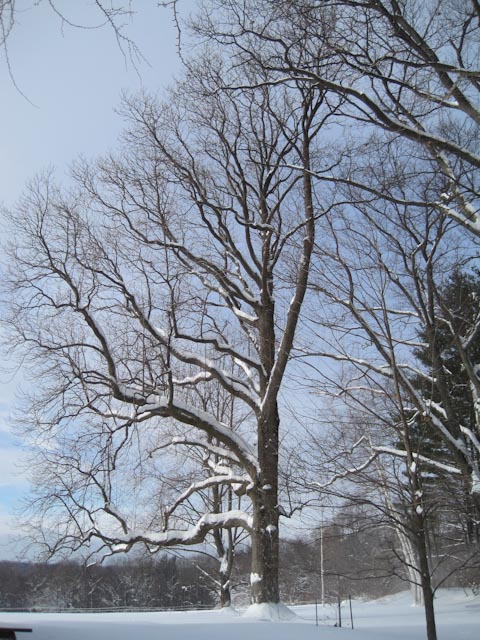
This picture is taken from the east (last winter) and shows the open crown side, but also the tree’s reaction to competition on the north and east: fewer branches and one major eastern branch that did not waste time going out toward the big oak, but rather aimed for the thinnest piece of canopy between the magnolia and the oak. This branch has since created a topknot effect, punching through the canopy, and reaching about ten feet above both the main trunk’s crown and the oak.
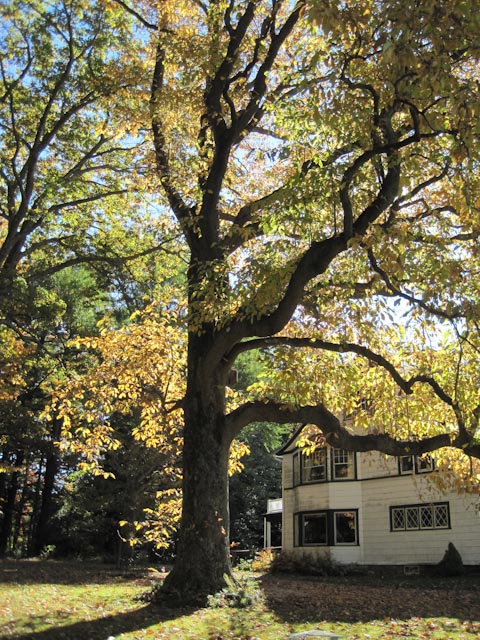
This photo from the northwest also shows the ‘up’ versus ‘out’ behaviour of the two sides of the tree. Observe the different growth pattern of the main eastern branch and its western counterpart at the same height.
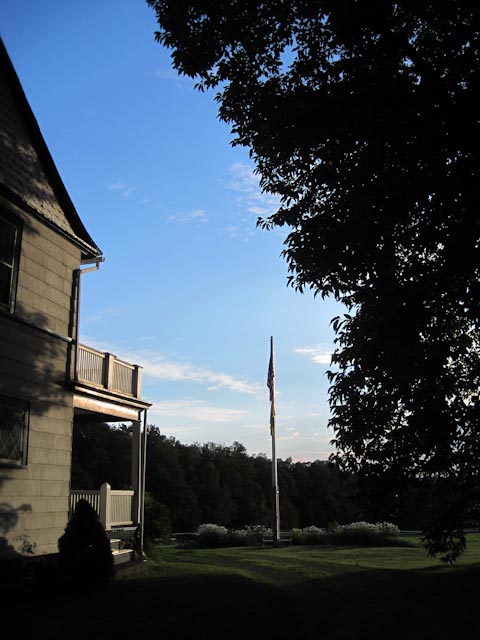
Finally the last picture shows a remarkable growth pattern that has only become evident in the last few years. The tree has never been trimmed in order to keep it out of the drive, but because of the wind and the shadow of the house you can see how the lower twenty feet are not growing out as fast as the section which is above the house’s roofline. The tree is now expanding south as much as it is west, but is doing so starting above the house’s roof, since those branches are not being shaded.
 Acair Fearann
One would love to know how the root growth corresponds to – or not – this asymmetrical branching pattern. Branches here (and on most trees) are reacting to patterns of available light predominately, plus wind. Roots. . . could care less about available light, being rather more interested in available moisture. But they might well care about wind given the connected nature of the creature. Also by reason of connectivity they might well care about mass (static or dynamic); it would be nice to think that they grow asymmetrically so as to best anchor the asymmetry above. Some trees growing on steep slopes do this, with roots on the steep downhill side going much more vertically down than those on the uphill side which tend to spread laterally into the bank. I don’t know if a tree growing on level ground as the magnolia does would behave that way. Not being a forester I don’t know if the ingenious human creature has developed a way to visualize root growth patterns – without digging them up. (Or looking after the tree has fallen over, uprooting things in the process. Not methods I’d like to see on this lovely tree.)
I have a sneaking suspicion that nobody actually knows what a tree’s entire root structure looks like… Supposedly, cucumber magnolias are deep, taprooted trees; they certainly do have fleshy, white roots with apparently few fibers. I was most surprised to discover that at least a foot down in the west lawn there were few roots present from it, suggesting that it does go deep. I hope that roots grow in reaction to wind loads, that tree has quite the sail area!