Trace Sign Friday, Sep 30 2011 

I don’t know if anyone else has ever encountered those TV shows on ‘if humans suddenly vanished’; they always assume that everything made by man would vanish very quickly, cities engulfed in a few decades by lurid CGI jungles.  Anyone who has studied any archaeology knows that couldn’t be farther from the truth.  If neolithic fish traps can still be seen on Google Earth (if you know what to look for), it is rather unlikely that a modern city would vanish in a century.  Chernobyl has given us a fascinating case study on just how a modern city that is totally abandoned by man does or does not decay. 

Hard structures take millenia, some will probably take a timescale closer to geological time to vanish.  Yet even minor disturbances leave their traces.  Old abandoned roads in New England are legion, New Hartford alone has four major ones and an entire settlement.  These are easy to find, the stone walls, the parallel form of the depression, often enhanced by becoming a water course, the different types of vegetation willing to grow on compacted soil, old cellar holes, unusually massive trees or tree stumps, and so forth.  But even single use logging roads can be found decades later: unusually straight, wide paths in the forest, distinctive scars on trees. 

Sometimes, inadvertently, a single event remains recorded. Up on Yellow Mountain the other day with a state forester, we came across a beech tree that had a distinctive ’14’ cut into it.  Judging by the age of the beech tree and the style of the mark, that ’14’ was made by a CCC crew back in the 1930’s when they came through clearing gypsy moth infestations and removing gooseberry bushes (an attempt to stop the life cycle of a blister rust that damages white pine).  The ’14’ would have been a mark by the crew, presumably no. 14, that they had finished that quadrant to which they were assigned.   Nearly eighty years ago some one, probably a young man who is now elderly if not dead, made a quick mark on the tree. Eventually, that beech will fall; but for the time you can almost see the crew working what increasingly feels like a truly different century (it is, technically, I know!), and yet that tree is a physical connection across decades.

Headwaters Tuesday, Sep 27 2011 

Technically, the headwater is the end of the tributary stream farthest from the river’s end…the direction of the crow’s tail, on the tallest pine in the forest somewhere in Minnesota determines whether the water runs to the St Laurence or the Mississippi, as begins the story of Minn of the Mississippi.   Headwaters have a certain innate mythic weight, similar to that of a spring. 

Headwaters are also the furthest extant of a watershed’s boundary line.  Watersheds are almost fractal in nature and at their boundaries the matter of a few inches can shift the water’s path, by a mile or by a continent.  Yellow Mountain has a river watershed boundary running through it,  interwoven, like a series of fingers.  The east and west sides of the property drain south into the Nepaug river; the center drains north into the Farmington river.  At what exact point on the ridges does the water switch from one to the other?  Does the way the crow sit in the pine tree matter?  It can actually, and that such a small action can make such a difference is somewhat strange and wonderful to contemplate.

Hobbies or a half baked ramble Saturday, Sep 24 2011 

(a not wholly unrelated topic for this house)Everyone has them, it has taken me much longer than it ought to figure out what I really like: old tools. Specifically, pre-1950 metal or wood tools. Some people collect baseball cards or shoes, others collect cars or guns (the latter are really cool but out of my budget). I get innate pleasure out of finding a pair of ‘vintage’ forged steel tin snips, or wrenches built in that elegant curve which was the answer to confined working spaces before weird ratchets came along. I can’t tell you the names and I certainly can’t, to my shame, use many of those old tools; but their relationship of form and function hit a highpoint around 1900 that we have since fallen away from, to our detriment. A carpenter’s square could just be a square edge, the level and handle doesn’t need to have an added curved fillip, it doesn’t do anything functionally, but why not make it beautiful? When a culture decrees that even the utilitarian should be elegant, there is something going right. When it decrees that the utilitarian ought to look utilitarian, and we ought to be proud of that….well….

Equinox Friday, Sep 23 2011 

The equinox has passed, neglected behind the rain clouds.  The house marks the time, as if a giant sundial, for the kitchen is strangely shadowed by the maple and apple trees, whose leaves are still green and for now, for a few weeks longer, block the sun.

Climate Control Tuesday, Sep 20 2011 

Without modern climate control systems.  Air conditioning is a rather recent invention, but the problem of how to remain comfortable in the summer is hardly new.  The obvious, major steps which the lucky few could manage all helped to create Esperanza: buy a summer house outside of the city, ideally on a hill.  (one has to wonder if the cooling benefits of being on a hill were of equal importance to the view when so many of these summer estates were selected, we assume it was  the view only…but we have the option of a/c)

Esperanza then takes the next step: add large porches, if possible all the way around, this creates shade for both those sitting outside and for the house itself.  Not only is the first story shaded, but so is the ground surrounding the basement.  The last step is the most extreme at Esperanza: orientation for sun and wind.  In a house designed for winter survival, as seen in your earliest farmhouses, the largest face faced south if at all possible.  This house disobeys that rule.  At 30 feet wide on its south/north faces and 100 feet on its east/west, the difference is unusually large.  But this configuration is ideal for the summer.  The long axis is located along the ridge of the hill, only a few degrees off true north.  What this means is the prevailing winds are almost always hitting the long west side.  It also means that with only four exceptions all the rooms on the first two floors have full cross ventilation, in some cases the rooms are the full width of the house, in others the arrangement of rooms permits the cross ventilation.

All of which is ideal for a pleasant summer time experience without the need for any sort of climate control.  It also means that on a damp, windy day such as this…I am acutely aware that we missed closing a storm window on the other side of the house.

On investments Saturday, Sep 17 2011 

One might argue that an excellent training seminar for investment bankers would be studying trees.  I am currently, and have been for more than a decade, working on a sugar maple grove above Julie’s Pond.  When I started thinning saplings, they were so dense you could not have ridden a horse through the area and all were about an inch in diameter and fifteen to twenty feet in height.  Today, one section is almost thinned as far as I dare (considering the young trees stand beneath 100 foot giants that periodically fall in an uncontrolled fashion).  Those left measure 4-6 inches in diameter and are heading to forty and more feet.  No whippy saplings, but solid trees. 

This has been an exercise in close observation, which tree is growing well and why.  Sometimes, there are hard choices: two quality trees that are simply too close together, you flip a coin and hope.  It has also been a lesson on time and patience.  Had the thinning started twenty years earlier, they would be that much larger; had it not started, they would still be scrawny poles.  What takes a decade in nature, will take a decade.  To try to force the growth would result in poor quality, to have not done the work would also result in poor quality.  In a century, God willing, those skinny saplings will be the giants.

Asters Friday, Sep 16 2011 

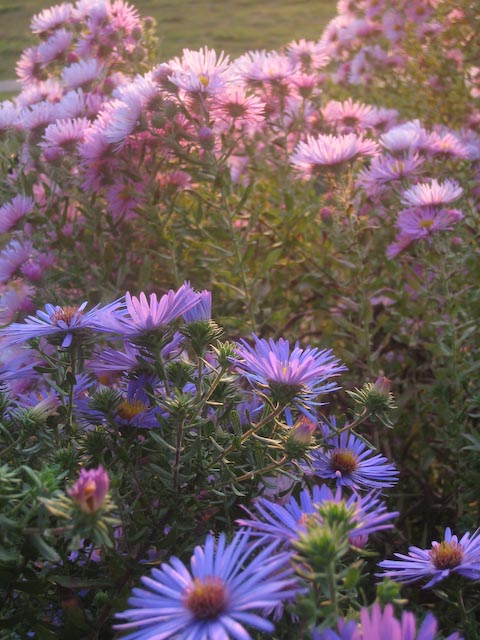
Asters (a huge and confusing family, that according to the molecular botanists should be split apart) are one of the stars of fall.  The blues, pinks, wine-reds, and whites are all dusky.  They are antique colors, not the saturated hues of summer.  And even the modern hybrid crosses stubbornly refuse to be excessively extravagant and exotic looking. 

The ones in this picture are descendants of the novi-belgii and novae-angliae group, the New York and New England native asters.  Some of the other modern garden types are descedants of the Michaelmas Daisy (A. amellus), the European aster family.  The North American group  includes the prolific white wood aster, blue wood aster, heath aster, stiff aster and a myriad of others.   All plants that go from dull green foliage to a profusion of white or blue flowers in September, usually without any care or feeding.  Indeed, the white wood aster is more than capable of taking over any area.  The New York and New England asters will grow in nearly any soil, from boggy to dry, though they don’t tolerate salt.  They need some sun; ideally full sun, but are more than happy to grow on forest edge.

The aster is one of the plants where the North American species has as much, if not more, to recommend it when compared to its European cousin.  It is a whole set of posts to ponder why the long preference for European or Asian flowers in North American gardens, and why in recent years that has changed. 

The aster family is an excellent example of how modern science continues to debate and refine our understanding of the natural world: what was one genus has now been split into many, thanks to genetic studies.  It is also a flower whose name evokes history.  Aster is, of course, from the Greek.  Michealmas recalls the old English calendars and hooks to whole symbology, from the naming of school terms to astronomy to Christianity, that lies behind that single word.  Novi-belgii and novae-angliae serve as reminders of the complexity of the European settlement in North America, for the New York aster’s Latin name stakes the flag of Belgium.

On Context Tuesday, Sep 13 2011 

One of the astonishing things with history is how easily and how quickly information can disappear.  We are accustomed to an overload of data in our modern world, but even that information can vanish.  It isn’t a matter of erasing the data, it is a matter of forgetting why the data matters.  Photographs are the classic example.  

The photograph is fine, that data set is complete.  But it carries none of the ‘obvious’ information.  The photographer and the people photographed knew who they were, so why write it on the back?  (With the computer it is even easier to seperate a photo from the context) Maybe the person is a casual friend, their name forgotten after a few years; or maybe it is a close family member, but two generations on nobody is alive to recognize the only picture of Uncle Joe, even if they have heard stories about Uncle Joe.

Every historical society probably has at least one file drawer, or more, of unfiled photos.  Hundreds of people who were important to someone, somewhere, stare out at the frustrated archivists in silent anonymity.   And I daresay that the Facebook is probably beginning to accumulate ‘who is that guy in the back?’ photos as well.   Esperanza is no different, its photo archive contains many ‘who is that guy’ photos,  some are relatives, some long time guests, some here just for the day.  Those unknown people were important, there is a whole life story there, just outside the picture frame. 

In some ways the unfiled photographs can be the most haunting ones.  The disjunct between the desire of the person photographed to be memorialized and the anonymity that happened despite their efforts is sobering.  The silent voices of the millions that have gone before who have faces but no names.

Still Life Saturday, Sep 10 2011 

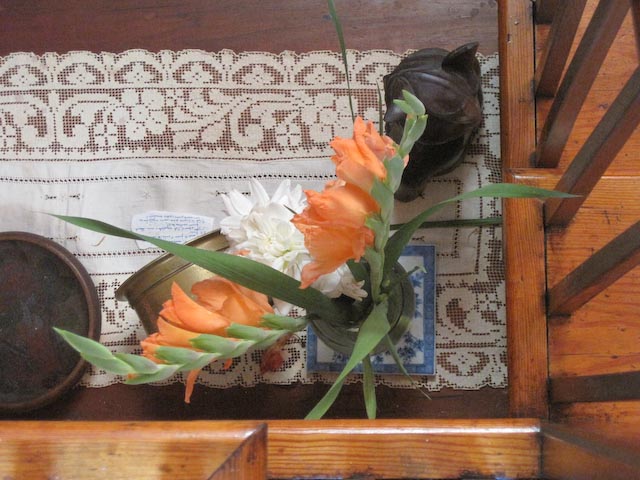
As seen from above, main stairs.

You live where? Friday, Sep 9 2011 

Or what is to love about Connecticut?  Let us be honest, loving Connecticut is hard.  At least a few people I am related to despise it.  I am more than capable of holding it up as an example of all that is wrong politically, culturally, environmentally, etc.

This bit of Connecticut earns no ‘cool’ points: it isn’t a chi-chi Berkshire town, it isn’t chic urban, it isn’t dramatic mountain/ocean/’wilderness’ vacation escapism, it isn’t romantic Southern charm, it isn’t even genuine rural or genuine ‘small-town’.  In general people look at Connecticut and say (usually the same person) it isn’t chic urban and it isn’t quality ‘wilderness’ so why care about it?  And history?  It is the center of the industrial country that won the North that dispute of the 1860s, that made the West possible, that drove America’s rise for nearly 150 years.  Webster, Whitney, Winchester, Colt, Pratt, Sikorsky, Ovation…  but industry is a dirty word…

Well, you don’t fall in love with it immediately.  It isn’t the sort of place with jaw dropping vistas.  Maybe you have to have bad, uncorrected vision, because you fall in love with it through little incremental things.  The structure of brickwork in an old mill town, the multitude of architectural and cultural types, the mist on the river, hoar frost in the winter, foggy mornings, the rain lifting off the blue hills, the hundred different greens that change through the season, you have to fall in love with trees first, Connecticut is 68% forest even though it is one of the most densely populated states.  Fall colour and spring flowers, asters to daffodils, goldenrod to trillium.  Fireflies and migrant warblers, the horned owl deep in the sharp winter night.  There is great beauty, but it is fleeting.  In Connecticut familiarity breeds love, contempt is bred by inattention.  The mist lasts for an hour, the fall colour shifts and is gone.  These are scenes that demand constant attention.  You blink driving down the road and the astonishing vista of New England is gone, a trick of light, of space and time.

It has all four seasons, but never brutal; you can’t earn macho points for living through them, but you don’t need to either.   And perhaps that is part of its attraction.   Connecticut doesn’t offer you excuses or convenient images to hide behind.  There is no romance, so you can’t pretend to be romantic.  If you plant something, and it is in the right zone, there is no excuse here for it not to grow…on the other hand, it won’t grow without some effort on your part.  No casual tropical flowers here, but also no excuses of heroism in the face of the climate when you get only a single rose. 

Connecticut is a human sized landscape with enough land that a person’s stewardship or lack of stewardship has direct results.  In an urban landscape, the land is ‘other’ elsewhere, one’s actions seem to have no visible effect; in areas of the West, the land is a constant force so great that one can feel that one’s actions will not even be noticed by that greatness, even if they are visible; in Connecticut the land is a partner for good or ill.

Next Page »