Contrary to the belief of at least one visitor (yes, let us have a full house while it rains!), we actually did have some damage from the non-event, for us, of Tropical Storm Irene. I don’t object to the fact that our preparations were not needed, I prefer to look like an idiot rather than be an idiot. In any case below are pictures of what water can do, a mild case.
The damage done to the woodlands is extensive and would be very costly to resolve. Thankfully, due to the heroic efforts of those involved and the luck that the water’s first preference is to go just a bit farther down the curve (the one bit of proper engineering on that stretch of road), it was kept out of the pond. A thousand feet of dirt road, stripped to the sub-base in sections being dumped directly into the pond (shallow, spring fed) would have destroyed it beyond repair.
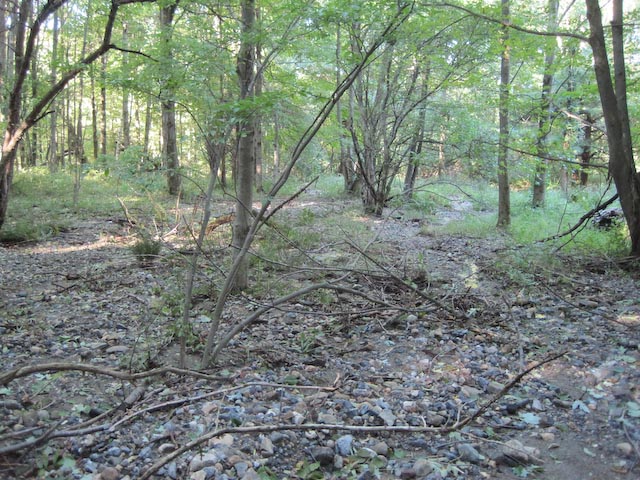
Royal Oak woodlot
This picture shows the bottom of one of the two flows from the lane, about 400 feet down hill from it. I am standing where there had been one of the few remaining colonies of wake-robin trillium in this parcel, now a drift of rock about 8 inches in height.
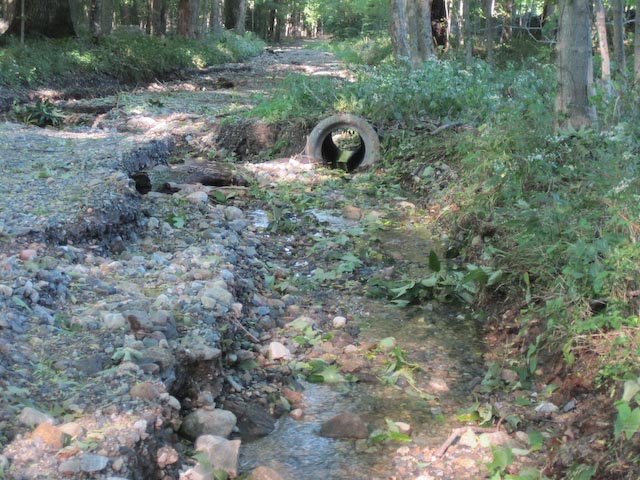
This shows the first failure, the culvert simply isn’t sized correctly and is also too high in relation to the stream. Consequently, in flood conditions the water jumps into the road bed. From here on down, about a 1000 feet, the stream used the road as its bed, taking essentially all the fine sand and much of the rock. It did not return to the ditch because the grading actually tilted the road away from the ditch in this section.
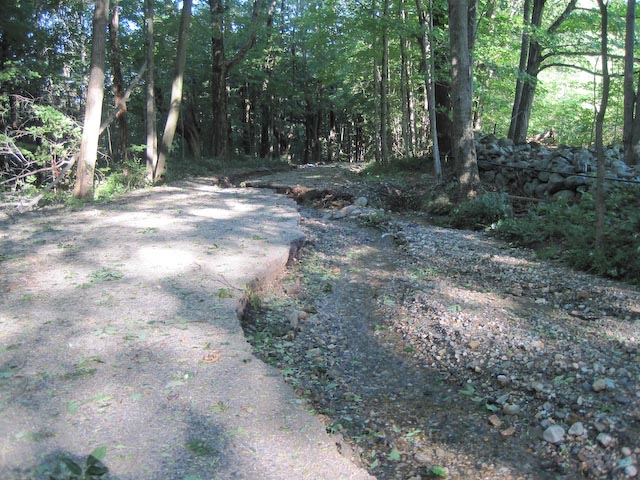
The pond is directly to my left in this photo, and is actually about 2 feet below the modern road bed. The water doesn’t go into it because at this point the road is graded correctly, into the the inside of the curve and the ditch at the right. Consequently, the ditch widened to take out about half of the road on the ditch side through the curve, which is the worst that should happen. We were also able to keep about a quarter of the flow, which did want to go into the pond, from heading in that direction by some fast shovelling. The ditch should go into a culvert, but that was obviously not capable of handling the water, let alone the road debris, again due to improper sizing; so the water cut across the road, as it had with the first culvert, finally going into the Royal Oak woodlot to the left just about where the break of the hill is in the photo.
 Acair Fearann